

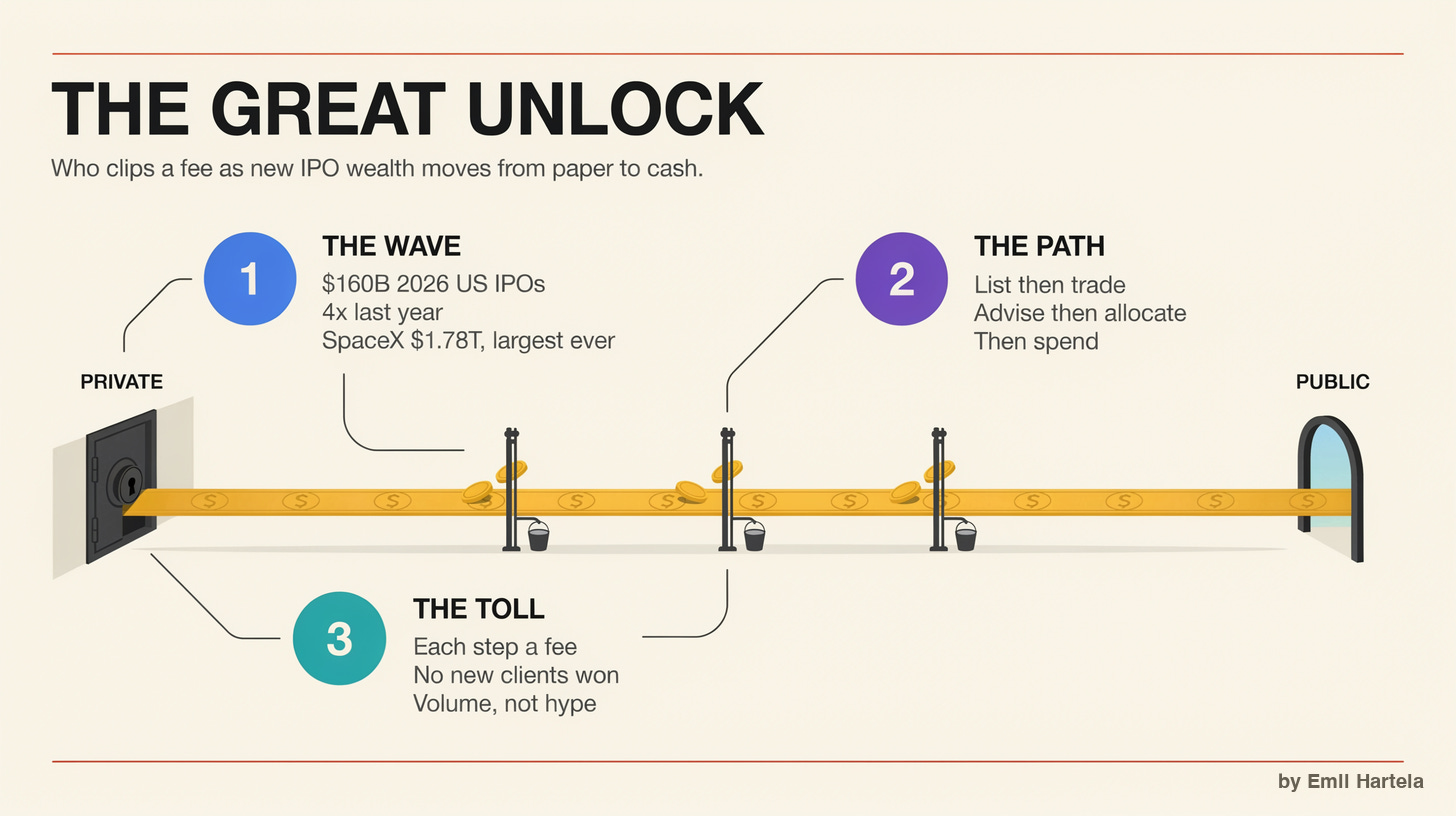
Picture $50 billion in newly public shares landing in client accounts overnight. Every rebalance that follows, every margin loan drawn against the position, every estate plan that incorporates the windfall still touches the same broker and custodian that handled the original distribution. The conversion of private founder and employee stakes into liquid public wealth does not create new rails. It loads far more volume onto rails that already exist.
This write up maps the companies positioned to capture that volume. The goal is to identify the biggest winners of the coming IPO boom, the institutions sitting at each choke point as private wealth converts to public liquidity.
The volume moves in predictable stages. Shares must list, then clear and settle, then the proceeds must be advised, allocated, and in many cases spent on status goods. Each stage has a narrow set of institutions already positioned at the bottleneck. The question for each name is whether it captures more revenue from the added flow or whether fee pressure strips the gains away before they arrive.
One mechanism makes the point. When a single SpaceX-style listing triggers index inclusion inside fifteen trading days, passive vehicles have no choice but to buy. That forced purchase does not depend on sentiment or analyst upgrades. It is mechanical. The same mechanical quality runs through custody hand-offs, margin calculations, and the advisory conversations that follow. Once shares sit inside an established platform, extracting them means rewriting permissions, tax lots, and reporting frameworks that took years to build. That friction is the moat.
The new shares do not arrive as a blank slate. They land inside a permissioned surface that already knows the client’s full picture, processing larger checks at the same negotiated margins. The rest of this piece works through that surface stage by stage and names the stock at each one.
The bear case that has kept multiples depressed
The prevailing fear is straightforward. Advisors already expect to charge less than 1 percent on accounts above five million dollars, with average fees for clients above ten million dollars sitting near 66 basis points. Commission revenue across the industry is projected to drop from 22.8 percent of total revenue in 2024 to 16.6 percent by 2026. If the same pattern holds after the largest IPOs in history, the incremental AUM may simply arrive at lower unit economics.
A second concern compounds the first. One marquee deal that slips or disappoints could trigger a broad de-rating across any name tied to capital markets activity. Financials have already experienced multiple compression even while earnings growth has remained resilient. Platforms that rely on listing fees or episodic trading spikes face the additional risk that the entire wave arrives later or smaller than current pricing assumes.
I have watched the same logic applied to earlier cycles. When valuations for anticipated mega-deals compress in advance, secondary platforms and wealth franchises often de-rate together even if their core custody or clearing volumes stay flat. The fear is not irrational; it simply assumes the new wealth will behave like ordinary inflows rather than concentrated liquidity events that force re-pricing across multiple product lines at once.
The compression numbers themselves come from advisor surveys that predate the current IPO calendar. They reflect client pushback on value delivered, not an absence of assets. That distinction matters when the assets arrive in sudden, outsized blocks rather than steady drips.
Why the same shift expands rather than destroys the revenue pools
History offers a clearer template. When online trading reached 37 percent of retail equity volume by 1998, many assumed full-service brokers would lose their clients. Merrill Lynch still held 1.5 trillion dollars in private-client assets by the end of 1999 while the exchanges recorded record trading volumes. The new channel did not replace the old one; it expanded total activity and left the largest incumbents with larger balance sheets.
The ETF transition followed the same pattern. Active managers were expected to lose share permanently. Instead the largest asset managers acquired ETF platforms early and now control 74 percent of U.S. equity ETF assets, with BlackRock’s iShares alone exceeding 5.4 trillion dollars. In both cases the infrastructure that moved the assets captured the economics of the shift rather than watching them migrate elsewhere.
The 1990s tech IPO wave produced the same result at even larger scale. Newly public founders routed liquidity into wealth-management relationships and alternative allocations. Exchanges collected elevated listing and trading fees while overall assets under management expanded across the system. The mechanism is identical today: the banks that underwrite the IPOs already sit inside the syndicates, the exchanges already run the index-inclusion rules, and the wealth platforms already hold the custody relationships.
What changed this time is speed and scale, and the first proof point has already printed. SpaceX priced on June 11 and began trading on the Nasdaq on June 12 under the ticker SPCX, raising 75 billion dollars at a 1.77 trillion dollar valuation — the largest listing in history, run through a syndicate of nearly every major bank with Goldman Sachs and Morgan Stanley as leads. Those two alone earned a combined 500 million dollars in underwriting commissions on the deal. The stock opened at 150, closed its first day up 19 percent, and has since climbed toward 200, carrying the market value above 2.5 trillion dollars within a week. OpenAI and Anthropic have both since filed confidential S-1s of their own — Anthropic on June 1, OpenAI on June 8 — queuing up the next two legs of the same wave. The fee pool from each deal lands inside institutions that also own the downstream wealth and alternatives franchises. The same entities that price the IPO stand to advise the proceeds.
The parallel that keeps surfacing is how regulatory gates concentrate rather than disperse the flow. Every new issuer must still file through established underwriters and list on venues with fast-entry index rules already in place. Those gates do not multiply with each wave; they simply process larger volumes at the same structural margins.
Here is the map
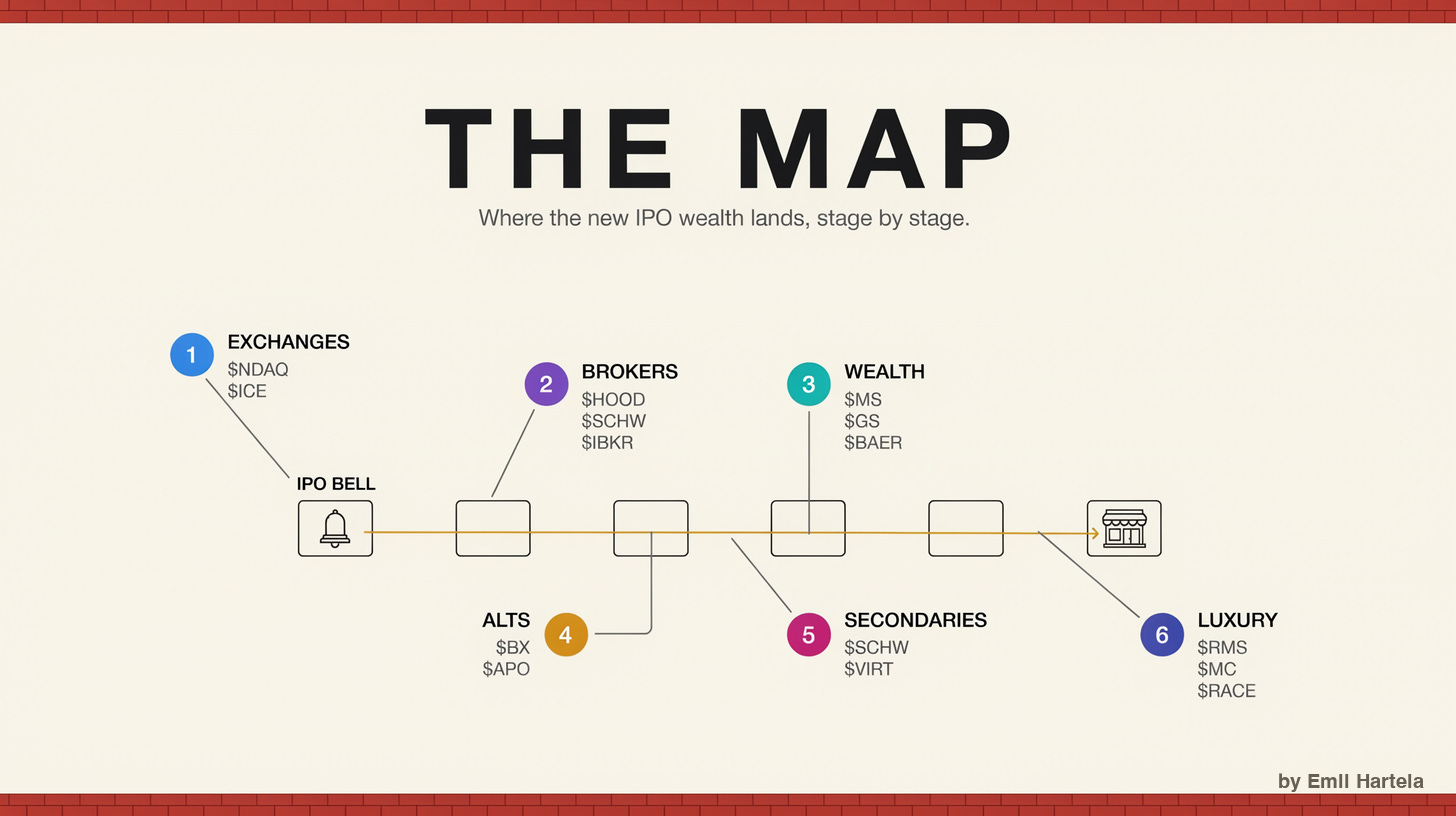
The flow follows five linked clusters. Exchanges and listing venues collect fees at the moment of entry and index inclusion. Brokers and trading platforms monetize the subsequent order flow, custody, and margin. Wealth and private banks capture recurring advisory fees once the proceeds sit in client accounts. Alternative asset managers receive fresh allocations into credit, real estate, and private equity. Luxury houses capture the high-margin, discretionary purchases that follow large liquidity events.
A single founder who sells five percent of a newly public company can trigger activity across every cluster in sequence. The same institutions handle each step because the regulatory, compliance, and relationship layers required to move that capital at scale already sit inside them.
Permissioned surfaces offer a useful frame rather than products. An issuer cannot reach index inclusion without choosing a listing venue that already maintains fast-entry rules. A newly liquid shareholder cannot move large blocks without a prime broker that already holds the necessary regulatory permissions. Those surfaces do not multiply when new wealth arrives; they simply process higher volume at margins that were already negotiated years earlier.
The same surfaces also determine where value pools. Once a client relationship includes both private-share custody and public-market execution, the cost of switching rises because the new provider must replicate tax-lot history, margin agreements, and reporting frameworks simultaneously. That replication cost grows with the size of the liquidity event, not the number of providers.

Exchanges and listing venues
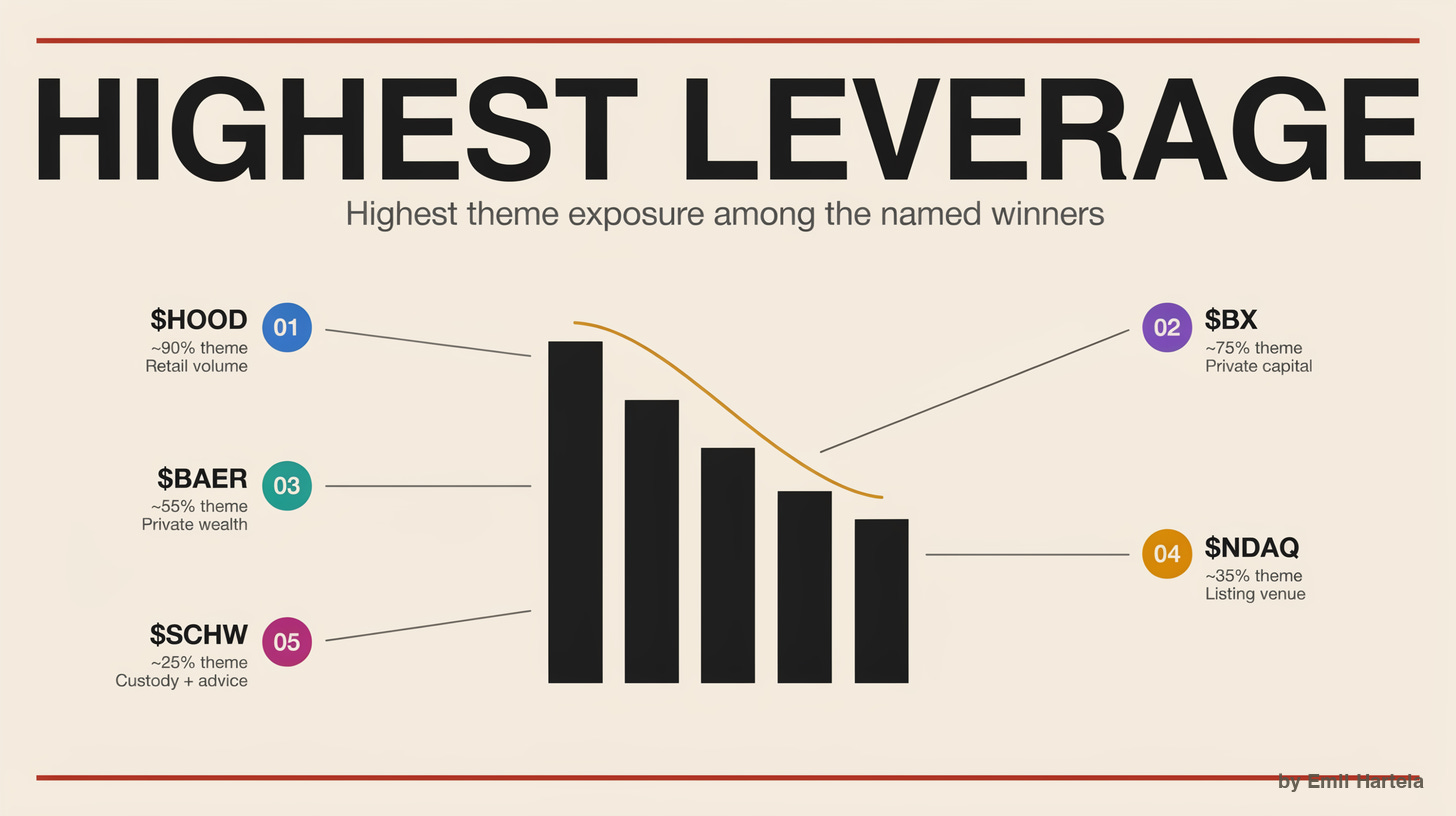
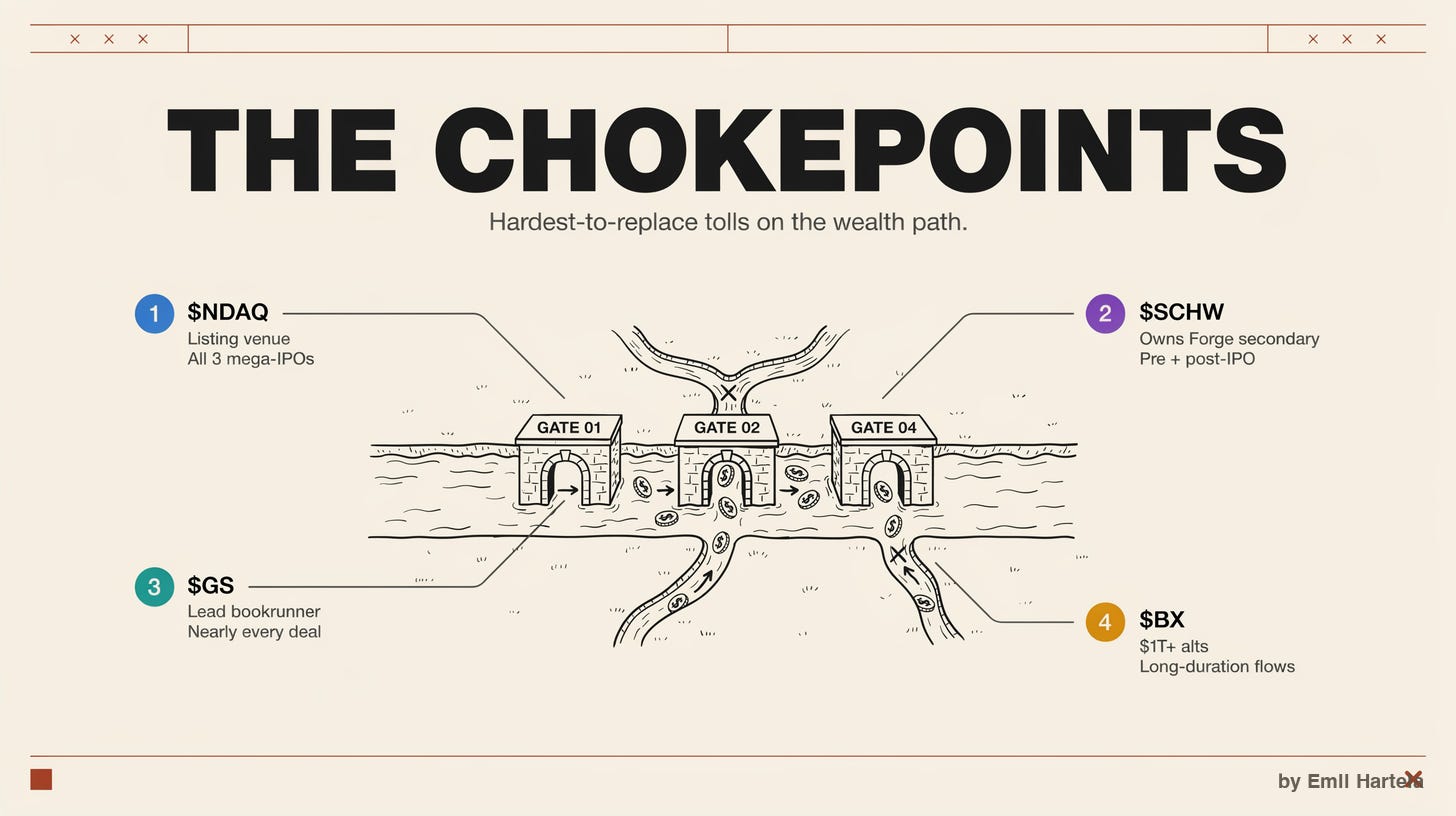
$NDAQ operates the primary listing venue and index ecosystem that captures both the initial listing fee and the data revenue that follows. The street narrative treats it as a straightforward beneficiary of any IPO wave, with recurring revenue from listings and market data already priced in. What actually happens is more structural. Nasdaq’s fast-entry rule now places any top-40 market-cap company into the Nasdaq-100 within fifteen trading days of listing. Passive funds must buy the shares. That forced buying raises switching costs for issuers who want index visibility and strengthens the exchange’s pricing power over data and listing packages.
$ICE runs the NYSE and a diversified set of trading and data businesses. The consensus view sees narrower direct exposure to pure-tech IPOs. The reality is steadier: listing fees and data subscriptions compound with any expansion in equity wealth, and the exchange already clears and settles the majority of U.S. securities volume. Both venues sit at the first mandatory choke point.
The parallel worth watching is how index inclusion turned a one-time listing fee into a permanent rebalancing flow. Once the shares enter the Nasdaq-100, every passive vehicle rebalances on a schedule that cannot be avoided. That recurring mechanical demand sits outside the control of either the issuer or competing venues.
The same rule set also limits substitution. An issuer seeking immediate passive ownership cannot simply choose a venue without equivalent fast-entry mechanics; the index methodology itself channels flow to the established player.
Brokers and trading platforms
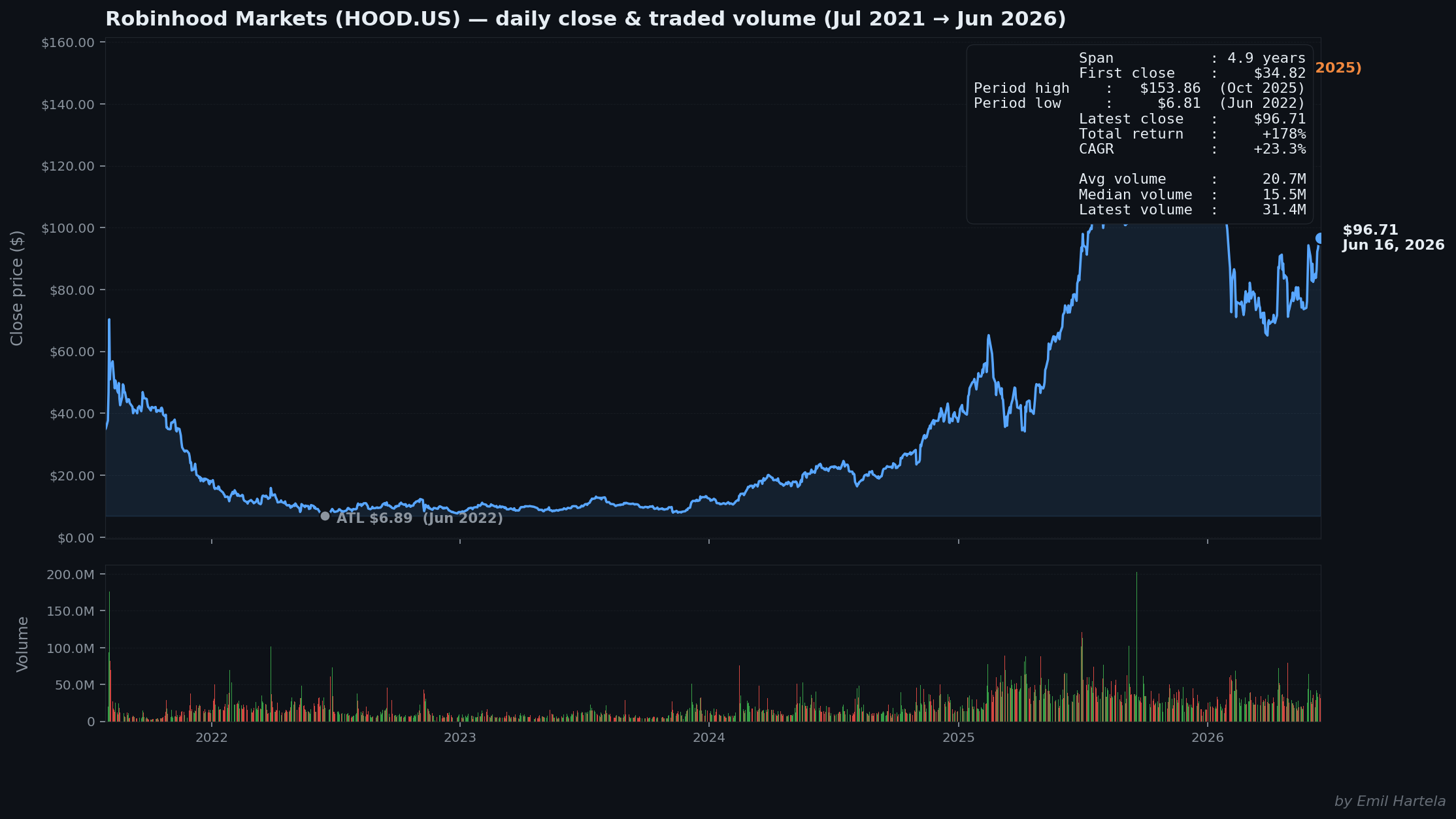
$HOOD monetizes retail trading volume and new account formation. The prevailing narrative positions it as a high-beta play on IPO excitement. Volume-driven revenue does rise directly with wealth-rotation events, yet the platform’s low switching costs and thin differentiation leave durability lower than pure listing venues.
$IBKR scales commissions and margin lending with trading activity from newly wealthy clients. Its global reach and sophisticated order-routing technology give it a durable position in institutional flow that pure retail platforms lack. The same technology stack that routes retail orders also handles the more complex crosses required when large employee liquidity events hit the tape.
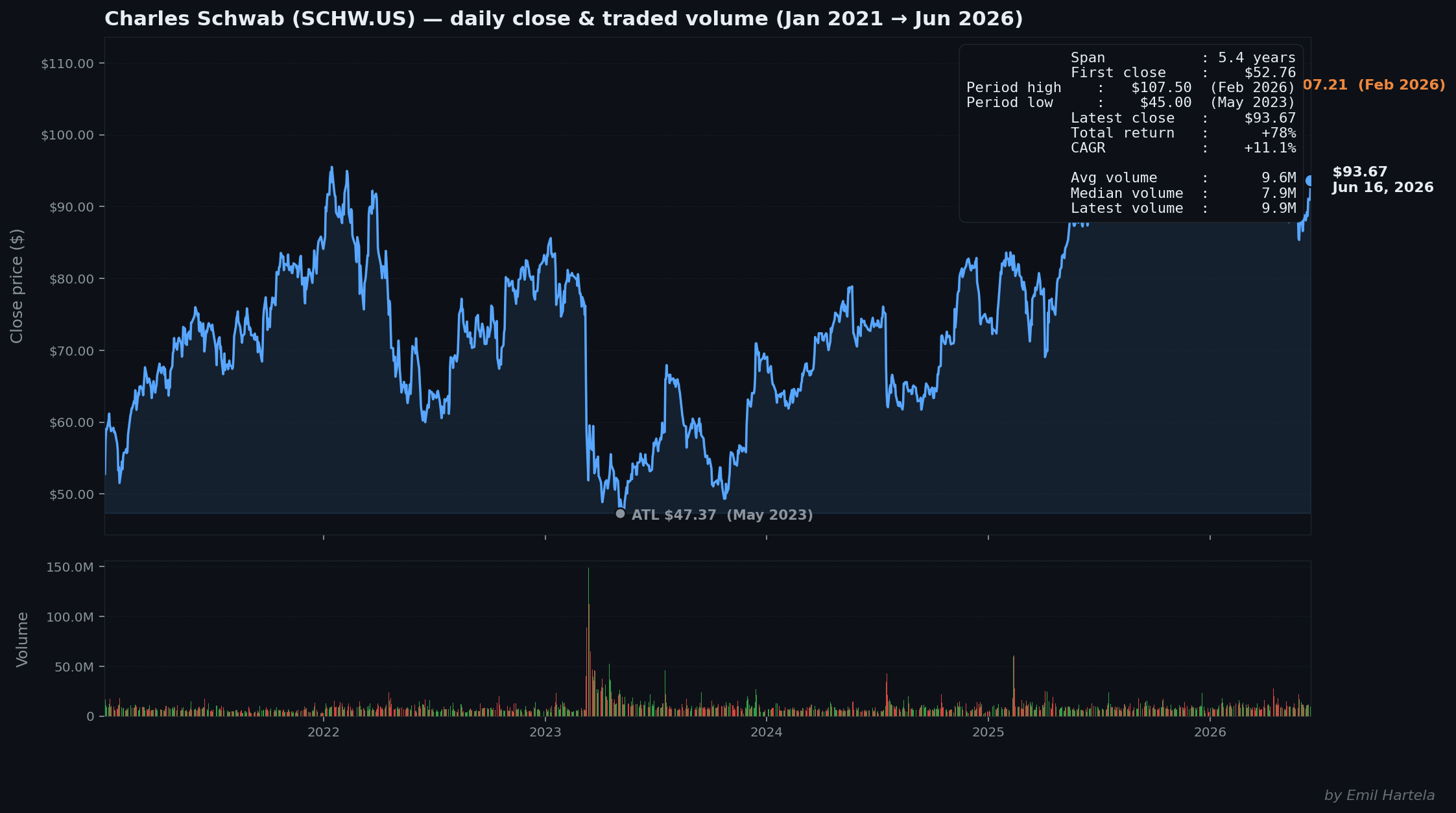
$SCHW combines retail brokerage scale with custody and now private-market access after acquiring Forge. The street sees it as a steady wealth winner. The acquisition embeds the firm deeper into pre-IPO flow, raising client stickiness at the exact moment liquidity events accelerate. Once a client’s private shares sit inside the same interface that already holds their public brokerage account, moving the relationship requires replicating both the private-market data feed and the integrated tax reporting. That integration raises switching costs precisely when the volume of such clients is about to increase.
The competitive force at work is substitution threat. A pure retail platform can lose flow to any lower-cost interface, while an integrated custody-plus-private platform forces any competitor to rebuild the entire data and compliance layer before the client can move.
Wealth and private banks
$MS wealth-management and investment-banking arms both stand to gain. The consensus story emphasizes direct exposure to IPO and private-market activity. Morgan Stanley’s acquisition of EquityZen extends that reach into secondary trading of pre-IPO shares, raising barriers around client relationships that competitors without similar platforms cannot easily replicate. The same client who once traded private shares on a standalone venue now does so inside an account that also offers margin, estate planning, and direct underwriting access.
$GS private-wealth franchise serves ultra-high-net-worth tech clients through the same relationships that lead the underwriting syndicates. The integrated model keeps the firm inside both the fee pool at issuance and the ongoing advisory relationship. When a founder liquidates a portion of a newly public stake, the conversation about allocation often begins with the banker who already knows the cap table.
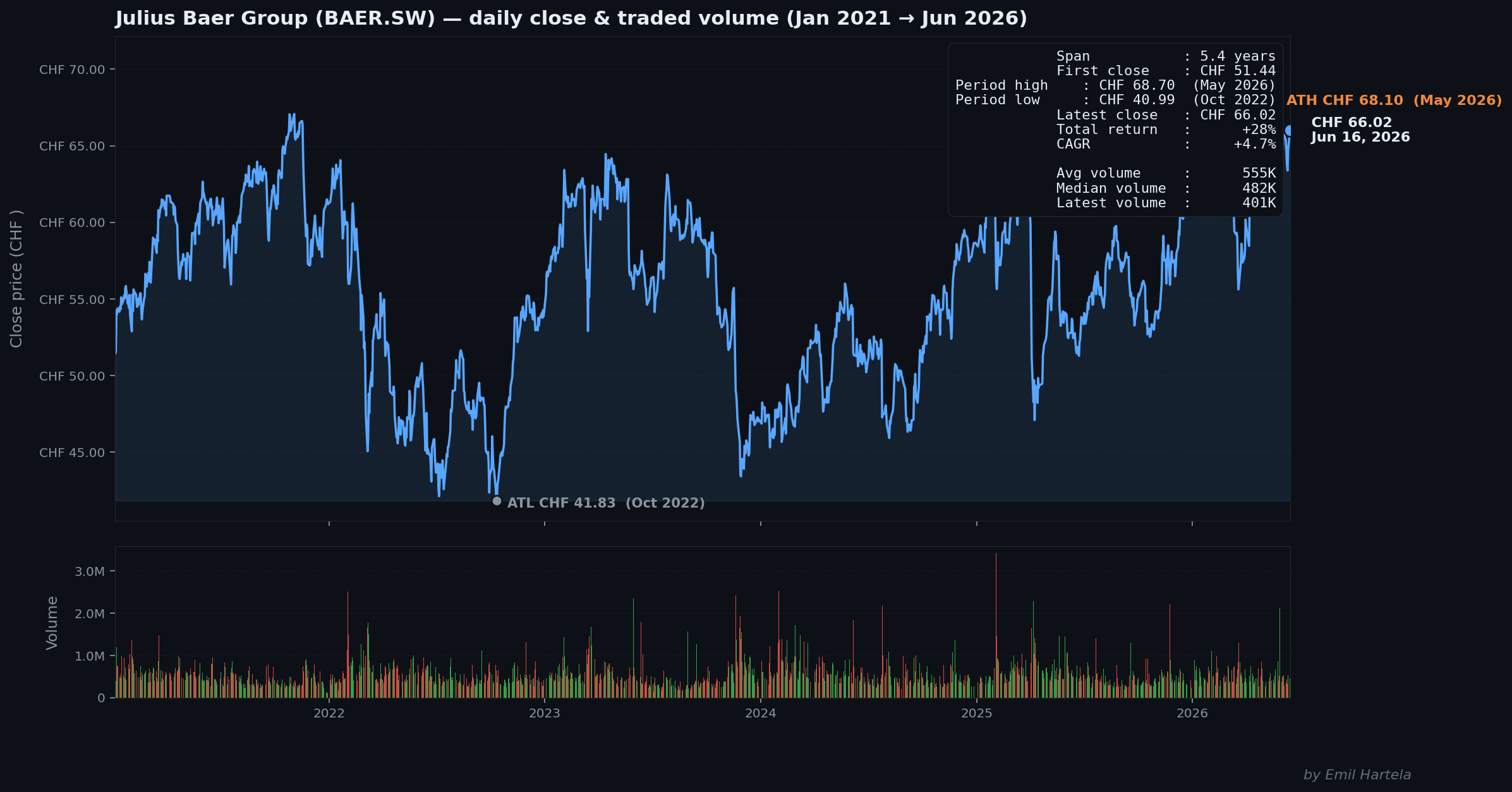
$BAER focuses on Swiss UHNW advisory directly tied to liquidity events. Earnings pressure and regulatory overhang have created a valuation gap, yet the structural link to cross-border tech wealth remains intact. Swiss private banks have long served as the default venue for non-U.S. founders seeking stable, multi-currency wealth structuring; that preference does not disappear simply because the shares become public.
What strengthens these platforms is the accumulation of context. Each liquidity conversation adds tax-lot history, family-office preferences, and allocation patterns that later advisors must replicate from scratch. The barrier is not the product; it is the accumulated permissions and memory inside the relationship.
Alternative asset managers
$BX receives allocations into credit, real estate, and private-equity funds from newly liquid wealth. The consensus positions it as the prime vehicle for deployment. Scale advantages in raising and deploying large mandates offset fee compression elsewhere; the platform that can absorb the largest checks tends to keep them.
The same logic that drove 1990s founders into alternatives applies here at larger dollar amounts. A single liquidity event can generate nine-figure checks that only the largest alternative platforms can deploy without moving market prices against themselves. That capacity becomes a self-reinforcing barrier: larger checks flow to the managers already equipped to receive them.
The force at work is barriers to entry through deployment capacity. Smaller managers cannot absorb the same check size without market impact, so the largest platforms receive the flow by default. That advantage compounds with each successive wave rather than eroding.
Luxury status beneficiaries
$RMS, $MC, and $RACE sit at the final stage where status consumption occurs. Hermès and LVMH capture high-margin discretionary purchases; Ferrari does the same at the ultra-luxury end. The spend is not core to any of them, yet it is recurring, high-margin, and directly linked to liquidity events that have no natural ceiling in the near term.
These names function as the final confirmation layer rather than the primary driver. When newly liquid capital seeks visible signals of arrival, the marginal purchase tends to land at the scarcest brands. That behavior is culturally sticky and price-insensitive in the upper tail, which is exactly where concentrated IPO proceeds concentrate.
The parallel here is simple. Status goods do not require ongoing relationships or regulatory permissions; they require only recognition. That recognition already exists inside the brands that survived prior wealth waves, so incremental spending flows to them without new competitive entry.
Safer anchors versus asymmetric bets
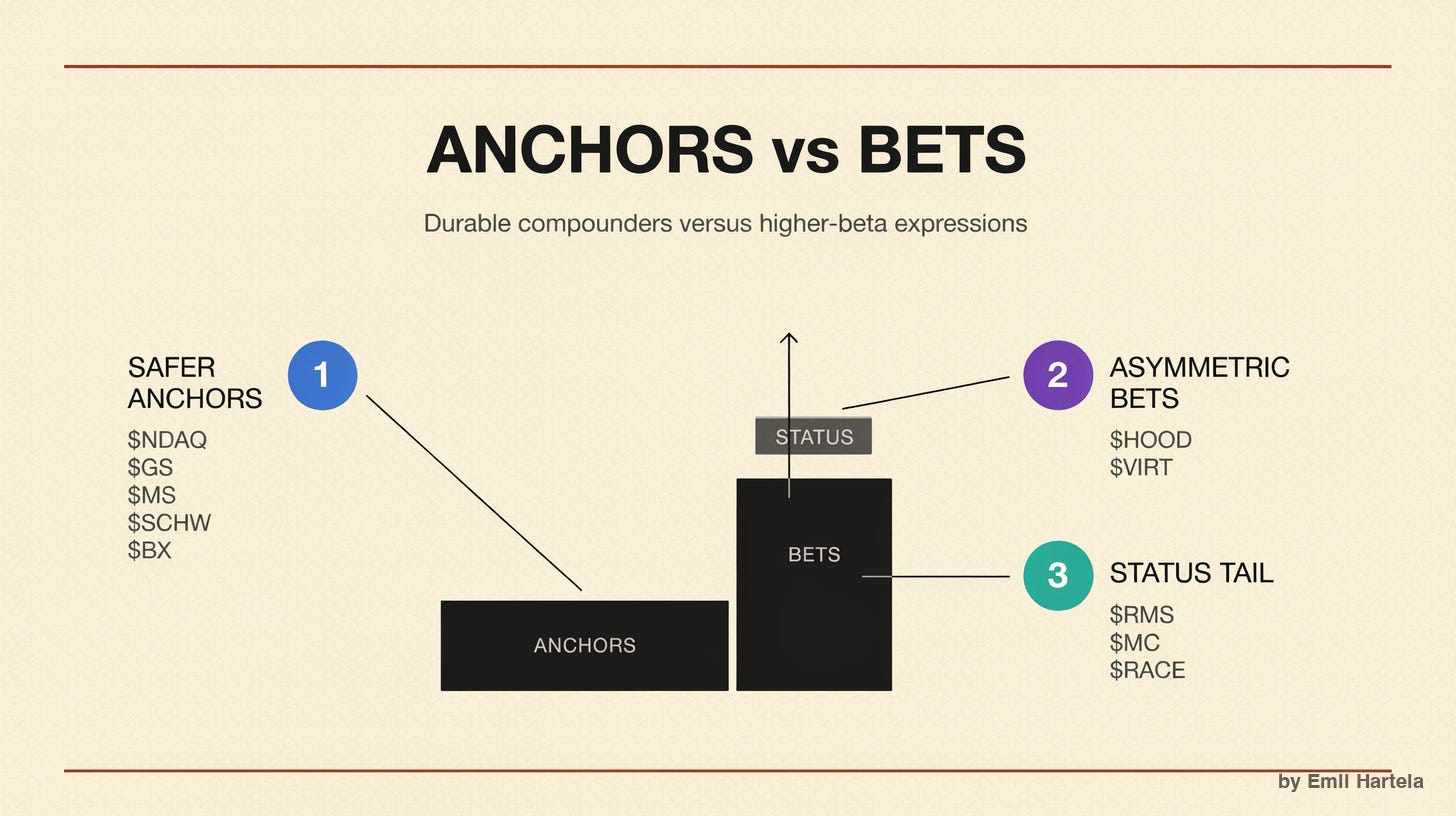
The more durable compounders sit where switching costs and regulatory barriers are highest. $SCHW, $ICE, and $NDAQ combine scale with structural mandates that new entrants cannot easily displace. $RMS adds pricing power through brand scarcity that survives macro shocks.
Higher-beta expressions include $BX, $MS, and $BAER, where inflows or execution can move results materially but where outcomes also depend on the timing and size of the actual IPO proceeds. $HOOD offers the purest activity beta yet the lowest durability if competition intensifies.
The distinction matters because the mechanical flows I described earlier—index inclusion, custody hand-offs, margin calculations—land first inside the platforms that already maintain regulatory licenses and data integrations. Those platforms are the anchors. The higher-beta names capture the variable portion of the same flow but must re-win the client at each liquidity event.
The same logic separates the two groups on pricing power. Anchors can maintain or even widen margins because clients face real replication costs; higher-beta names compete more directly on price or convenience and therefore absorb more of the documented fee compression pressure.
The bet
This is no longer a hypothetical. SpaceX is already public — it listed on June 12 at a 1.77 trillion dollar valuation and now ranks among the largest companies in the country, with its fifteen-trading-day path into the Nasdaq-100 already running. OpenAI and Anthropic have both filed confidential S-1s and are queued behind it. Index-inclusion mechanics have already been updated to accelerate mega-cap entries. The underwriting fee pools alone run into hundreds of millions per deal. Yet the market continues to price the downstream infrastructure as if that liquidity might never arrive or might arrive at permanently lower margins. The historical pattern and the concrete mechanics already in place suggest the opposite outcome.
The gap between the mechanical triggers already coded into index rules and custody systems and the valuation multiples that still reflect fear of fee compression alone stands out as most asymmetric. The compression is real, yet it applies to a larger base of assets that must travel through fewer hands. That combination has produced durable revenue expansion in every comparable cycle I have studied.
The bet therefore rests on sequence rather than sentiment. The shares must list before they can be advised, allocated, or spent. Each mandatory step already routes through institutions whose permissions and integrations predate the current wave. Those institutions do not need to win new clients; they need only process larger volumes inside relationships that already exist.
Not financial advice. This content is for informational and educational purposes only and reflects my own opinions, not a recommendation to buy or sell any security. I am not a licensed financial advisor. Do your own research and consult a qualified professional before making any investment decision. I may hold positions in the securities discussed.