

Foreword
Recently, I announced that I will be expanding my research coverage materially. My niche is tracking companies whose main customer surfaces are web traffic and app usage. That matters because these digital footprints can often be turned into revenue prediction models, creating the potential to uncover alpha before it is visible in reported numbers.
The coverage expansion is still in its early days. At the moment, I cover Haypp, and MakeMyTrip will become the second ticker added to the research desk. In the near future, I will also publish my first revenue prediction on MMYT.
MMYT was chosen because it is an especially interesting candidate for alternative data analysis. The company has the data, but the data is not easy to model. That makes it more challenging, but also more interesting. Beyond that, the stock has a compelling narrative and will likely be a fresh idea for many of my current readers.
This post marks the start of my coverage on the company. The purpose is to provide a deep dive into what MakeMyTrip actually does and help you determine whether the name is worth following more closely. If you enjoy this post, consider subscribing to the coverage section so you do not miss the upcoming revenue prediction on MMYT.
Finally, this is not financial advice. The purpose of this coverage is to surface interesting opportunities and, over time, identify divergences through alternative data for readers who want to follow the name more closely.
So, let’s get into it.
MakeMyTrip is the leading online travel platform in India. For most users, it is simply the place where travel gets booked: flights, hotels, buses, holiday packages, and increasingly a broader set of travel-related services. But as an investment case, the company is more interesting than that. It sits at the intersection of several powerful trends in India: rising incomes, increasing domestic mobility, growing digital adoption, and the gradual formalization of travel bookings through mobile platforms.
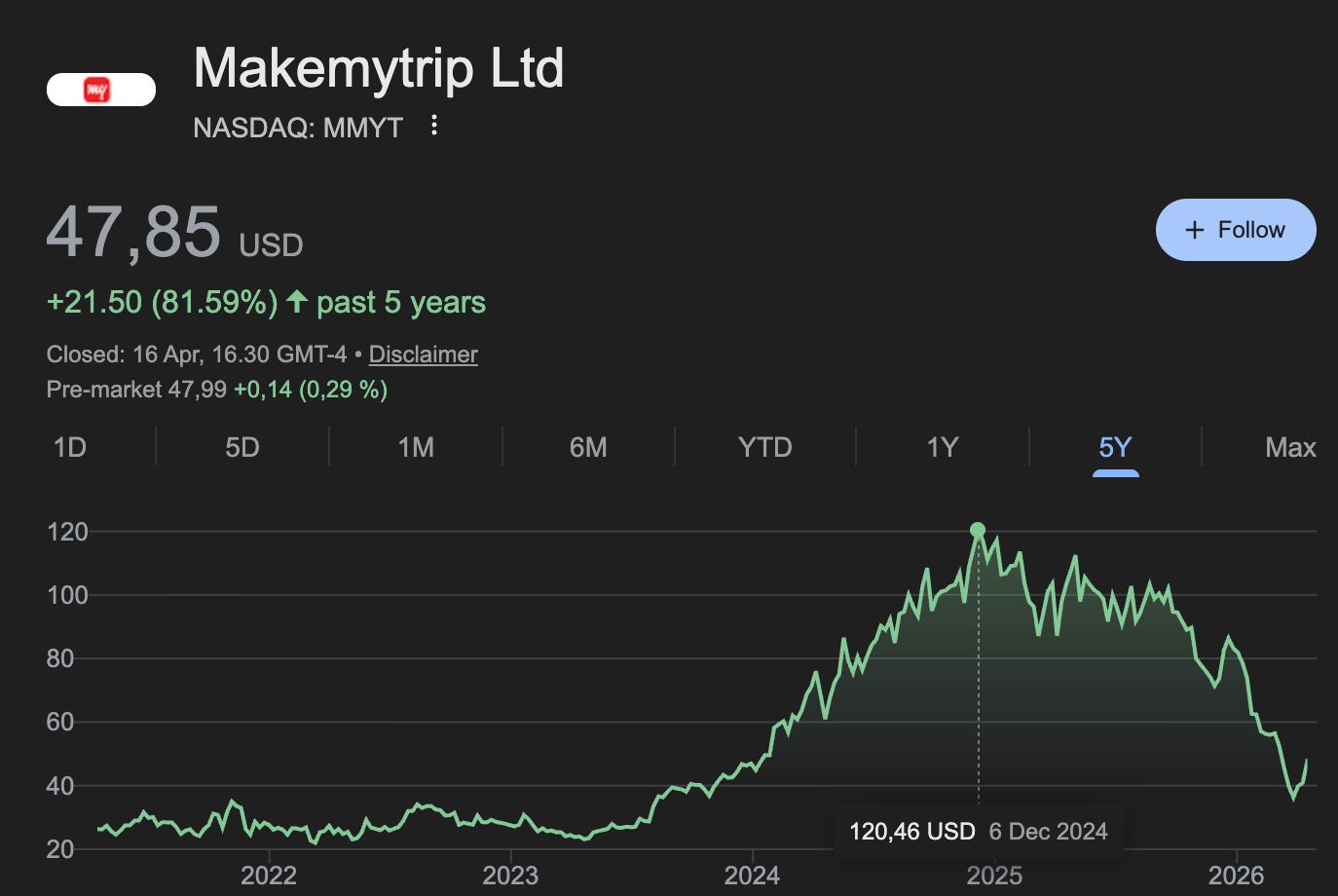
The more important point is that MakeMyTrip is no longer just a growth story. After years of investing through a highly competitive market and then surviving the collapse in travel during COVID, the company has emerged as a meaningfully profitable business. That changes the framing. Investors are no longer looking only at bookings growth or market share. They are now asking whether this can become a durable compounder in one of the most attractive consumer internet markets in the world.
Founded in 2000 and listed since 2010, MakeMyTrip operates through a portfolio of strong brands including MakeMyTrip, Goibibo, and redBus. The business is headquartered in Gurugram and employs more than 5,000 people. On a trailing twelve-month basis, revenue is around $1.0 billion, with gross margins close to 58% and operating margins nearing 14%. For a company that spent years prioritizing scale and market positioning, that level of profitability is notable.
What makes the story compelling is that the company has already been stress-tested. Travel is cyclical by nature. Demand is vulnerable to economic slowdowns, fuel price spikes, public health shocks, and discounting wars. MakeMyTrip has already gone through the most severe travel downturn in modern history and came out stronger. That resilience matters because India’s travel market still looks early in its development.
A Simple Business Model With Powerful Scale Economics
At its core, MakeMyTrip is a marketplace and distribution business. It connects travelers with airlines, hotel operators, bus companies, and other travel service providers, then monetizes that connection through commissions, service fees, advertising, and ancillary products.
The model is straightforward, but its attractiveness comes from scale. Customers book through the company’s apps, websites, call centers, and agent channels. The offering spans flights, hotels, packages, bus and rail tickets, car rentals, experiences, insurance, foreign exchange, and visa-related services. For the user, the appeal is convenience. For MakeMyTrip, the appeal is volume.
This is a classic high-frequency, low-ticket distribution business. Millions of small transactions pass through the platform. As that volume grows, fixed investments in technology, customer acquisition infrastructure, and supplier integration become more productive. In other words, once scale is established, incremental bookings can become very profitable.
That does not mean the business is immune to pressure. Travel remains a price-sensitive category, and online travel agencies often compete aggressively on discounts. But the broader point stands: in a mobile-first market like India, where more of the travel booking journey is moving online, scale is extremely valuable.
Where the Money Comes From
MakeMyTrip’s revenue mix is fairly balanced, though Hotels and Packages now represent the most important part of the business.
Hotels and Packages account for roughly 55% of revenue and are the strongest part of the model. This segment benefits from higher take rates, better margin structure, and greater opportunity for cross-selling. A consumer booking a hotel stay or holiday package typically creates more monetization opportunities than someone booking a standalone flight.
Air Ticketing contributes around 30% of revenue. It remains a large and strategically important category, but structurally it is less attractive than hotels. Airline tickets are easier to compare, consumers are highly price-sensitive, and suppliers have more bargaining power. It drives traffic and engagement, but the margin profile is usually lower.
Bus Ticketing contributes the remaining 15%, largely through redBus. This is an especially interesting segment because it gives MakeMyTrip exposure to a part of the Indian travel market that is both massive and still digitizing. Bus travel is essential across the country, and redBus has become a strong category leader. That makes it more than just a side business. It is a real source of differentiation.
Geographically, the company is still overwhelmingly tied to India, which makes up more than 90% of revenue. International operations exist, including exposure to markets such as the US, Singapore, and the UAE, but these are supporting pieces rather than the core driver. This is fundamentally a company built around the Indian travel consumer.
Why the Segment Mix Matters
The quality of MakeMyTrip’s segment mix is one of the stronger features of the business.
Hotels and Packages combine growth with attractive economics. The supplier base is fragmented, which improves the platform’s negotiating position, especially when it operates at scale. Consumers also tend to prioritize convenience and trust more than pure price when booking higher-value travel. That gives MakeMyTrip more room to monetize effectively.
Air Ticketing is the weakest segment in structural terms. Airlines are larger and more concentrated suppliers. Consumers compare prices aggressively. External factors such as fuel costs and fare volatility can affect booking behavior. Even so, this segment remains important because flights are often the starting point of the travel journey. A company that controls the booking relationship for air travel can often attach hotel, insurance, and other services to that transaction.
Bus Ticketing is a stronger business than many investors may initially assume. redBus has carved out a meaningful niche, and because the category remains relatively underpenetrated digitally, there is still room for continued growth. It also broadens MakeMyTrip’s customer reach beyond the more premium parts of the travel market.
The result is a business that does not rely on a single fragile growth engine. Hotels provide margin strength, flights provide scale and traffic, and buses provide category depth and long-tail growth. That is a healthy combination.

Competitive Positioning
MakeMyTrip competes against domestic players such as EaseMyTrip and Yatra, as well as international travel platforms like Booking Holdings and Expedia. Yet its position in India remains very strong.
The company’s advantage starts with breadth. MakeMyTrip is not just a flight booking app or a hotel marketplace. It offers a full ecosystem that spans several major travel categories and multiple consumer segments. Its brand architecture also helps. MakeMyTrip, Goibibo, and redBus each play a distinct role in the market, allowing the company to address different use cases without relying on a single brand identity.
That breadth matters in a market like India, where travel behavior is fragmented across price points, geographies, and transport modes. A company that can serve the budget bus traveler, the domestic leisure flyer, and the hotel customer within one ecosystem has a stronger competitive position than a narrower platform focused on one category.
The company’s market share appears to sit in the roughly 30 to 40% range, which is meaningful in a market of this size. While competition remains intense, MakeMyTrip seems to occupy the strongest position among the major OTAs operating in India.
The Moat
The moat here is not mysterious. It comes from brand, scale, and ecosystem strength.
Brand matters because travel is a trust-based category. Consumers are making time-sensitive purchases, often with relatively large amounts of money, and they want reliability. MakeMyTrip, Goibibo, and redBus have built strong recognition over time, and that matters when customers are deciding where to book.
Scale matters because it improves supplier relationships and operating leverage. A platform with more demand can negotiate more effectively, secure better availability, and spread its technology and customer acquisition costs across a larger base of transactions. Smaller competitors can discount aggressively, but they often lack the broader advantages that come from scale.
The ecosystem matters because it makes the platform more useful over time. A user may arrive to book a flight, but if the same platform also offers hotels, buses, insurance, and other travel-related services, that booking relationship becomes more valuable. Reviews, loyalty features, and repeat usage strengthen this effect. It may not be a pure network effect in the strongest sense, but it does create increasing returns to scale and raises switching costs.
All of this suggests that MakeMyTrip is not simply winning through temporary discounting. It has built real structural advantages.
Industry Structure
The Indian online travel market has characteristics of an oligopoly, even if competition remains active. A few scaled players dominate digital bookings, and the barriers to entry are higher than they may first appear.
The biggest barrier is not building a website or app. It is acquiring users at scale, building trust, integrating supply, handling customer service, and operating profitably through cycles. That is much harder. Travel is also a category where reliability matters enormously. Consumers remember bad experiences, especially around cancellations, refunds, or poor service during disruptions.
The industry is still cyclical. Demand can swing with macro conditions, oil prices, currency moves, or broader uncertainty. COVID showed just how brutal those downturns can be. For that reason, online travel businesses need cash discipline and operating flexibility even when demand looks strong.
Regulation is present but not overwhelming. Tax changes, data privacy requirements, or sector-specific rules can matter, but these do not appear to be the core threat to the business. The larger risk remains the normal travel cycle itself.
Management and Capital Allocation
One of the more reassuring parts of the story is that the company remains founder-influenced and insider ownership is meaningful. That tends to matter in businesses where the path to value creation requires patience.
CEO Rajesh Magow and Chairman Deep Kalra have been central figures in building the company through multiple phases, including rapid growth, intense competition, the pandemic shock, and the return to profitability. The market does not always reward long investment cycles, but management appears to have stayed focused on building durable scale rather than optimizing short-term optics.
Capital intensity is low, which is exactly what investors want in a platform business. Capex remains modest, and the company has generally deployed capital in sensible ways. The acquisition and development of redBus stands out as a particularly strong strategic move. It gave the company a leading position in a major adjacent travel category and added another durable brand to the portfolio.
There is also a difference between growth that consumes capital and growth that benefits from already-laid infrastructure. MakeMyTrip increasingly appears to be moving into the second category.
Strategic Priorities
The next phase of the story likely revolves around deepening its leadership in Indian travel while increasing monetization per customer.
There are several levers here. The first is continued penetration of domestic travel demand, which remains the core opportunity. The second is growth in higher-value categories and ancillary services. The third is improving personalization and conversion through technology, particularly in a mobile-first environment where user experience can materially affect booking behavior.
The company also has optionality. It can expand more aggressively into corporate travel, broaden its offering in experiences and value-added services, or pursue selective M&A where there is a good strategic fit. Because the underlying platform is already built, these extensions can be attractive if executed well.
The key question is not whether there are opportunities. There clearly are. The question is whether management can pursue them without undermining the improved profitability profile the company now has.
Technology and Product
MakeMyTrip is not a deep-tech company, nor does it need to be. This is a distribution platform, and the technology goal is practical: make planning and booking travel easier, faster, and more personalized.
That means investing in search, recommendation systems, supplier integrations, and increasingly AI-enabled personalization. None of this needs to be flashy. It just needs to improve conversion, reduce friction, and increase repeat usage.
This is actually a positive. Some internet companies talk endlessly about innovation while the economics remain weak. MakeMyTrip’s technology spending appears more grounded. It supports the business model rather than distracting from it.
The Bigger Tailwind
Ultimately, the MakeMyTrip thesis rests on a simple macro idea: India is likely to produce far more travel demand over time.
As incomes rise, more consumers travel domestically and internationally. As digital payments and mobile internet penetration increase, more bookings move online. As transport infrastructure improves and the middle class expands, travel becomes a more routine part of consumer life rather than an occasional luxury.
That does not mean growth will be linear. Travel never is. But the long-term backdrop remains attractive, and MakeMyTrip appears to be one of the clearest listed ways to participate in it.
Final View
MakeMyTrip looks like a company that has already done the hard part. It built scale, survived a major industry collapse, defended its position in a competitive market, and finally emerged with real profitability.
That does not make it risk-free. Travel is cyclical, competition remains real, and market enthusiasm can run ahead of fundamentals. But the business itself looks stronger and more durable than the average platform story. It has category leadership, a sensible segment mix, real brand strength, and exposure to one of the most attractive long-term consumer demand stories in the world.
For investors, the question is no longer whether MakeMyTrip is a real business. It clearly is. The more important question is whether this is still an early-stage winner in a market that has much more room to grow.
In that sense, MakeMyTrip is not just an online travel agency. It is one of the cleaner listed plays on the digitization of Indian consumption.
End Note
Thank you for reading. I hope you enjoyed the piece.
If you found it useful, please consider sharing it and subscribing so you do not miss the upcoming revenue prediction on MMYT. In that post, I will model the business through web traffic and app data in an effort to front-run earnings and potentially surface alpha if a meaningful divergence can be identified.
If there are other names you would like to see covered, feel free to leave them in the comments below. And if you have not already, be sure to check out my work on Haypp as well.