

Hims & Hers (HIMS): initiating coverage
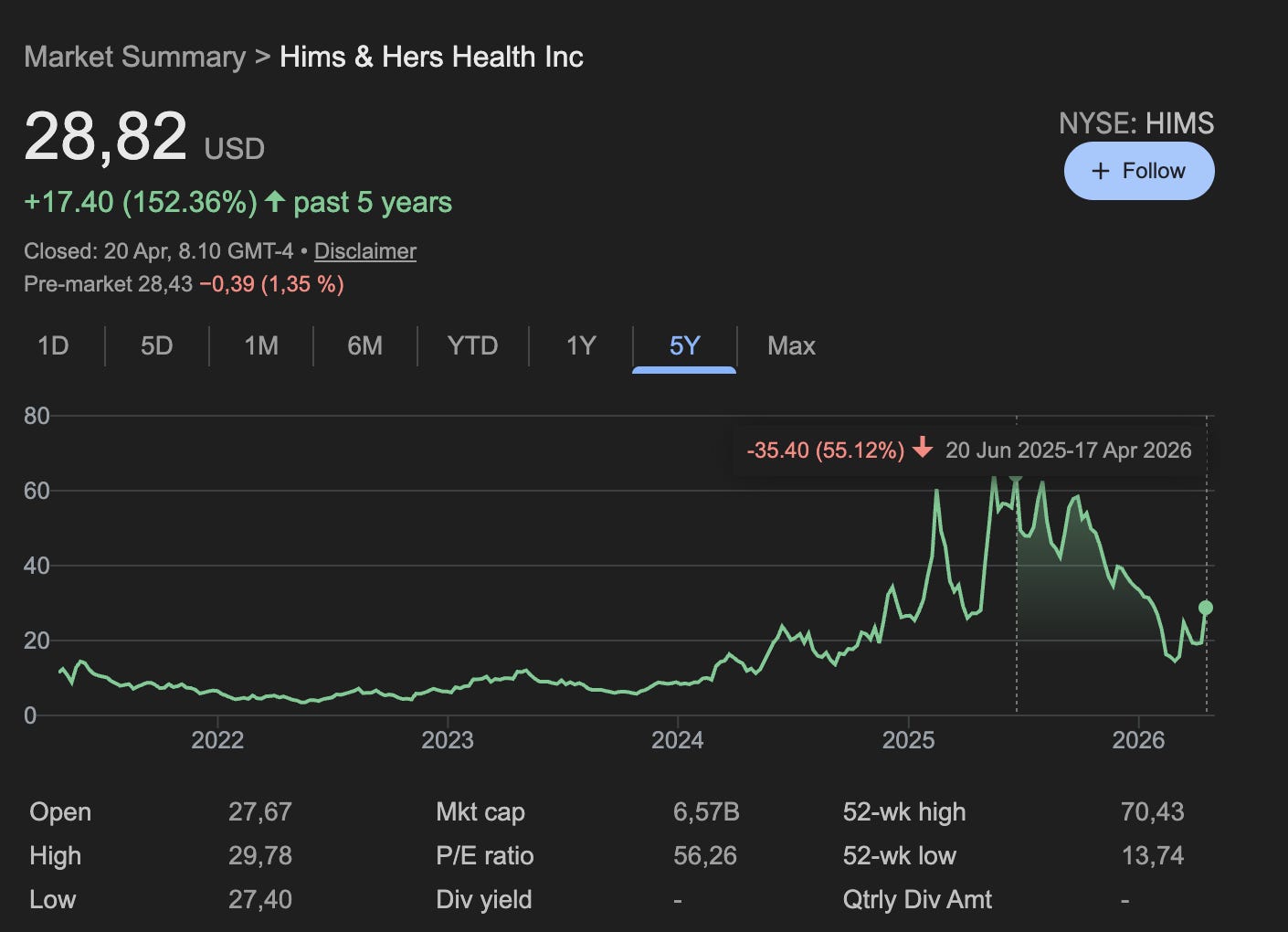
I followed and traded HIMS for roughly a year and a half. It was a chaos trade. The stock has a beta of 2.47 and it earned every bit of that, moving 15-20% on FDA headlines with no warning. At its worst the regulatory noise around compounded semaglutide made the stock nearly untradeable on fundamentals; at its best the GLP-1 hype sent it vertical. I stepped away. Now I’m back, and I want to explain both why this stock belongs in my coverage universe and why right now is the right time to initiate.
Why HIMS is a natural fit for alt-data coverage
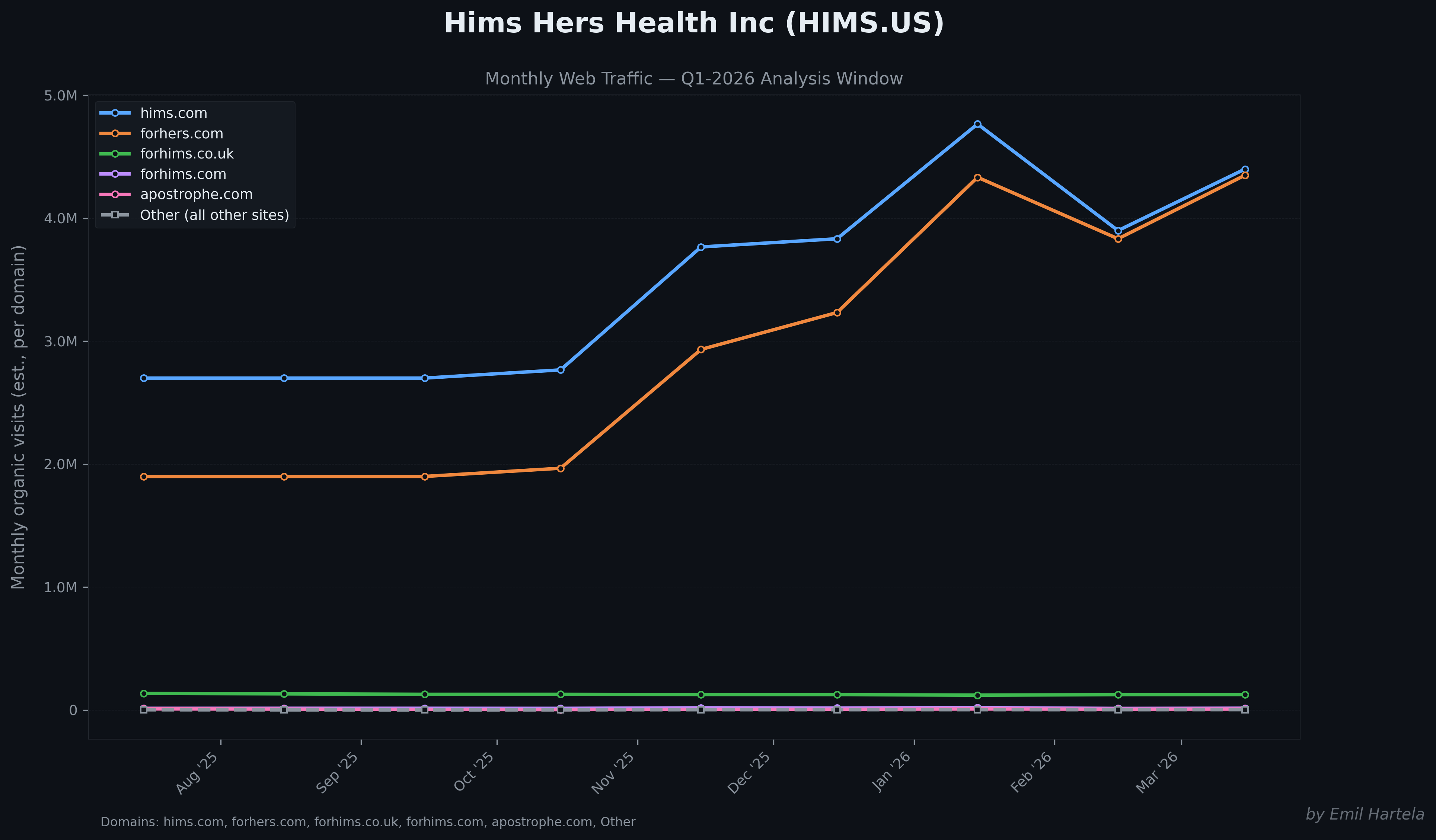
The business model is almost entirely digital. A customer discovers Hims or Hers, visits the website or app, consults with a licensed provider, and enrolls in a subscription. That funnel generates a clean, trackable signal in web traffic and app install data weeks before the company reports anything.
This is the core of what I do. When a DTC health platform is growing at 49% year-over-year and I can observe whether that growth rate is accelerating or decelerating through alternative data, I have a meaningful edge over the market, which is sitting on the sidelines waiting for the quarterly print. HIMS is one of the cleanest setups for this kind of work that I cover.
What the business actually is
Hims & Hers runs a telehealth platform that connects consumers to licensed doctors and nurses for prescriptions across stigmatized wellness categories: erectile dysfunction, hair loss, skincare, and now weight management. Everything is delivered directly to your door. No office visit, no pharmacy line, no awkward conversation. That privacy angle is not a marketing gimmick; it is the structural reason the brand has pricing power in categories where competitors hesitate to go.

The model is subscription-based. Customers consult, get prescribed, and receive recurring shipments. That creates predictable revenue and high retention if the product works. Gross margins sit at 75%, which reflects the efficiency of a DTC operation without physical retail overhead. Operating margins are thin at 2%, but that is a deliberate choice; the company is spending aggressively to grow the subscriber base.
TTM revenue is $2.2 billion, up 49% in the most recent quarter. Founder-CEO Andrew Dudum has been at the helm since 2017, and insiders hold 6.3% of the company. The market cap is $3.7 billion.
Where the money comes from
Revenue breaks into four segments. Weight management is now the largest at 39% of total revenue, fueled by compounded GLP-1 drugs including semaglutide analogs. Dermatology and skincare is 24%, sexual health is 20%, and wellness and hair care is 17%. Geographically, 95% of revenue comes from the US.
That segment mix matters for how I think about the stock. The top segment at 39% is the highest-growth part of the business but also where the regulatory risk concentrates. The other three segments are stable; they provide ballast but they are not driving the growth narrative. This is fundamentally a weight management growth story with a diversified base underneath it.
The competitive position
Hims competes against Ro in sexual health and weight loss, Teladoc in broader telehealth, and GoodRx at the discount end. The differentiation is brand trust in taboo categories. A consumer who already trusts Hims with their ED prescription is far more likely to start a GLP-1 subscription through Hims than through a platform they have never used. That trust is genuinely difficult to replicate and it extends naturally into each new vertical Hims enters.
The brand moat is the most durable part of the story. Network effects are moderate; the Labs personalization product, which tracks biomarkers over time to refine treatment plans, adds stickiness but it is not a flywheel in the way that social platforms have one. Scale advantages from spreading fixed costs over a large subscriber base are real. The weakness is FDA exposure on compounded drugs, which is concentrated in the highest-revenue segment.
On the supplier side, pharmaceutical ingredient providers have meaningful leverage, and FDA rules amplify that in weight management specifically. Buyer power is low by structure; millions of individual consumers making small recurring transactions have no negotiating position. New entrants face moderate barriers in stigmatized categories where brand rapport matters, and lower barriers elsewhere.
Management
Dudum has built this from a sexual health niche into a multi-category telehealth platform in seven years. The strategic bets have been sharp: the GLP-1 pivot was early and it paid off. CFO Yemi Okupe brings execution depth. The Zava acquisition adds European distribution; the Trybe Labs acquisition deepens the data personalization layer. Stock-based comp runs at 8% of revenue, which signals a growth-over-profits mentality and is worth watching as the business matures. Insider ownership at 6.3% is acceptable alignment but not exceptional.
The strategy and the optionality
The near-term priority is scaling the weight management subscriber base. Affordable compounded semaglutide, the Hers women’s line, and AI-driven Labs personalization are the three levers. The international opportunity via Zava is early but real. Longer-term, mental health and chronic care verticals are logical extensions of the platform. The optionality here is genuine; a company with this brand, this margin structure, and this distribution reach has multiple paths to compound.
R&D spend is 5.3% of revenue, modest but targeted. The focus is AI personalization and the Labs data flywheel, which tracks biomarkers over time to refine treatment protocols. That positions Hims to differentiate from basic telehealth as the category commoditizes.
Why I’m initiating now
Two things have shifted. First, the regulatory situation around compounded GLP-1s looks materially more settled than it did for most of the past 18 months. The compounded semaglutide question was the central bear thesis; if that risk is largely resolved, the valuation math changes. The 39% weight management segment can be underwritten more confidently.
Second, peptide and GLP-1 consumer demand is genuinely accelerating. This is not hype normalizing; it is structural. The consumer addressable market for weight management subscriptions is far larger than what Hims has captured, and the platform is well-positioned to take share. Accessible pricing, discreet delivery, and a trusted brand are the right combination for this category at this moment.
The stock was untradeable on FDA headlines. Now the fundamental picture is cleaner, the alt-data signal is trackable, and the demand backdrop is strong. That is the setup I look for.
What comes next
I will be running web traffic and app install data on HIMS going into the next earnings print. That data will form the core of the earnings preview, which goes to paid subscribers. Free readers get the coverage initiation and the setup framing. Paid readers get the data read, the model, and my view on positioning.
If you are not already subscribed, the link is below.