

If you want to invest in the trend, there are not many pure options; most big tobacco names are diversified; many pouch brands are private. My favorite is Haypp Group $HAYPP; the Swedish nicotine-pouch company profiting directly from the boom through its online platforms. In this deep dive I will cover everything that matters about Haypp; segments; sites; markets; and what drives the next leg of growth.

Haypp first landed on my radar roughly two years ago; I took a small starter position and added on the way up in the 110 SEK range. Then came the hits; a ZYN shortage; a US lawsuit; and a revoked license in Sweden. The stock halved. That is when I leaned in. By then I had enough conviction and understanding to size it as a real position; so I kept buying into the lows.
Fast forward to today and that decision aged well; but I think this is just the beginning. Most people in the world still do not know what nicotine pouches are; many have never tried them. That will likely change. In my view the category can 30x over the next twenty years; and Haypp is positioned to capture a meaningful share of that growth.
If you read my original deep dive, several things have shifted since then:
Media & Insights has continued rising in importance and is increasingly central to the thesis
France banned nicotine pouches; a reminder of regulatory fragility in EU expansion markets
The FDA updated its guidelines on nicotine pouches
The UK vape division was wound down
ZYN returned to the US sites via the direct PMI agreement
Segmentation was unified into two segments; Growth and Core
The short-term profitability narrative has shifted
Some of the wider hype in the sector has calmed down
What does Haypp do?
Haypp is an e-commerce business that sells nicotine pouches, snus, and vapes across Sweden; Norway; DACH; the UK; and the US. They buy finished products from a range of suppliers including Philip Morris, British American Tobacco, Turning Point Brands, and others; then sell directly to consumers through their portfolio of websites.
This is a low-margin retail model; Haypp currently runs at roughly 19 percent gross margin. In practice a customer adds one or more cans to the cart on a site like Snusbolaget or Haypp; pays online; and Haypp earns a few bucks per order. The parcel arrives a few days later; repeat purchases drive the engine.
Do not confuse low margin with low quality; Haypp is far from a boring e-commerce shop with no moat.
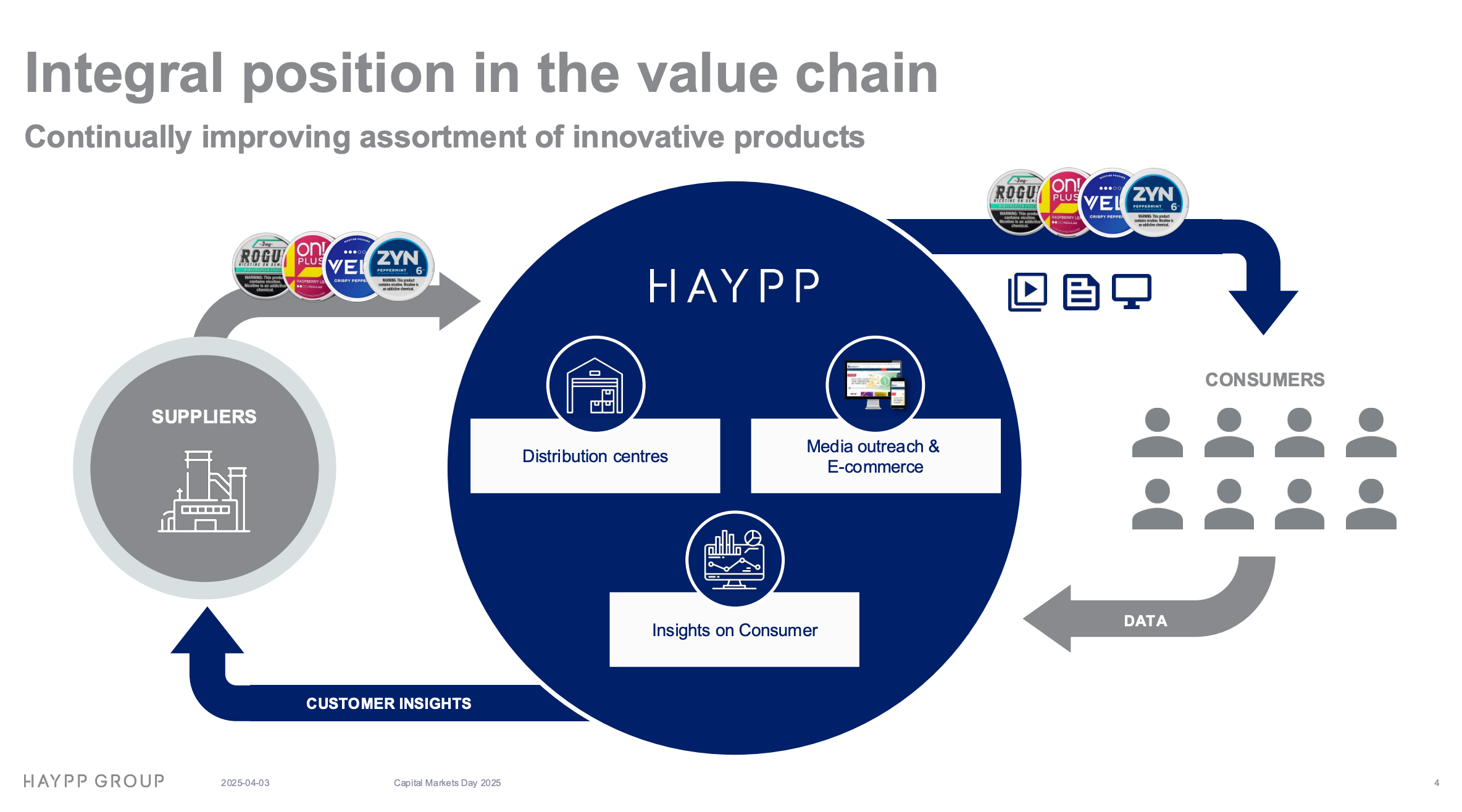
Each time Haypp sells a can of nicotine pouches and books a small retail margin, a second asset compounds in the background; data. Every order captures structured signals; brand and SKU; flavor and strength; format and pack size; price paid and discount; device and channel; delivery choice; location; reorder cadence. Over time this builds longitudinal cohorts that show how real customers move from trial to habit; which flavors they switch to; how strength preferences evolve; what promotions change behavior; and when baskets expand.
Haypp Media & Insights turns that stream into products; paid reports; custom analyses; and decision support for suppliers and regulators. Typical outputs include new-product screening; flavor and strength optimization; price elasticity curves; subscription propensity; promotion lift; and age-gating friction metrics. For suppliers like Philip Morris, British American Tobacco, and Turning Point Brands this is scarce and valuable; most in-store sales flow through intermediaries that do not expose consumer-level behavior. Haypp sees the shopper at the edge; at SKU and click level; across markets; in something close to real time.
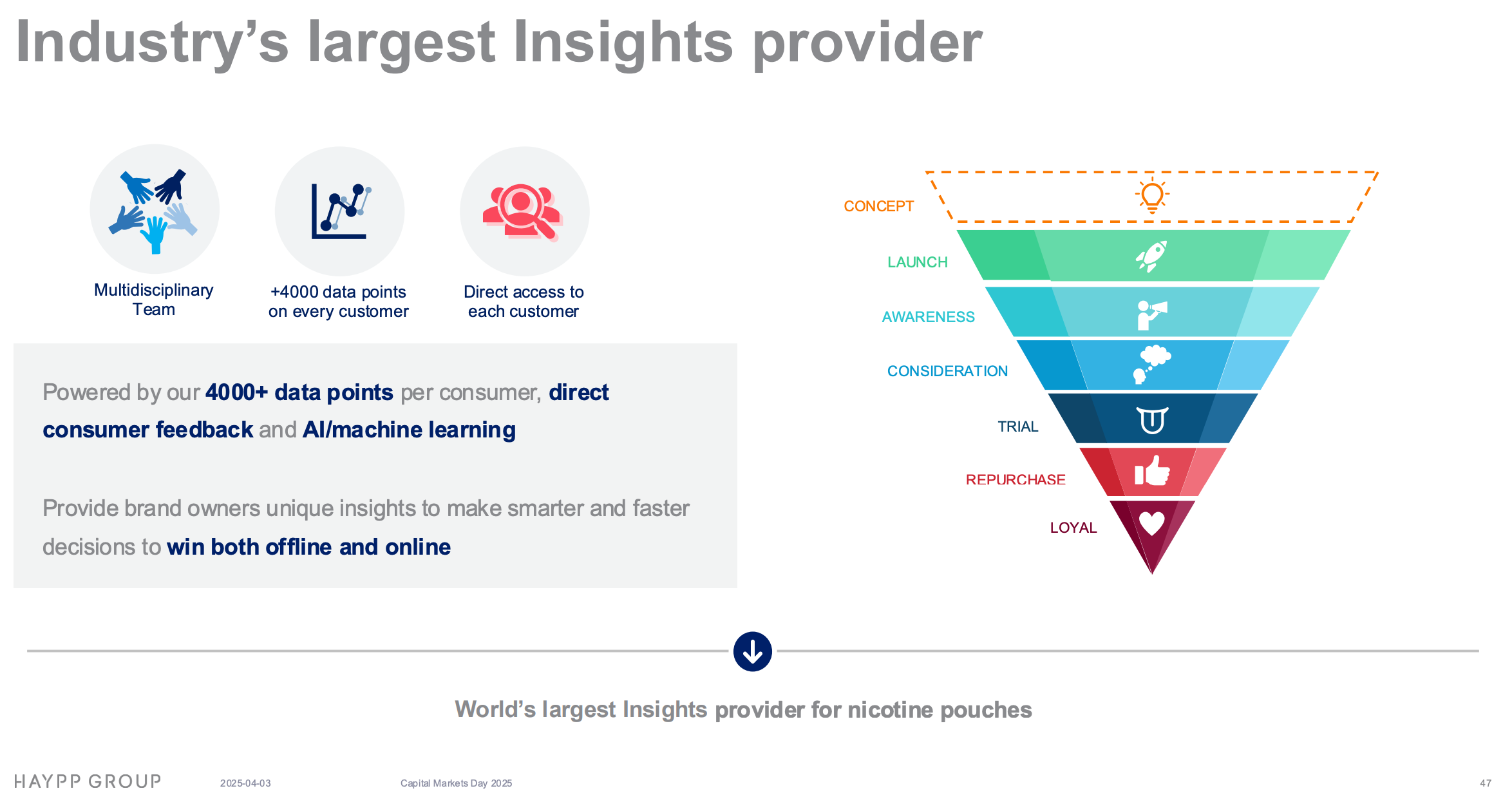
This means Haypp, in addition to e-commerce, has a secondary business layered on top that is highly profitable; the result is an e-commerce model with a huge structural data advantage. Haypp is the largest online nicotine-pouch retailer in every market it operates in. Right now the Media & Insights business generates almost 10% of revenue; margins are at least half of that; giving Haypp roughly a 5% cost advantage on selling nicotine pouches purely from data collection.
Why nicotine pouches?
To understand Haypp and why it’s interesting, you have to understand the opportunity in nicotine pouches. Everyone has heard of nicotine; mostly in a negative way; the “addictive ingredient” in tobacco; and yes, it’s been used as a bug killer. Both are true. However, nicotine itself does not seem to be very toxic to humans at typical consumer exposures; it is highly addictive; cheap; and there’s work suggesting improved cognitive capacity for some users; e.g., people with ADHD often report better focus.
In a nutshell, we have a cheap product that is highly addictive and seems to have minimal downside for many users; yes, there are health risks; but they aren’t drastic enough for most consumers to care; after all, every piece of candy you eat “kills” you in the long run.
What we have here is a product that is superior in almost every way. Consumers prefer it; regulators prefer it; companies prefer it. For users it’s cleaner; discreet; cheaper; easier to live with. For companies it carries better unit economics; longer cash-flow runways; and supports higher valuations. For regulators it’s a practical harm-reduction path that moves smokers into nicotine pouches.
The category is also evolving fast on the product side. Pouch tech has seen a remarkable amount of innovation in recent years; new flavor systems, faster release profiles, slimmer formats, moisture engineering, and improved fit under the lip. What looked like a commoditized product a few years ago is now an active R&D field where suppliers compete on real differentiation.
The regulatory backdrop is more mixed than two years ago. The FDA in the US has continued to refine its guidelines, with the federal stance leaning toward pragmatic harm reduction. France went the other way and banned nicotine pouches outright. The UK has moved toward strength caps that will limit higher-nicotine SKUs. Brussels keeps floating new proposals and member states keep interpreting them differently. The direction of travel is not a straight line; expect setbacks alongside the progress.
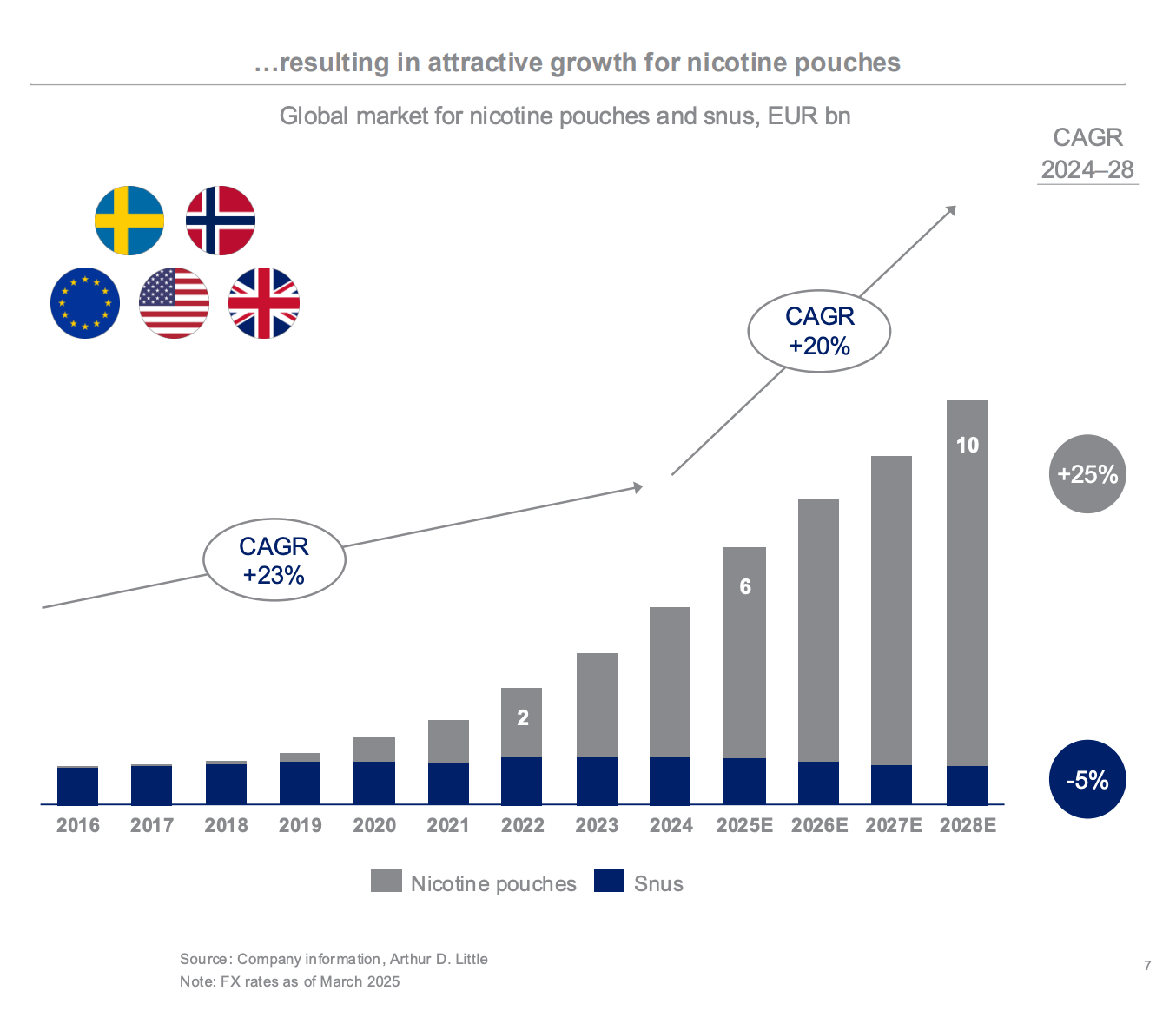
But the market is still early. Tobacco still dominates; globally there are far more smokers than pouch users. That is about to change. Look at Sweden and Norway; you see mass switching. Smoking is too harmful and no longer socially accepted. My view: the nicotine-pouch market is set to grow at an incredible pace until smokers are essentially gone. For investors that implies around 20% CAGR over the next decade; with some markets growing far faster right now.
Websites and Markets; Brand-by-Brand
Haypp Group runs 16 sites under 11 brands, selling snus, nicotine pouches, and vapes. Many brands serve several markets through localized sites, which is why the site count and brand count differ.
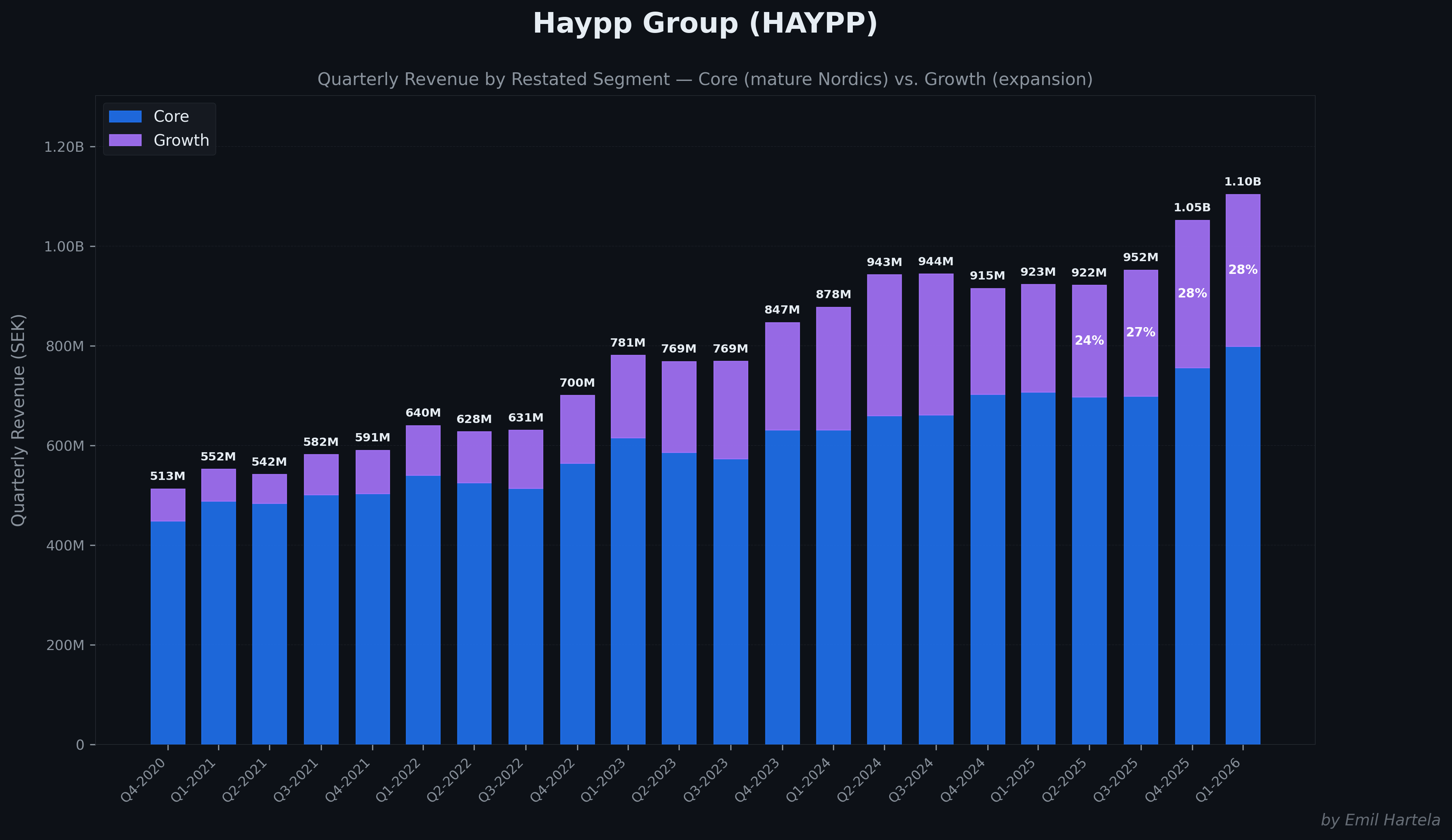
Operations are now split into two segments. The Core segment includes Sweden and Norway, where snus and nicotine pouches are well established and form the backbone of Haypp’s profitability. The Growth segment covers Germany, Austria, Switzerland, the United Kingdom, the United States, and the vape business through VapeGlobe DE. This is a meaningful change from the old three-segment structure; the previous Emerging segment is gone. VapeGlobe UK was wound down, VapeGlobe DE was folded into Growth, and vapes also sit inside Core through Haypp’s wider catalog where regulation allows. The simpler structure better reflects how the business actually runs today.
The difference between Growth and Core is surprisingly large; it is a central part of the Haypp thesis. In Core markets like Sweden and Norway, usage is mature; repeat rates are high; order patterns are predictable. Growth markets look very different. New pouch users often start light; roughly one can per week. After a couple of years many settle into a daily habit; that shift alone turns a customer into a 7x heavier consumer without Haypp adding a single new user.
This cohort maturation drives powerful compounding. As light users age into heavy users, baskets get bigger; reorder frequency rises; subscription uptake improves; fulfillment routes densify; CAC payback shortens. The same customer base can deliver step-function growth in volumes and gross profit as behavior shifts from trial to routine. That is why the US and UK matter so much; they are still converting early cohorts, while Core already sits near steady state.
This structure allows Haypp to balance stable cash flow from mature markets with expansion into new, high-growth geographies and categories. Core secures the base, Growth drives the long-term opportunity.
Next, I will quickly go over each brand.
Haypp
Haypp is the group’s flagship in Europe; one brand running localized sites for the UK, Germany, Austria, and Sweden. In segment terms it straddles Core and Growth; Sweden belongs to Core; the UK, Germany, and Austria belong to Growth. Over the last year Haypp has been among the fastest growers in the portfolio.
By focus, Haypp is primarily a nicotine-pouch banner. Germany and Austria are pouch-first markets. The UK is also pouch-led even though the catalog is broad; pouches anchor the proposition.
Snusbolaget
Snusbolaget is Haypp Group’s Swedish flagship in the Core segment; it sells traditional snus and also offers nicotine pouches. It is currently the largest site by sales; but its share has been shrinking as nicotine pouches take market share across the portfolio; it likely will not remain the largest over time.
Snusnetto and Nettotobak
Snusnetto and Nettotobak sit in Sweden within the Core segment; both are snus-led with some DIY supplies and nicotine pouches. Snusnetto is very small; traffic has plummeted over the last year; it almost looks like Haypp is phasing the site out.
Nettotobak is mid sized; but web traffic has dropped sharply; suggesting sales are close to half of what they were two years ago. Net read: these two look like legacy coverage for niche customers rather than growth engines.
Norway cluster (Snushjem, Snuslageret, Snus.com)
Segment: Core; Location: Norway.
These sites are Norway-focused; snus first with nicotine pouches alongside. The market is mature but still posting decent growth; not explosive, but better than steady-state. Norway is also a great case study of a highly regulated market; strict presentation and marketing rules shape how these sites operate and grow. You cannot show products the way you can elsewhere. That makes the Norway cluster doubly interesting; it delivers reliable contribution and serves as a real-world template for how Haypp executes when the regulatory environment tightens. Any future rule changes could materially shift visibility; conversion; and growth.
Snusmarkt
Segment: Growth; Location: Switzerland.
It is one of the smaller sites; among the weaker performers by traffic and sales. That makes it interesting strategically; it shows how Haypp fares when entering a market later; with more competition; and tighter rules. The offer is snus led with nicotine pouches available; repeat purchase driven; more signal than scale for the group.
Northerner
Northerner serves the United States; the United Kingdom; Germany; and Austria; with the US as the clear anchor. The focus is nicotine pouches; snus is offered where allowed. By web traffic it is now roughly tied with Nicokick as one of the two largest sites in the group. With the US nicotine-pouch boom accelerating and Haypp’s US operations scaling, Northerner has substantial upside from here.
Nicokick
Nicokick serves the United States; segment is Growth; focus is nicotine pouches. It is currently tied with Northerner as the top site by web traffic in the group, and is likely to become number one by sales as US adoption continues to accelerate. The brand faced a temporary setback from ZYN supply constraints; with ZYN back through the direct PMI agreement, Nicokick is the clearest near-term upside lever in the portfolio.
VapeGlobe
VapeGlobe sits in the Growth segment; market is Germany after the UK arm was wound down. Sales are still small but growth is rapid. Most people ignore this part of the business; yet it could become a meaningful contributor over time. Strategically it lets Haypp test its playbook in a different category; generating valuable learnings on CAC, merchandising, and age-gating that can feed back into the core. Keep an eye on it.
Market outlook and where Haypp goes next
Haypp already spans a wide range of countries and segments; the runway is still long. The clearest near-term growth sits in the US and the UK; nicotine-pouch adoption is compounding and the e-commerce playbook scales well. Sweden and Norway are steady profit engines; culturally entrenched oral nicotine; predictable reorders; disciplined operations.
DACH shows momentum but not dominance. Germany is the hinge; winning it will take sustained commitment on content, logistics, and local execution. The hesitation is regulatory; with rules in flux, Haypp has been reluctant to fully commit the resources needed to break through. Once EU clarity improves; expect a firmer push.
Central and Southern Europe remain uncertain; policy is the bottleneck. Without clearer EU and national frameworks, the risk-adjusted return on new launches is lower than doubling down where demand and rules are already workable. France’s outright ban is a reminder of how brittle the EU map can be.
Asia is the strategic swing. Gavin (CEO) answered my question about Asia like this: “Asia is ready but Haypp isn’t.” Translation; the opportunity is real, but spreading the organization too thin would dilute execution in the US and Europe. The likely path is sequence, not sprawl; establish unambiguous US leadership first, then make targeted entries or acquisitions in select Asian markets once the operating model can support it.
Strategy
The flywheel; how Haypp compounds
Think of Haypp as two businesses working together; a retailer that ships cans and a data company that learns from every order. When a new customer lands on a site and buys a trial mix, Haypp captures clean, structured signals; brand; flavor; strength; can size; price paid; delivery choice; reorder timing. That dataset grows with each purchase; across countries; across months; across thousands of cohorts.
Data turns into targeting. The sites learn which SKUs convert first-time buyers; which flavors people switch to on order three; when a user is most likely to accept a subscription; which delivery options reduce failed handoffs. Search results and recommendations improve; promotions are timed to actual reorder windows; landing pages reflect what works in that country. Conversion rises; churn falls; fewer clicks are wasted.
Targeting lifts value per customer. Baskets get a bit larger; reorder frequency ticks up; subscriptions smooth demand; returns drop. Lifetime value rises; payback periods shorten; paid channels can be pushed harder without destroying contribution. The same traffic produces more gross profit.
Higher customer value creates supplier leverage. With predictable volumes and precise demand signals, Haypp negotiates better terms; earlier allocations; co-op budgets for launches; exclusives in some cases. Media & Insights adds another lever; suppliers pay for reports that help them tune flavors and strengths; regulators buy category overviews; this offsets retail costs. M&I is increasingly central to the thesis; my view is that over time it goes from a useful sidecar to one of the main profit engines of the group.
Leverage funds price and speed. Buying terms improve; pick paths get denser; last-mile rates step down; working capital turns faster. Haypp can offer sharper prices; free shipping thresholds; quicker delivery windows; and it can do this sustainably because unit costs are falling as scale rises. The operational layer is being upgraded behind the scenes; Haypp has been moving more and more of its fulfillment to fully automated warehouses; same-day delivery is being tested in the US; and the UK is set to come online with a fully upgraded warehouse this summer.
Price and speed bring more customers. Better value wins trials; reliability builds habit; authority in search compounds; direct traffic climbs; CAC mixes down as organic grows. The brand becomes a default choice for the category in each market it serves.
Regulation and trust lock the gains. Age checks; KYC; product presentation limits; and local tax rules are handled cleanly; errors and failed deliveries drop; approval rates improve. That competence is hard to copy at scale; it lowers friction for users and for suppliers that want a compliant online channel.
More customers feed more data; targeting improves again; supplier terms tighten again; operations get denser again. The loop repeats. Over time the gap between Haypp and followers widens; not because the storefront looks different, but because the engine behind it keeps getting smarter; cheaper; and faster with every can sold.
Media & Insights; from sidecar to second pillar
Media & Insights deserves its own treatment because the trajectory matters. Today it generates close to 10% of revenue at materially higher margins than the retail business. That share is set to grow. Suppliers like Philip Morris, British American Tobacco, and Turning Point Brands are increasing their spend; the category is hiring AdTech and retail media roles; and Haypp has been steadily expanding the product set beyond manual reports.
What we know today is that M&I sells reports, custom analyses, and decision support, and that Haypp has been investing in AdTech infrastructure including Kevel-based ad serving. What we do not know yet, and what management has not detailed publicly, is how far the self-serve side will go. My read on the direction is that the model evolves toward something closer to a programmatic retail media network; brands buying audiences, sponsored placements, and experiments through a platform rather than through a person. That would mirror the Amazon Ads playbook applied inside a regulated nicotine vertical, where suppliers already pay for shelf placement and consumer data and Haypp is the only place where they can do both at scale online. I want to be clear that this is the direction I think the business is heading; it is not a capability Haypp has confirmed in detail.
If that path plays out, M&I becomes the part of the business with the highest structural margins and the cleanest software-like scaling. Over time I expect it to drive a disproportionate share of group profit; the retail business funds the moat, M&I monetizes it. Even if self-serve takes longer or lands in a more limited form, the report and insights revenue alone keeps M&I as the highest-margin layer of the group.
First-mover advantage, SEO, and GEO
Haypp is far larger than the next online competitor in every market it serves; typically by more than five times. Being first created default destinations for pouches and snus; people recognize the site names; trust them; return; and recommend them to friends. That familiarity compounds into brand searches and direct traffic that competitors cannot easily replicate.
The search playbook is simple and aggressive; own the highest-intent queries so the top two or three Google results point to Haypp. When those positions are secured, almost all purchase-intent traffic flows to Haypp first. The company prioritizes organic growth; country-specific category pages; brand hubs; FAQs; buyer guides; clean information architecture; fast load times; and tight internal linking. Google rewards sites that keep users engaged and convert visits into purchases; strong dwell time and conversion feed back into ranking strength and make future wins easier.
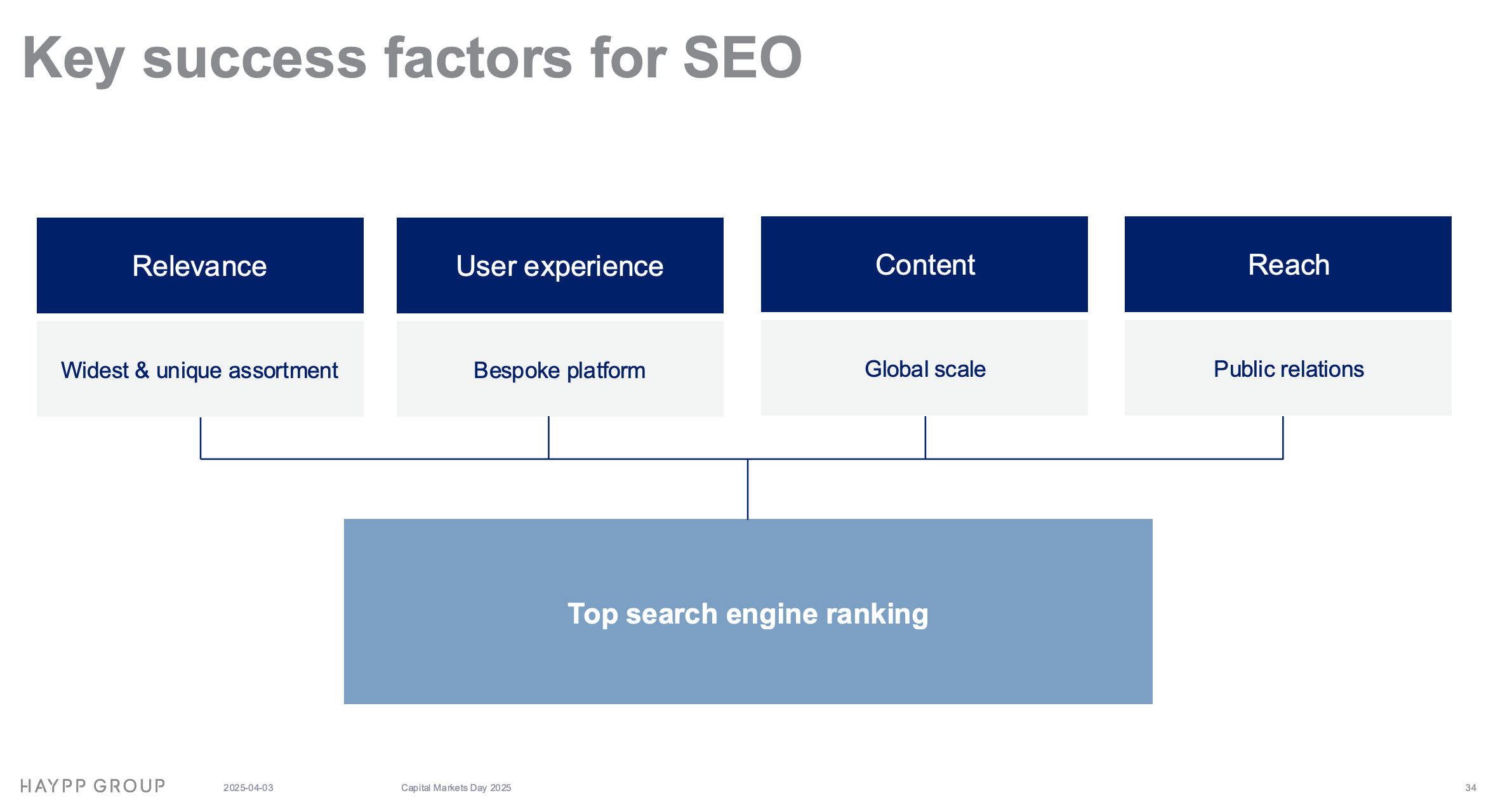
Importantly, SEO and the emerging GEO work (generative engine optimization; how product information shows up inside LLM answers and AI search) is handled in-house. That is unusual for a retailer this size; most outsource. Keeping it internal means the team can iterate on schema, content, and structured data fast as Google’s algorithms and the LLM answer engines shift; it also keeps the most strategic part of customer acquisition under Haypp’s own control. As discovery moves from ten blue links to AI-generated answers, the companies that get cited inside those answers will compound the way SEO winners did over the last two decades; Haypp is building for both worlds in parallel.
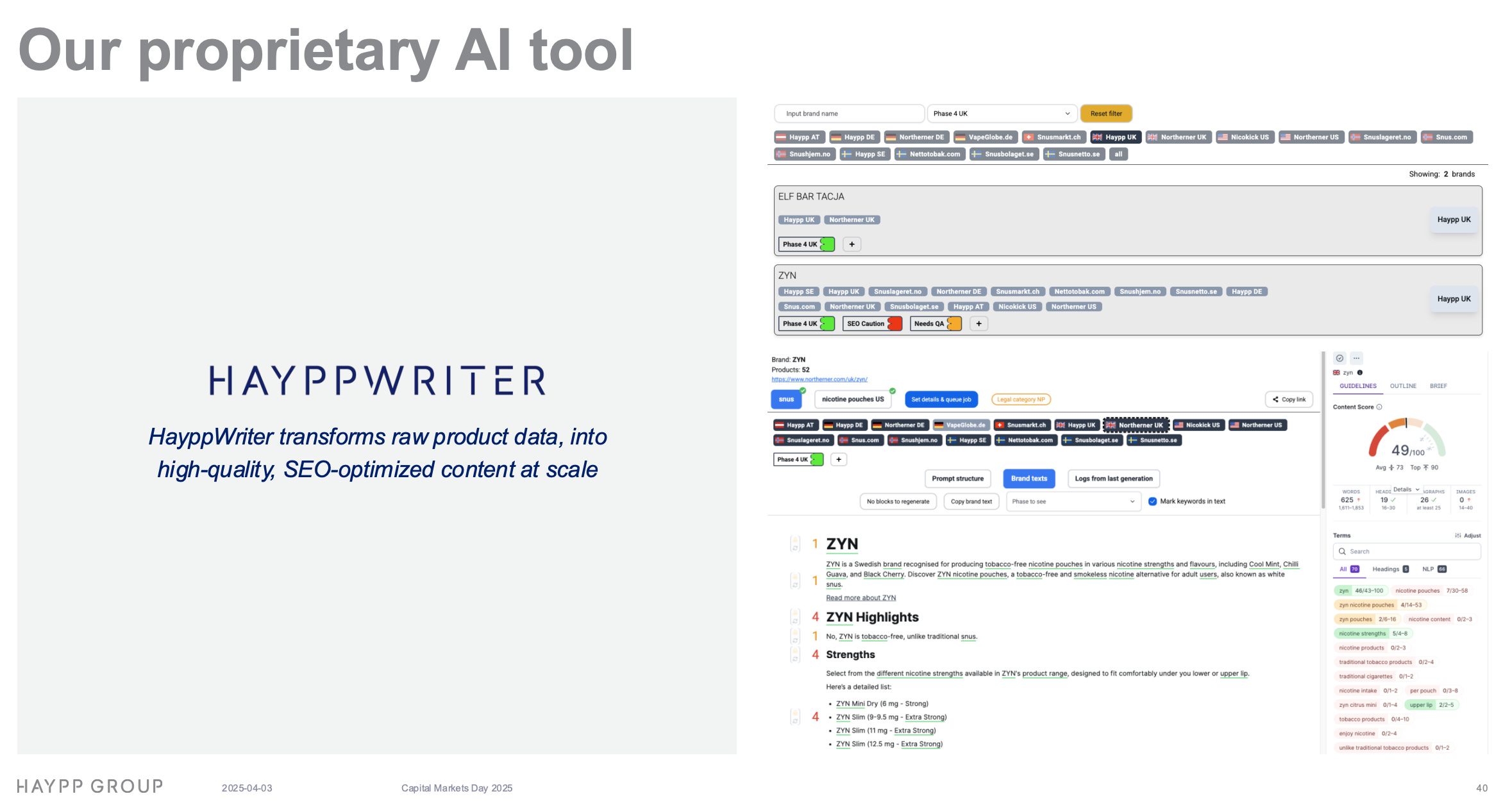
An AI-assisted content system keeps product pages accurate at scale; when stock, pack size, strength, flavor name, or imagery changes, the underlying product data updates page copy and attributes across locales quickly and consistently. Fewer stale pages; fewer mismatches between site and warehouse; a steady stream of fresh, structured information that search engines and LLMs can parse and trust.
Combine first-mover authority, trusted brands, and disciplined SEO and GEO capture and you get a moat. Competitors must spend years earning links and building helpful content while starting from behind on brand trust and type-in traffic. Ads are constrained in this category, so you cannot simply buy your way to parity. Haypp keeps publishing, updating, and compounding; the result is a discovery funnel that routes most high-intent traffic to Haypp regardless of whether the user is searching on Google or asking an LLM.
Competition
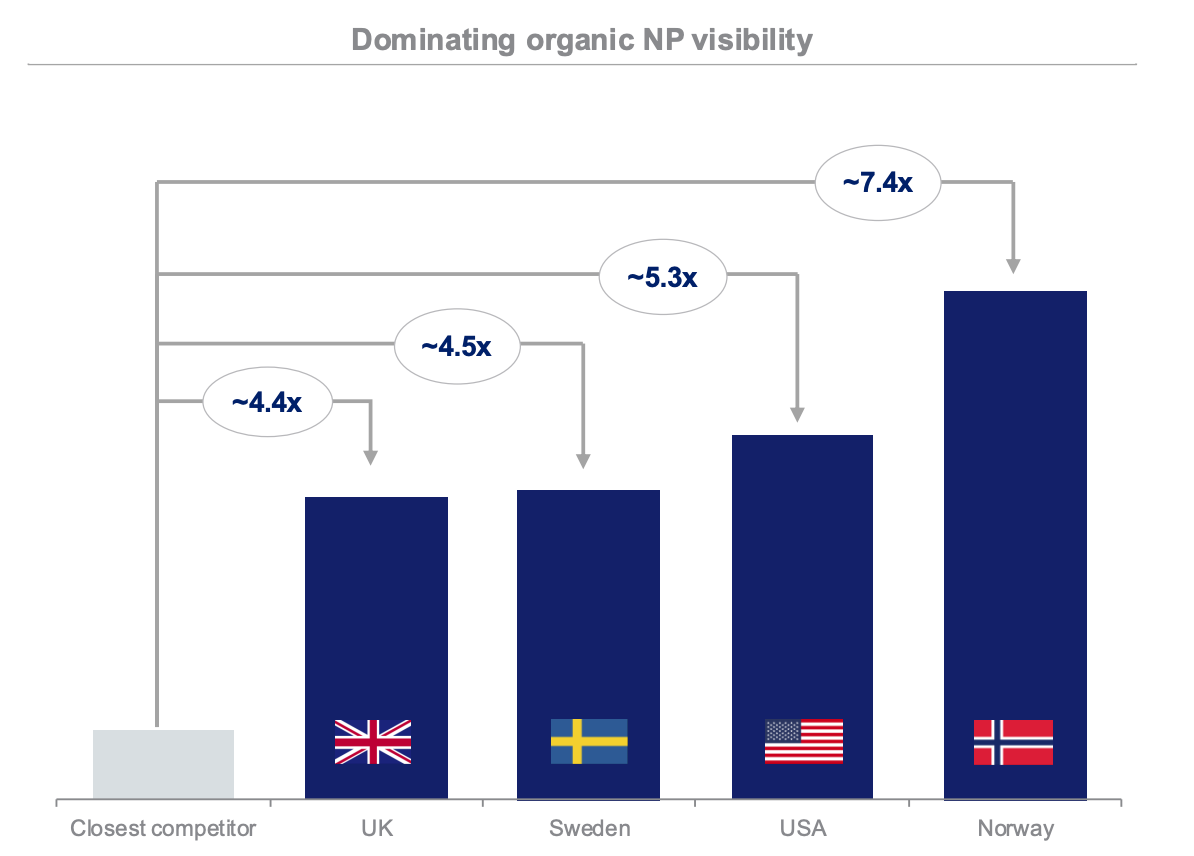
Haypp is significantly larger than the next online player in its key markets; in organic nicotine-pouch visibility it is about 4,4x bigger in the UK; 4,5x in Sweden; 5,3x in the USA; and 7,4x in Norway. Outside these, the pattern is similar; Haypp usually leads by a wide margin across its footprint.
There is also a grey market. Unlicensed sites pop up; skip age checks; and undercut prices for a while. Gavin has said the grey market is not a real concern; these actors tend to run into payment, logistics, or regulatory problems and disappear. That dynamic has strengthened recently. The FDA has been actively cracking down on unauthorized pouch products and grey-market sellers in the US; other markets have moved in the same direction. The net effect is a cleaner playing field for compliant operators; the cost of doing things right falls relative to the cost of cutting corners, which structurally favors Haypp.
Even among licensed rivals, short bursts of growth often come from pouring cash into marketing and discounts rather than from any lasting advantage. Some may look strong for a quarter or two; without a real edge they struggle to sustain it.
Direct competition is not what people usually ask about; the common questions are these: why wouldn’t Amazon sell nicotine pouches; can manufacturers go direct online; and couldn’t grocery delivery just add pouches to the basket.
Amazon first. Listing pouches would force strict age-gating at checkout and ID checks at delivery; warnings and record-keeping; and ongoing policy risk for a tiny revenue line relative to the rest of the marketplace. Extra verification steps cut conversion; compliance exposure rises; the payoff is minimal. The rational move for Amazon is to avoid the category.
Manufacturers next. PM briefly offered direct ordering; PM ended it. Going DTC creates channel conflict; undercutting retail partners looks like unfair treatment and strains distribution relationships. It also pushes brands outside their competence; high-performing e-commerce requires SEO; KYC; payments; fulfillment; and customer support at scale. Even with big budgets, the ROI is questionable when brick-and-mortar already delivers reach and margin.
Grocery delivery last. In theory a Whole Foods-type service could add pouches; in practice they would need age-gating at the point of sale and ID verification at the door; plus compliant product presentation and record-keeping. The operational burden and failure rates overwhelm thin per-can economics. Digital ID could make verification smoother over time; but generalist grocers would still struggle to match Haypp on price; assortment depth; and the structural data advantage that tunes merchandising and repeat behavior.
Management
Gavin O’Dowd; who he is and why he matters
Gavin O’Dowd has led Haypp Group since 2017. He is a chartered management accountant educated at Waterford Institute of Technology who started his career at Accenture and PwC before moving into nicotine at British American Tobacco, where he spent more than a decade across group corporate finance, CFO Iberia, and as general manager for Sweden and Norway. That mix of finance discipline and operating experience in Haypp’s core category is the spine of his profile.

On ownership, he is not a hired gun with no skin in the game. As of 4 March 2026, he holds 859.691 shares and 155.000 warrants, placing him among the top ten owners. Worth noting; over the last twelve months he has actually been a meaningful net buyer. The biggest single sale was historical and conducted at a price well above current levels; since then he has been adding, with insider data showing him as the largest buyer among insiders in the trailing year. That is a signal worth weighing.
O’Dowd is also a very visible operator. He fronts earnings calls and capital-markets presentations and regularly appears at category conferences like GTNF and ATNF to discuss regulation, harm reduction, and the e-commerce channel for oral nicotine. The consistent message: SEO and first-mover advantages, building the insights business, tightening compliance, and sequencing geographic expansion rather than chasing headlines.
The throughline in his background is relevance. He ran P&Ls in Scandinavia when pouches and snus were already mainstream and understands the regulatory texture that defines Haypp’s day-to-day. He has lived the budgeting, portfolio, and channel conflicts faced by large manufacturers and now works the other side of the table as their most important online retail partner in multiple markets. That combination of category literacy and retailer pragmatism is rare.
My notes from watching him across interviews and webcasts: he is a neutral describer of events who does not sugarcoat setbacks or overhype wins. He is quick and specific on details, often answering with operational context rather than slogans, which signals he is on top of the numbers and the levers. He reads as a strong, active leader who keeps pushing the company forward without theatrics. Given Haypp’s size, he is a heavy hitter in this niche; credible with suppliers and regulators, comfortable with the public markets, and effective at aligning the organization around a clear playbook.
In short, O’Dowd brings exactly what Haypp needs at this stage; a finance-trained operator from within the nicotine world who is fluent in regulation, comfortable with sharp execution in e-commerce, and aligned with owners through a meaningful equity stake.
Other key leaders; the bench has shifted
Since the last deep dive the executive bench has reshuffled meaningfully, and the pattern tells you exactly where management thinks value gets created.
COO and Deputy CEO is now Jonas Kolehmainen, effective January 9, 2026. He joined Haypp in March 2024 as Chief Supply Chain Officer; before that he was CEO of PostNord TPL with over a decade of retail logistics experience at Apoteket, Granngården, Sportamore, and DHL Freight Sweden. He holds no shares but has 127.500 warrants.
Svante Andersson, the previous COO and a Haypp veteran since 2017 (originally CFO), transitioned in the same announcement to become President of the UK business. The UK is Haypp’s strongest European growth opportunity and is set to grow further as new legislation is finalised this year or next; putting one of the most experienced internal operators in charge of that P&L is a strong signal. He is not gone; he is now running one of the two most important markets in the group.
President US is now Gabriel De Prado, also effective January 9, 2026. He previously served as Haypp’s CCO across six countries; before that he spent years at BAT leading strategic planning, consumer insights, and commercial execution across international markets. Read the two appointments together; Haypp pulled its two most senior commercial and operational leaders into the US and UK President roles on the same day. The US and UK becoming standalone P&Ls under dedicated Presidents tells you exactly where the next decade of value gets created.
CFO Peter Deli remains in place; he brings GE, AmRest, and BAT finance pedigree and holds roughly 215.000 warrants.
Head of Legal & External Affairs Markus Lindblad anchors regulation and public affairs; he holds about 192 shares and 192.000 warrants.
Below the named executive management, the US team has been built out aggressively. Issa Abuaita joined as Head of Legal and Laura-Leigh Oyler as VP Regulatory Affairs in mid-2025; May Pan was appointed E-Commerce Director and UK Business Unit Manager in July 2025. These hires reflect Haypp’s two strategic priorities; scaling the US and tightening regulatory and operational competence as the company moves from small cap into something bigger.
Recent insider activity
This is worth a separate flag. Over the last 90 days Haypp has seen net insider buying of roughly 6,1 million SEK, with the CFO, CEO, and another senior executive among the buyers in March. Insider buying at depressed prices after a meaningful drawdown is the kind of signal that gets discounted by markets but tends to age well. Insiders rarely buy for a single reason; the simplest explanation is usually that they think the stock is mispriced relative to what they see internally.
Board and key insiders
Haypp’s board is small, hands-on, and unusually owner-heavy for a listed company this size. The board consists of six ordinary members.
The chair is Lars-Johan Jarnheimer, best known for chairing Ingka Holding (IKEA’s parent) and Telia Company. He also chairs Arvid Nordquist, Elite Hotels, and Grimaldi Industri, and sits on the board of Stillfront Group. He brings big-company governance, brand, and telecom-scale operating experience. He joined as chair in 2025 and holds 10.000 shares as of 9 March 2026.
Founder Linus Liljegren sits on the board and remains a major shareholder, holding 1.960.301 shares through a partly held company. His presence keeps founder discipline in the room. Alongside him is long-time backer and operator-investor Patrik Rees, who holds 3.635.323 shares through company and has been on the board since 2016. Between them you have deeply aligned owners who think in years, not quarters.
Deepak Mishra adds global nicotine and strategy depth. He spent years at McKinsey, then served as Chief Strategy Officer at Philip Morris International and later led PMI’s Americas region. He is independent and holds no shares, which keeps him clean on conflicts while bringing top-tier category insight.
Adam Schatz brings e-commerce and listed-company operating chops. He is President and CEO of Nuent Group; previously CFO, then CEO, of BHG Group. He is independent and holds 2.000 shares.
Helena Juhlin Pink rounds out the digital edge on the board; she has senior brand and marketing experience from Soundtrap/Spotify (Head of Brand) and OMD Sweden (CEO), and currently holds board positions at Forte Digital, Avoki, and Mobile Interaction. She is independent of major shareholders, holds 1.000 shares.
What stands out is the mix; two materially invested insiders who know the playbook intimately (one founder, one owner-operator), and three more recently added independents who cover governance at scale (Jarnheimer), nicotine strategy (Mishra), and e-commerce scale-up plus digital marketing (Schatz, Pink). Add a CEO who is a top-ten shareholder and you get tight alignment. The net effect is a board that looks overpowered for the size of the company, in a good way; heavy experience, real skin in the game where it matters, and enough independence to challenge management without drifting into bureaucracy.
Key risks
Haypp Group has many good sides; ignoring the risks would be foolish. I have referenced some risks in other sections; here I will go over the main risks I personally see and consider the gravest.
First: health-narrative and policy shock
First I’ll start with a key risk; new studies or public statements by powerful people could stall the nicotine-pouch boom. Today most people treat pouches as relatively harmless; but long-term data is limited; a single high-profile study showing unexpected adverse effects could slow adoption and invite tighter rules. There is also the risk that influential officials decide they dislike pouches for non-evidence reasons; that happens when decision-makers are uninformed. Haypp engages regulators to educate and align; yet regulators sometimes make poor calls; as we have seen with France’s outright ban and Austria’s reclassification of pouches as tobacco products. France is the clearest cautionary tale of how quickly an entire market can be closed; it can happen elsewhere, and the risk should not be underestimated.
Second: littering and optics risk
On adverse regulatory shifts; the main risk I see is public littering. Nicotine pouches are turning up everywhere; streets; parks; golf courses. For some reason people treat used pouches differently from other trash like cans and wrappers; they just drop them; and they tend to sit where they land for a long time. The danger is obvious; policymakers may decide to act against pouches based on littering optics rather than health evidence. That action could be a tax; a local or national ban; disposal rules; or broad awareness campaigns. This worries me long term because it only takes a few high-profile complaints or photos to trigger reactions that slow adoption even if the underlying health case for pouches stays intact.
Third: the EU, the US, and the FDA
The US currently looks friendly for nicotine pouches; the federal stance is pragmatic harm reduction. The FDA has continued to refine its approach throughout 2025 and 2026. The key recent developments: in January 2025 the FDA authorized 20 ZYN products through PMTA; in December 2025 six on!PLUS variants from Altria became the first decisions out of the FDA’s accelerated nicotine pouch pilot program; and on May 8, 2026 the FDA issued new guidance saying it will not prioritize enforcement against unauthorized pouches and e-cigarettes whose marketing applications have been under review for 180+ days. That last one matters; it tells industry the FDA is conserving enforcement resources to focus on the worst illicit actors while letting legitimate manufacturers under review keep operating. The direction is constructive overall, though several US states have proposed or enacted pouch-specific taxes (a proposed 75% wholesale tax in New York is the most aggressive example), so local exceptions will keep popping up.
The EU is the wildcard. Brussels keeps floating new rules and member states interpret them differently; flavor limits; strength caps; online presentation; age checks; taxes; even delivery rules. France went all the way to a full ban. Austria reclassified pouches as tobacco products and will restrict sales to licensed tobacconists from mid-2026, prompting Haypp to exit the market entirely (less than 1% of group revenue). That mix can change quickly and is a key risk to monitor over the coming years.
The good news is that there is plenty of information to track; consultations; draft texts; agency notes. Haypp also publishes periodic updates on its outreach in the EU; engaging with policymakers and explaining why pouches are better for public health than smoking. Keep an eye on EU-level proposals and how Germany and other countries choose to implement them.
Fourth: search behavior is shifting
Another risk worth flagging is changing search behavior. ChatGPT and other LLMs are taking share from Google; there may come a point where traditional SEO loses relevance and new rules apply. I have downgraded this risk versus my last writeup; Haypp has clearly leaned into GEO (generative engine optimization) in-house and is investing in being cited inside AI-generated answers, not just ranked in classic search results. Their structural advantages (clean product data; fast catalog updates; owned customer relationships via email, subscriptions, and direct traffic) translate well into the LLM-first discovery world. The risk has not disappeared; but it looks more contained than it did six months ago.
Fifth: when no rules become the risk
One more risk that no one talks about enough is the absence of regulation and enforcement. If there are no real rules; or no one enforces them; the grey market can run rampant; operators skip age verification; permits; taxes; and product presentation standards; and undercut everyone on price. In that world Haypp carries the cost of doing things properly while unlicensed sellers don’t; margins compress; customer trust erodes; and the category becomes less profitable over time. Regulation is Haypp’s friend up to a point; sensible, enforced rules level the playing field and support sustainable unit economics; the lack of them does the opposite. Recently the FDA and other authorities have been more active in cracking down on unauthorized products and the worst illicit actors, which moves the dial in the right direction.
Sixth: mainstream retail entry with digital ID
The most talked-about risk is new entrants. If a major grocer like Whole Foods enables pouch delivery alongside groceries; and digital ID makes age verification instant; the convenience advantage narrows fast. In that scenario generalist retailers could leverage existing baskets; dense delivery networks; and loyalty programs to pull share; especially in the US. Haypp would face real market share pressure if mainstream delivery becomes seamless for age-restricted products.
Seventh: online channel risk
Selling age-restricted products online is still new; regulators are figuring it out. Standards for checkout verification; delivery ID checks; record-keeping; and product presentation are not uniform yet. That means rules can change quickly; a new guideline or an agency memo can add friction or limit what is allowed online.
So far the direction has been workable; most authorities accept that online sales with robust age-gating can be safer and more auditable than in-person cash sales. It is also common sense; in a modern economy you should not have to buy age-restricted items only in person. Still, the channel carries risk; extra verification steps can raise costs and lower conversion; couriers and payment processors add their own policies; and a few jurisdictions may tighten rather than loosen.
Net of it; the online channel is moving the right way, but it is not settled. Haypp needs to keep proving that its systems are strict; reliable; and easy to audit, so the default policy choice remains to allow compliant online sales.
Eighth: supplier concentration and US category dynamics
The final risk I worry about is supplier concentration. ZYN dominated the US pouch market for years and that gave Philip Morris real leverage over Haypp; allocations, pricing, and timing could swing results in ways Haypp could not fully control. That picture is improving. ZYN has lost share over the last year as new entrants like On!Plus, Velo, and Zone scaled up; PMI’s own Q1 2026 reporting showed ZYN shipment volumes down 23,5% even as offtake grew 10%, reflecting channel inventory normalization and a more competitive landscape. The US market is becoming structurally healthier with more suppliers competing for shelf space and consumer attention. Rule of thumb: the more suppliers, the better for Haypp; the more diversified the supplier mix, the less any single allocation event can swing a quarter.
Related to this is the US category slowdown over the last twelve months. After several years of explosive growth, US pouch volumes for the broader category have cooled. Part of that is natural deceleration as the category moves from explosive early growth into broader adoption. Haypp’s own US numbers have continued to grow strongly (nicotine pouch volumes up 40% group-wide in Q1 2026, with the US and UK as the primary drivers), but the category-level slowdown is real and worth tracking. If the broader US growth rate keeps decelerating, it would compress the long-term upside even if Haypp keeps gaining share.
Closing the risk section
Those are the main risks I personally focus on; of course there is also the risk of competition; management execution; cybersecurity; and similar issues that every company faces. I have tried to touch on some of those elsewhere in this post as well.
Capital allocation
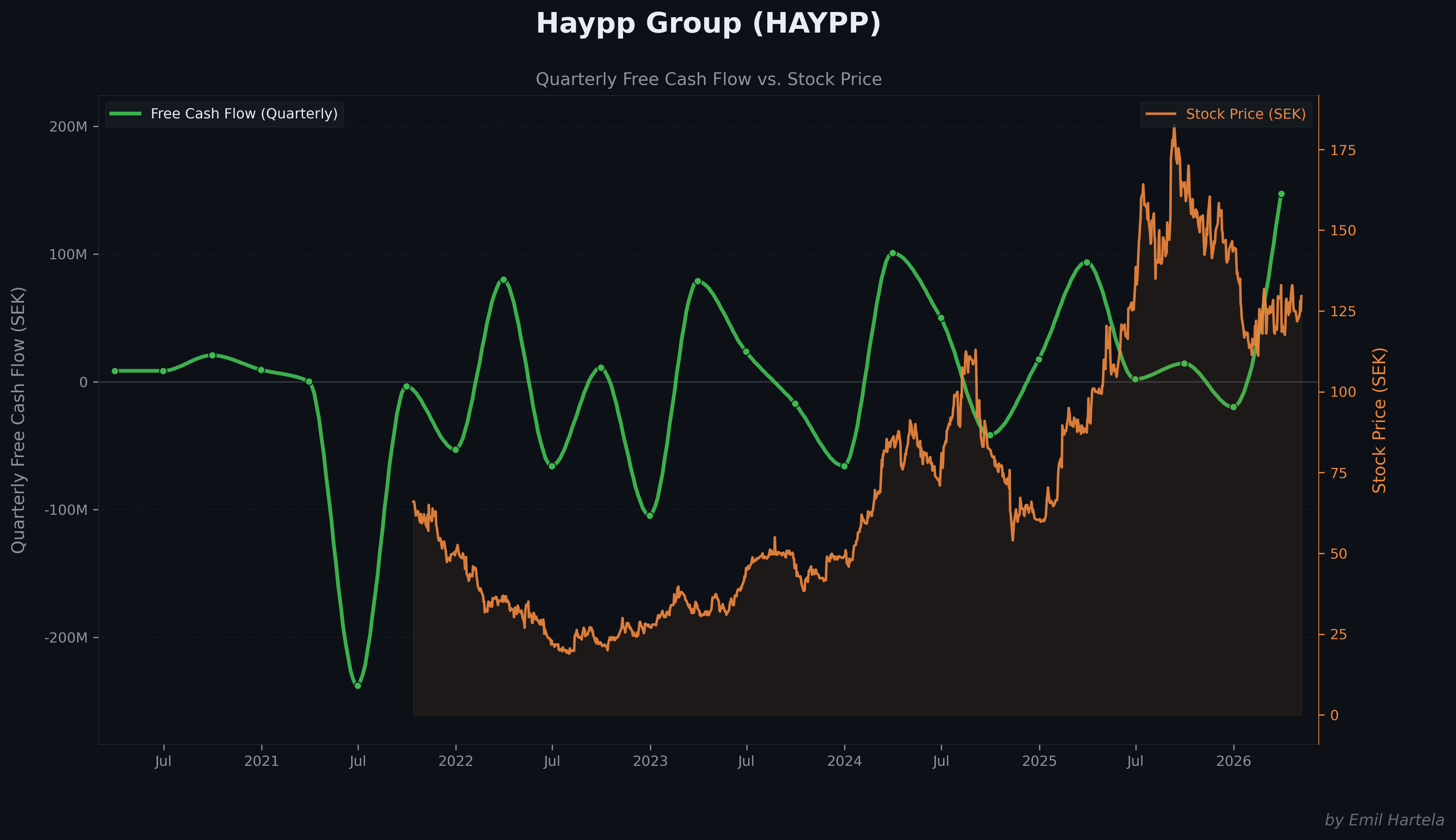
Haypp currently plans to reinvest essentially all cash back into the business; and will likely keep doing so beyond 2028; there is too much value to capture globally. Buybacks and dividends are on the table only when internal returns and M&A no longer clear a high hurdle. My speculation is that within roughly three years a larger share of free cash flow will be directed to acquisitions; Asia presents huge opportunities and would extend growth while improving diversification.
I also expect modest buybacks at some point to offset the dilution from ongoing incentive programs; the dilution is not massive, but the question of how necessary it is will soon become relevant. Overall, I think the team is skilled in capital allocation; I do not see a reason to fear misallocations.
Web traffic and nowcasting
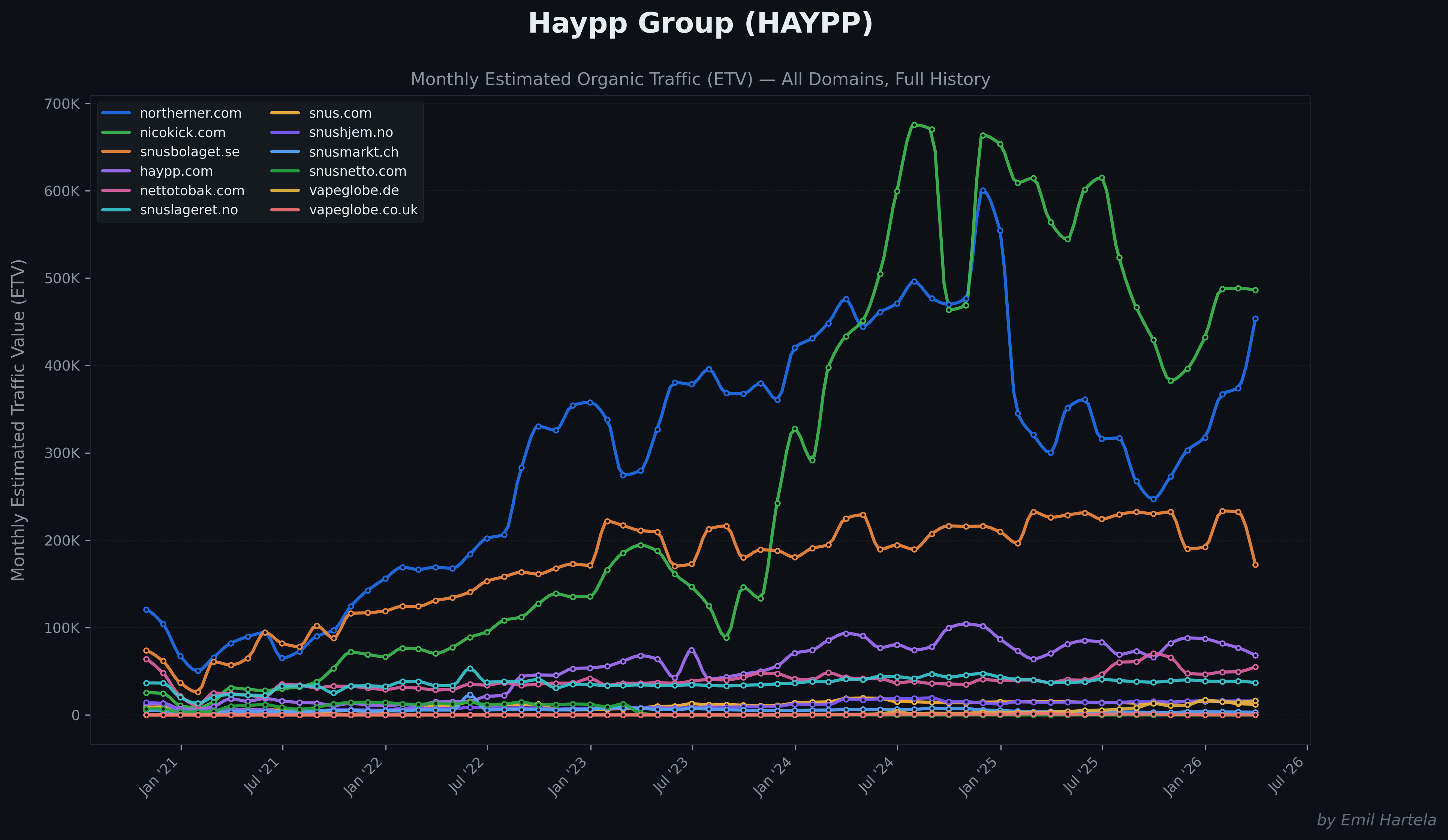
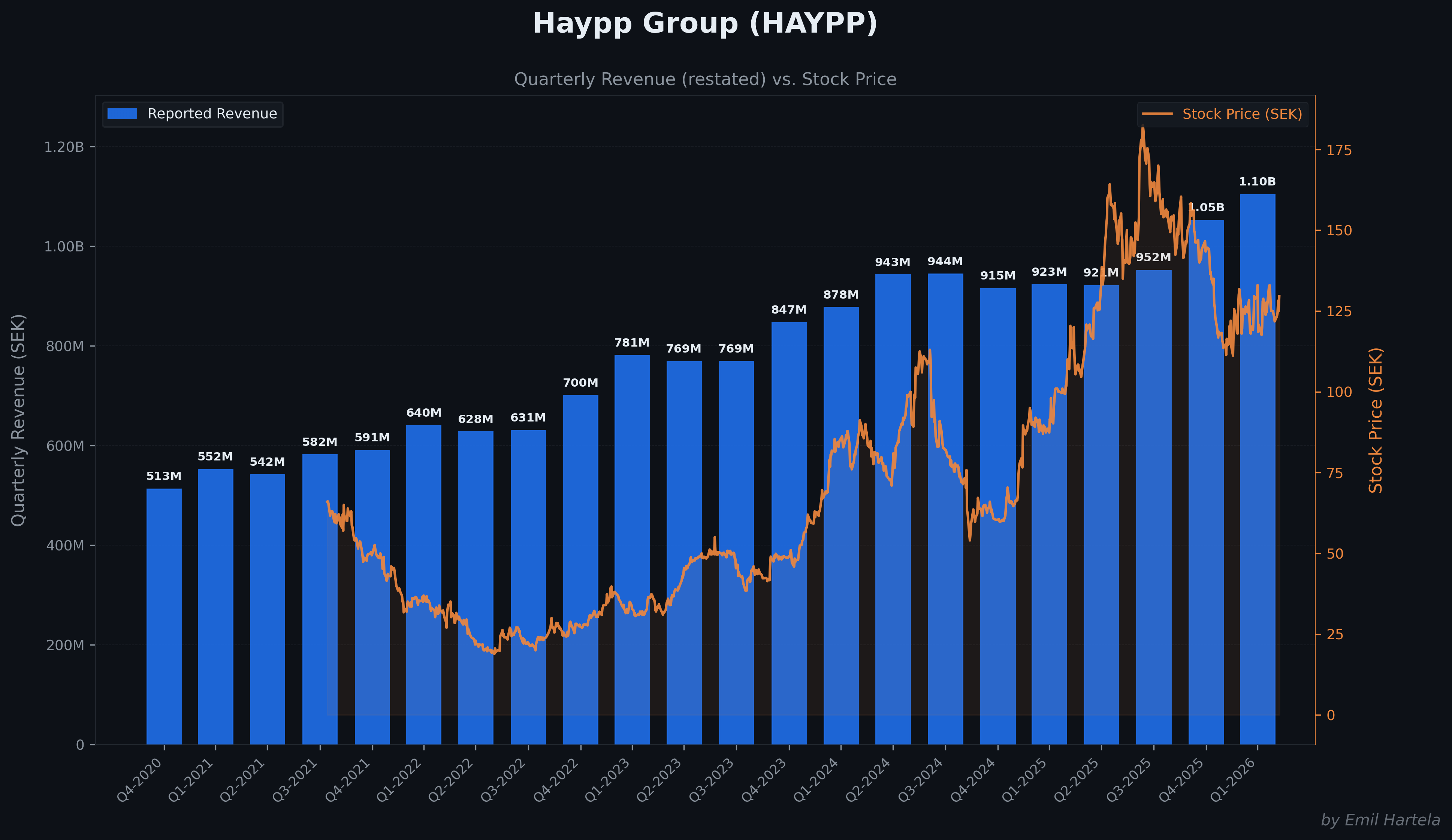
This is where most of my work on Haypp has gone over the last year. I have built two parallel models for nowcasting Haypp Group’s quarterly revenue: a hand-made model that triangulates web traffic across all of Haypp’s sites with seasonality and mix adjustments, and a machine learning model that takes the same underlying signals and runs them through a more systematic framework.
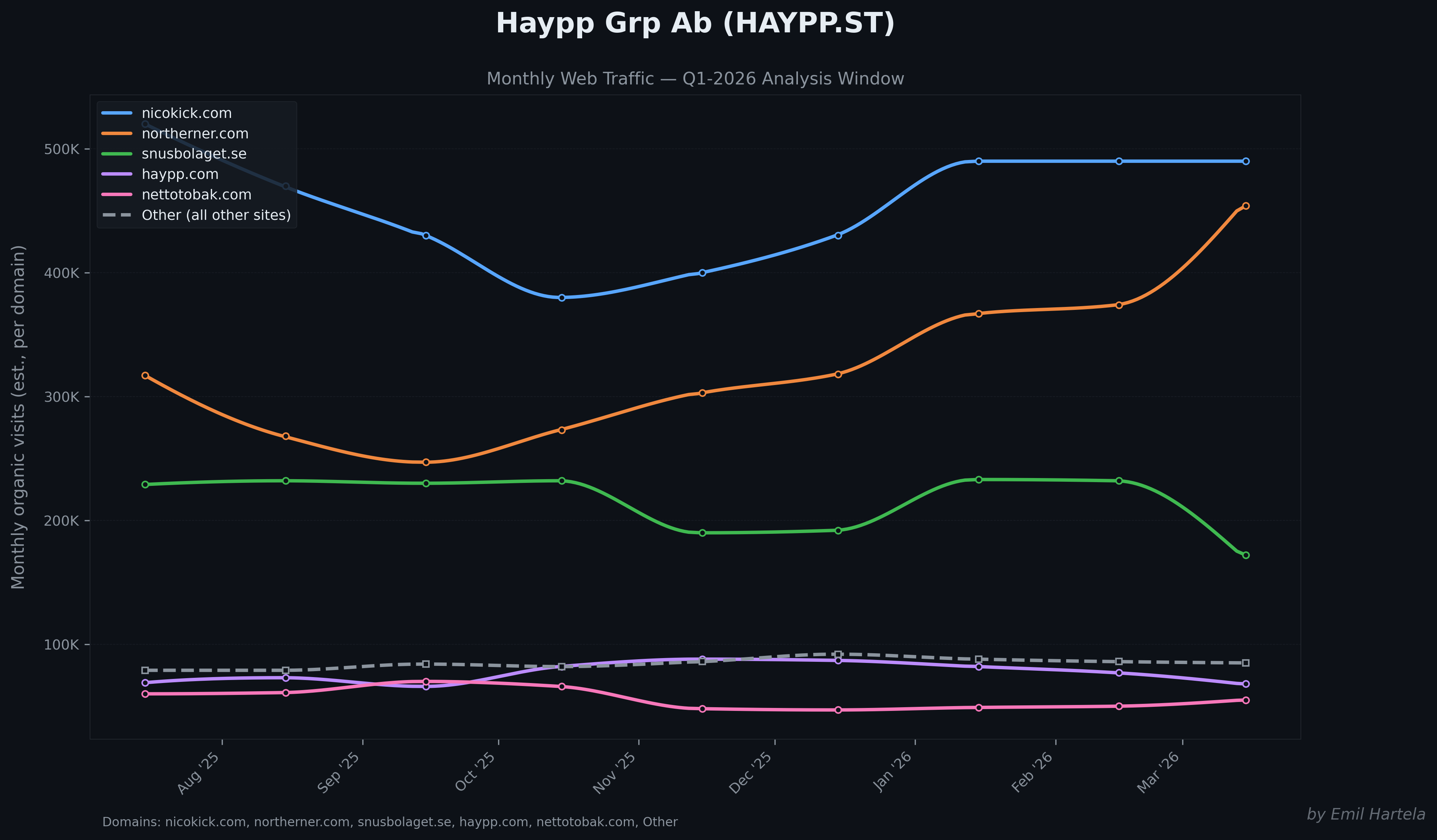
The track record has been better than I expected. Over the last four quarters both models have landed within a tight band of reported revenue, and the precision keeps improving as I add data and refine the methodology. The Q1 2026 print is the cleanest example yet: actual reported revenue came in at 1.104 MSEK; my hand-made model predicted 1.106 MSEK; the ML model (pre segment change) predicted 1.103,5 MSEK. Both within 1% of the actual number. That is unusual for any equity, let alone a small cap.
What makes Haypp uniquely well-suited to web-traffic nowcasting is the channel structure. Haypp is a pure-play online retailer with no offline channel masking the signal; nearly every cent of revenue passes through a site I can monitor. The category is also high-frequency repeat purchase, which smooths out noise; and the data feeds I rely on (SimilarWeb as the primary, DataForSEO and SEMrush as cross-checks) all converge on the same underlying truth. The result is a small-cap stock where you can effectively read the quarter weeks before the report drops.
This matters for two reasons. First, in a name this volatile, knowing where the print will land before the market sees it is a meaningful informational edge. Second, the nowcast also tells you something about the trajectory inside the quarter; if web traffic is accelerating into the back half, the next quarter looks different than if it is fading. Most investors in Haypp are reading the press releases; the nowcast lets you read the company.
If you want to follow Haypp closely, this is the part of my work that pays off most directly. I publish monthly updates on Haypp’s web traffic and quarterly nowcasts ahead of earnings; subscribe to never miss a post.
Valuation
Valuation; how to think about it
I am not doing a full valuation here; instead I want to lay out the assumptions that matter if you build your own DCF. Start with margins. Picking apart today’s margins is not very useful; the focus should be on where they land in five years. Right now the goal is to win the market; the lower Haypp can price, the faster online takes share from the whole category. Pushing margins too early just slows that process; I see no reason to do that yet.
So what could margins look like later. My view is that the Media & Insights layer lets Haypp capture profits far above typical retail; add in regulatory know-how at scale and the operating leverage from search; and you get a setup where normalized margins can be surprisingly high for an online reseller. My base case is a 10 percent net margin in steady state. The structural advantages that Haypp’s data brings make that level achievable in my view.
The longer-term case is even stronger. As M&I scales from sidecar to second pillar, the profit pool tilts toward higher-margin revenue with software-like operating leverage. I believe that over time M&I alone can drive Haypp to a 10% FCF yield run-rate at maturity; not as a stretch case, but as a realistic outcome of what the data layer is structurally capable of producing once the self-serve and programmatic side scales. Combine that with the retail engine that funds the moat, and you get a business that looks very different from a typical online reseller.
For sizing revenue growth I treat it like a big Fermi problem. A mature user can consume up to one can per day; the practical average is likely closer to one every second day. The product is superior to cigarettes in almost every way; so it is reasonable to assume that a similar share of the population that once smoked will use nicotine pouches in the future. That implies 20 percent of the population or more; with adoption spread across both genders, which widens the addressable base.
Remember that Haypp also sells vapes; but the main driver is pouches. Then layer in the lag effect between total category growth and online penetration. The United States has roughly 3 percent online penetration today; Sweden sits around 36 percent; simply closing part of that gap can create multi-year growth spurts for Haypp even before total category growth is considered.
Given this setup I would not be surprised if Haypp exceeds its own 18 to 25 percent CAGR target; at minimum the high end looks achievable. That range likely fits a longer horizon; near-term years can overshoot as cohorts mature and online mix catches up. I am very optimistic; in my view the global market will rise above USD 100 billion over time.
Discount rate and multiple; what the FDA shift changes
Discount rate is tricky. Haypp is a small cap on First North; liquidity is thin; the business carries real regulatory and execution risk; so a high WACC is reasonable. There are no clean comparables; beta-based formulas will mislead; and peer sets do not help much. I personally use a discount rate close to 20 percent.
What is changing is the multiple the market can credibly assign. The FDA’s posture through 2025 and 2026 (PMTA authorizations for ZYN and on!Plus, the accelerated pouch pilot, and the May 2026 enforcement guidance) materially de-risks the US category at the federal level. That matters for valuation because regulatory tail risk has historically been the single biggest reason investors apply punitive multiples to Haypp. As that tail compresses, the discount required to hold the stock compresses with it. A more constructive US regulatory backdrop opens the door to a higher steady-state multiple than what the market currently uses.
The simple valuation case
Here is the simplest version of the case. Haypp’s own 2028 financial targets imply roughly 8.000 MSEK in revenue at the midpoint of their growth range, with an adjusted EBIT margin of 5,5% (+/- 1,5%). At those numbers you get adjusted EBIT in the ballpark of 440 MSEK at the midpoint; somewhere between 320 and 560 MSEK across the range.
Apply a 15 to 20 times multiple (reasonable for a business with a long growth runway, structurally improving margins, an M&I layer with software-like scaling, and a de-risking regulatory backdrop) and you get a market cap somewhere around 6.600 to 11.200 MSEK. That is roughly 3x the current valuation. And this is before you give any credit to the longer M&I FCF trajectory or to upside above the 2028 targets, both of which I think are realistic.
Where the value actually sits
Almost all of the DCF value lives in the US and UK. Sweden and Norway are profitable cash generators but mature; they do not move the long-term valuation needle. Germany, Austria, and Switzerland are interesting optionality, but the combination of regulatory friction (France is the worst case, Austria is the most recent example) and slower adoption means they sit second-tier in the model.
The US and UK are different. They are early in the category curve, they have constructive (US) or improving (UK) regulatory backdrops, and online penetration is still a fraction of where it will land. They are also more profitable per customer than most assume, because competition is thinner. In mature markets like Sweden, Haypp competes against entrenched offline incumbents and other online specialists; in the US and UK, the competitive landscape is much weaker, which means better unit economics, cleaner basket economics, and faster payback on customer acquisition. The US and UK do not just drive volume growth; they drive a profitability mix shift that pulls group margins up structurally.
S-curve modelling
When valuing Haypp, I find it useful to think in terms of logistic growth curves. In practice, this means estimating when each market will hit peak growth, while also making assumptions about online penetration and margin development. With these three components (market growth, channel penetration, and profitability) you can build a rough framework that mirrors the natural S-curve of adoption.
From there, you discount the theoretical cash flows for each region and layer on scenario adjustments, such as the potential for outright bans in certain countries. This approach does not give a single-point valuation but a structured way of framing the upside and downside paths. I plan to write a separate Haypp valuation blog that dives deeper into this methodology.
Valuation summary
All in all, I think Haypp has more growth ahead than most investors expect, and its long-run margin potential is stronger than the market is pricing in. The 2028 targets alone, applied at a reasonable multiple, support roughly a 3x re-rating from today. The longer-term M&I trajectory adds another layer on top. And the US and UK concentration of value means a single year of strong execution in those two markets can change the picture materially.
There is a simple case to be made that this stock can deliver roughly 30% annualised returns over the next three to four years. That does not require heroic assumptions; it requires Haypp to hit something close to its own targets and the market to assign a multiple that reflects the de-risking US regulatory backdrop and the M&I trajectory. Neither of those feels like a stretch.
Important events
When looking at Haypp it is important to remember this is a business where negative headlines show up regularly: lawsuits, license reviews, shipping restrictions, supplier hiccups. That noise is part of the category. In this section I cover the ongoing and recent items that actually matter for Haypp and what they change, if anything.
The FDA shift; the most important regulatory development
The single most important development since my last deep dive is the FDA’s evolving posture on nicotine pouches. The agency has been steadily building a constructive framework.
In January 2025 the FDA authorized 20 ZYN products through the PMTA pathway; the first time nicotine pouches received marketing authorizations. In December 2025 the agency authorized six on!Plus variants from Altria as the first decisions out of its accelerated nicotine pouch pilot program, completing the review in record time. Then on May 8, 2026 the FDA issued new guidance saying it will not prioritize enforcement against unauthorized pouches and e-cigarettes whose marketing applications have been under review for 180 days or more. The message to industry is clear: legitimate applicants under review get to keep operating while the FDA focuses enforcement on the worst illicit actors.
Taken together, this is a meaningfully more constructive backdrop than what was in place six months ago. The FDA is operating as a pragmatic harm-reduction regulator at the federal level; pouches are being authorized in batches; the pilot program is accelerating future decisions; and enforcement resources are being directed at the grey market rather than at compliant operators. For Haypp this lowers regulatory tail risk in the most important growth market in the world.
Some US states will keep going their own way (the proposed 75% wholesale tax in New York is the most aggressive example), so local exceptions will continue to pop up. But the national stance does not look hostile; it looks supportive.
ZYN supply normalized; the supplier mix is healthier
When I wrote the original deep dive, Haypp had just secured a direct distribution agreement with Philip Morris to bring ZYN back to Nicokick and Northerner. That has now played through. ZYN is fully restored on the US sites, the direct PMI relationship has held, and the supplier mix has materially diversified. On!Plus from Altria, Velo from BAT, Zone, and other brands have scaled aggressively over the last year, taking share from ZYN and reducing the single-supplier risk that defined Haypp’s US business in 2024 and 2025.
PMI’s own Q1 2026 reporting showed ZYN shipment volumes down 23,5% as channel inventories normalized, while ZYN offtake (actual consumer purchases) grew 10%. This noise is to be expected as the market matures; the underlying picture is that the US category is becoming structurally healthier with more suppliers competing for shelf space. That is a better world for Haypp.
The new US division
Effective January 9, 2026 Haypp established the US as a standalone P&L under a dedicated President; Gabriel De Prado, the group’s former CCO, moved into the role. This is more than a title change; it reflects the strategic reality that the US is now the largest single growth opportunity in the group, and management is organizing around that reality. The same announcement moved Svante Andersson into the President of UK role; in one stroke Haypp put its two most senior commercial and operational executives in charge of its two highest-priority growth markets.
France ban came into effect; Belgium and Netherlands remain closed
The French ban came into force on April 1, 2026. It bans the manufacture, sale, import, and possession of nicotine pouches. A French manufacturer (EVLB Group) challenged the decree and France’s Council of State partially suspended the manufacturing and export ban pending a full ruling expected by June 2026, but the marketing and retail ban remain in effect. Haypp had no business in France going into this, so the direct revenue impact is zero; the indirect signal is that the EU regulatory landscape remains brittle.
Belgium banned nicotine pouches in 2023 and the Netherlands followed; both markets remain closed to compliant online retailers. This is part of the broader pattern: France, Belgium, and the Netherlands have outright bans; Austria reclassified pouches as tobacco products and pulled them into licensed tobacconist channels from mid-2026, prompting Haypp to exit Austria entirely (less than 1% of group revenue). Germany is using regulatory workarounds; Denmark is moving to flavor restrictions and a 9 mg cap from April 2026; the UK is moving toward a 20 mg cap through the Tobacco and Vapes Bill (Haypp has voluntarily adopted that cap already across its UK e-commerce platforms).
The pattern is clear; EU expansion is hard and getting harder. The US and UK look better and better by comparison.
UK vape division wound down
On January 1, 2026 Haypp exited the UK vape and heated tobacco markets entirely. VapeGlobe UK was wound down so the group could refocus resources on oral pouch products, where the structural growth is stronger and the unit economics are better. VapeGlobe DE remains as the group’s vape footprint and was folded into the Growth segment under the new two-segment structure. This is good capital discipline; vapes were never the core thesis, and freeing up management bandwidth to focus on pouches in the UK and US is the right call.
Sweden license episode; still ongoing, but the impact is small
The Sweden license dispute with the City of Stockholm has continued through the courts. In June 2025 the Administrative Court allowed Snusbolaget Norden AB to continue operating under a warning. That decision was appealed; on January 30, 2026 the Administrative Court of Appeal ruled the other way and upheld the original revocation of the tobacco sales license. Haypp has stated it intends to appeal further to the Supreme Administrative Court.
Two things to remember. First, the dispute covers only traditional tobacco products (snus), not nicotine pouches, which are regulated under a separate 2022 law in Sweden. Second, Snusbolaget Norden AB now accounts for less than 1% of group net sales. The company itself does not expect a material financial or operational impact regardless of how the final appeal resolves. The episode is more important as a signal of how Swedish municipalities interpret age verification rules than as a financial event.
San Francisco lawsuit settled
The San Francisco City Attorney’s lawsuit against Northerner Scandinavia Inc was settled in October 2025 for USD 2,5 million, of which USD 1 million was already reserved. The remaining amount was reported as a comparability affecting item in Q3 2025. This is done; California-related disruption is now in the rear-view mirror, and shipping policies have been adjusted accordingly. Worth noting as context, not as an ongoing risk.
Caffeine pouches; a small but interesting extension
In March 2026 Haypp launched caffeine pouches across its UK and Scandinavian e-commerce sites; the first nicotine-free category in the portfolio. Sales are minimal so far, but the move is strategically interesting. It uses the same fulfillment, age-verification, and merchandising infrastructure to test a wellness-adjacent category that does not carry nicotine regulatory risk. If it scales it diversifies the revenue base; if it does not, it cost very little to find out.
Ownership; who holds the keys
Haypp’s register is tight. The top ten holders control roughly two thirds of capital and votes; the rest sits in broader hands. The largest positions are GR8 Ventures AB (Linus Liljegren’s vehicle, around 12 to 13 percent), Patrik Rees through his company at roughly 12 percent, Fidelity Investments around 10 percent, and Northerner Holding AB around 10 percent. Below that you have Wellington Management, Robotti & Company, Ola Svensson, Erik Selin, CEO Gavin O’Dowd, and Caro-Kann Capital each holding meaningful positions in the low-to-mid single digits.
Two takeaways. First, ownership is concentrated among informed, long-horizon holders who have shown limited interest in selling despite the volatility; that reads as conviction and aligns incentives. Second, float is thinner than the headline market cap implies; with roughly a third of shares in broader hands, the share price can move sharply on both buying and selling pressure.
Volatility and trading dynamics
When looking at Haypp it is important to remember that the stock is volatile. It is not a large company and it trades on First North; access is limited for many investors; liquidity is thin. As a result the share price reacts very strongly to negative headlines; but it usually corrects just as quickly. I have personally added multiple times on larger drawdowns; so far the stock has tended to recover within a week or two after bad news.
The trading is not always rational. Multiples expand and contract aggressively; sentiment swings amplify every move. I would not be surprised to see the stock halve or double in the short term without any real fundamental change.
The stock came down meaningfully from its highs as some of the broader nicotine pouch sector hype cooled. The category as a whole had been priced for continued explosive US growth; when the headline volume numbers slowed and PMI’s ZYN shipments came in noisy through 2025, sentiment across the entire pouch complex compressed. Haypp got dragged down with the sector even though the underlying business kept executing. That is exactly the kind of mispricing that creates entry points; a quality compounder priced like the category, not like the company.
Investor interest; who is watching
I have been writing about Haypp actively for over a year now; interest has been steady and broadening. The watchers fall into two clear groups.
The first group is private investors and smaller boutique funds. Inbound here is consistent and the audience is unusually diverse for a Stockholm small-cap; alongside the natural Swedish private investor base, I see roughly equal engagement from Asia, the US, and the Middle East based on my own conversations.
The second group is more interesting. Real institutional interest comes primarily from funds that are free enough from mandate constraints to go into illiquid small caps; the ones who can actually hold a name like Haypp without forcing index inclusion or daily liquidity. There is a real and slowly growing presence among bigger funds in this bucket; not yet a wall of capital, but a measurable lurking demand. The larger long-only institutions I have spoken with often cannot touch the name yet (market cap, liquidity, First North listing constraints, simple unfamiliarity), but they are watching. When any of those constraints ease (a main-market uplisting being the most obvious unlock) that audience can convert into real flows fast.
The pattern reminds me of the early phase of any small cap that eventually re-rates; the smart money is already positioned or watching, and the broader institutional base is waiting for the green light.
Catalysts
Since my last writeup the catalyst stack has shifted meaningfully. Here are the ones I think actually drive the next leg of the story.
First catalyst: uplisting from First North to the main Swedish market
This is the single most important near-term catalyst and I think it is likely to come reasonably soon. An uplisting from Nasdaq First North to Nasdaq Stockholm’s main market is transformational for a name like Haypp; broader broker access, improved liquidity, tighter spreads, and crucially, the ability for larger funds with mandate constraints to actually build positions. A lot of the real institutional money I described in the previous section is sitting on the sidelines specifically because Haypp is on First North. That barrier removes itself the day Haypp uplists.
In my view Haypp is approaching the threshold where re-rating risk tilts firmly to the upside. The stock can grind higher in anticipation, and a single uplisting announcement could flip the story into wider recognition and substantial valuation expansion. This is the catalyst I would not want to be short into.
Second catalyst: the FDA impact and category reheating
The FDA’s May 8, 2026 enforcement guidance, on top of the on!Plus authorizations in December 2025 and the broader ZYN PMTA work through 2025, materially de-risks the US category at the federal level. Regulatory tail risk has been the single biggest reason the entire nicotine pouch complex has traded at compressed multiples; as that tail compresses, the discount the market applies to the whole category should compress with it.
I think it is quite likely that the category as a whole reheats as the FDA’s pragmatic harm-reduction posture makes pouches genuinely investable for a wider base of institutional capital. New products keep getting authorized, demand keeps growing, and the regulatory backdrop keeps improving. When sector multiples expand, Haypp expands with them; when they expand and Haypp is also executing, you get the multiplicative effect.
Third catalyst: Swedish retail flows and First North sentiment
Haypp’s share price is sensitive to Swedish retail investor flows. When Swedish small caps go in favor, Haypp gets pulled up with them; when they go out of favor, it gets pulled down disproportionately. The First North index as a whole has come down brutally from its pandemic-era peaks, which mechanically depresses every name on the venue regardless of fundamentals. Any meaningful return of risk appetite to Swedish small caps is a structural tailwind for Haypp specifically. This is not a fundamental catalyst, but it is a real one; sentiment in the Swedish retail base shifts faster than most people expect, and when it shifts, illiquid First North names move violently.
Fourth catalyst (longer dated): a US listing
A US listing is genuinely transformational but it is not a near-term event. My view is that this likely sits in the 2028 to 2029 window, when group revenue is large enough to support the additional costs of being dual-listed and US-mix is large enough to make it economically obvious. When that listing eventually happens, it unlocks an entirely different investor base; US retail participation, US institutional access, and a re-rating to multiples that reflect US growth-stock peers rather than Stockholm small caps. Worth keeping in the calendar but not something to underwrite the next eighteen months around.
Risks to the catalyst path
The risks have not disappeared. Supplier concentration remains, even though the mix is healthier than it was a year ago; if something goes wrong with PMI or ZYN again, the stock sells off. Sector risk still matters; if tobacco or pouch multiples compress, Haypp gets dragged down regardless of execution. Litigation and regulatory headlines will continue to surface from time to time, and given Haypp’s illiquidity, drawdowns can overshoot fundamentals badly.
The simple case
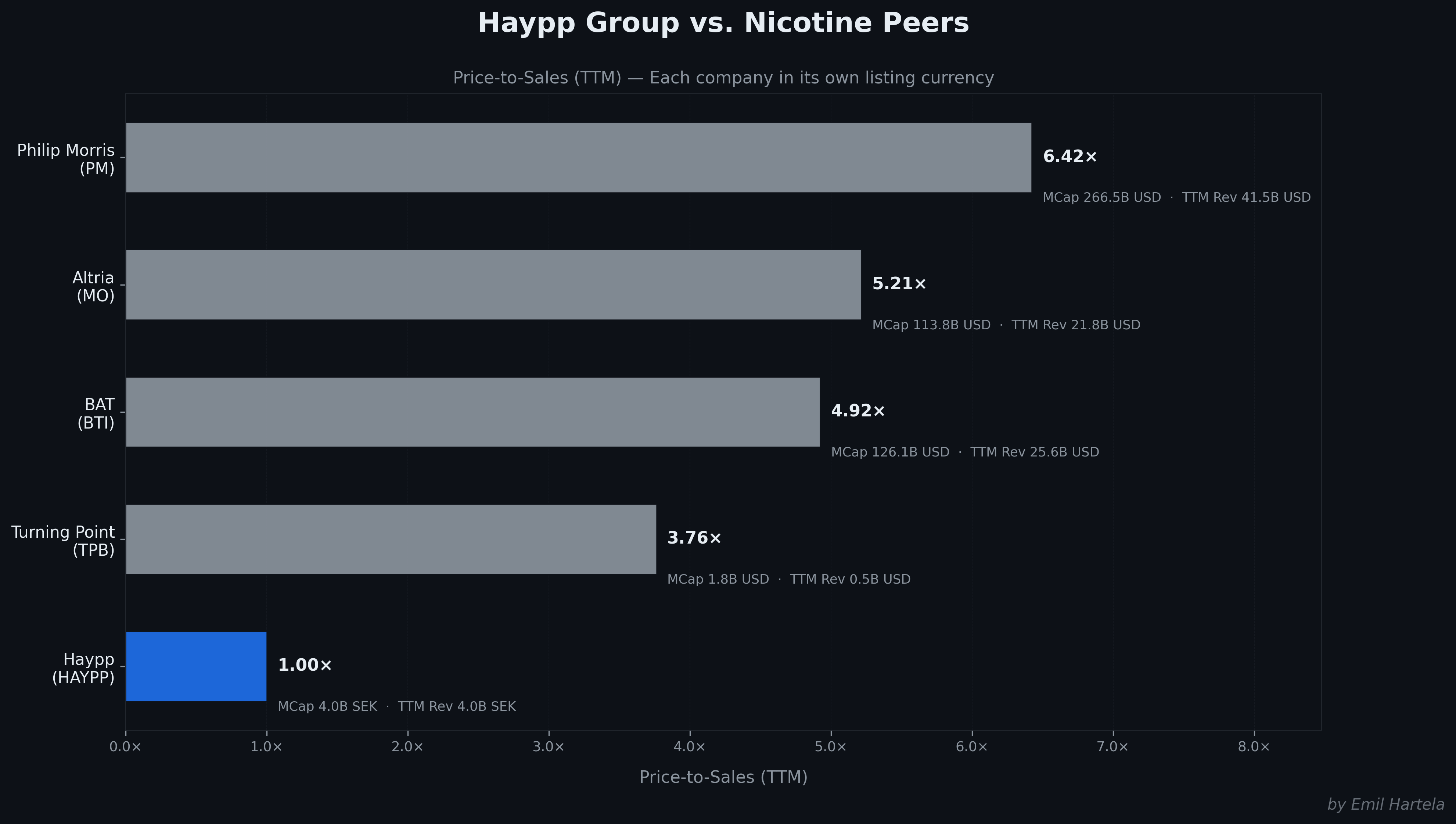
Today Haypp trades around 1x sales. The combination of the First North uplisting, the FDA-driven sector reheating, the eventual US listing, and Haypp’s own execution toward its 2028 targets points to a credible 2 to 3x re-rating path. If the company keeps printing clean US growth and margins hold up as expected, the market can quickly shift from treating Haypp like a First North micro-cap to paying up for what it actually is: a growth compounder with structural data advantages and a long runway in two of the best nicotine pouch markets in the world.
Where to start if you want to dig in
If you are interested in Haypp and wonder where to start, I strongly recommend their Capital Markets Day presentations; they consistently contain the highest signal-to-noise ratio of any material the company puts out. Many of the visuals and frameworks in this blog originated there. Next, work through the recent quarterly reports and earnings calls. For something more niche, find one of the more recent fireside chats on YouTube; Robotti has hosted several and there are quite a few if you search for Haypp Group.
Beyond Haypp’s own materials, the most useful ongoing coverage you will find anywhere is on my Substack. I publish monthly web traffic updates, quarterly nowcasts ahead of earnings, and ad-hoc pieces whenever something material happens with the name. If you want to follow Haypp seriously, subscribing is the simplest way to stay current.
Closing thoughts
Writing this updated Haypp deep dive has been a useful exercise. A lot has changed since the original; the segment structure was unified, the executive bench reshuffled, ZYN supply normalized, the FDA materially de-risked the US category, France banned, Austria followed, the UK vape division was wound down, and the company kept executing through all of it. The thesis is intact and in several ways stronger than it was six months ago.
There is still a huge amount about Haypp that gives me conviction, and I could keep writing for much longer. If I missed anything important, ask me.
On a personal note
I will keep covering this name closely. Right now is one of the more interesting moments to be following Haypp in the last two years; the stock is not euphorically priced, the sector hype has cooled, and several real catalysts are stacking up just out of view. That combination (a quality compounder with structural advantages, trading at a reasonable valuation, with multiple legitimate paths to re-rating) does not appear often in this kind of name. I plan to be writing about Haypp consistently through the next phase of the story, so if you want to follow it with me, subscribing now puts you in front of the next round of updates.
Haypp Watch: Q1 2026 Recap and Prediction Review

Haypp Group reported Q1 2026 earnings this morning, and the headline read is simple: this was a very expected quarter, with very strong underlying numbers. Net sales came in at 1 104 MSEK, up 20% YoY on a reported basis and 24% in constant currency. Core Markets continued to deliver solid growth, the US and UK remained the engines of the Growth segment, and momentum was broad across the platform. Active consumers reached an all-time high of 652 thousand. Nicotine pouch volumes grew 40% across the Group.
Haypp's M&I might be the entire story

I’ve recently been digging into Haypp’s M&I business based on their LinkedIn hiring, and I think I might have been slightly undervaluing the company. Let me explain.
Disclaimer
This is not financial advice; for informational and educational purposes only; not a recommendation to buy or sell any security. I am currently long Haypp Group (HAYPP); I may buy, sell, or change my position at any time without notice. I am not compensated by Haypp or any competitor; all opinions are my own. Estimates and forward-looking statements are based on my assumptions; they can change; outcomes may differ. Do your own research; consult a licensed advisor before acting. Investing involves risk; past performance is not indicative of future results. Accuracy and completeness are not guaranteed.