

I’ve written quite a bit about Canatu, but I’ve never actually taken the time to do a proper deep dive. Now seems like an excellent moment to fix that.
The company has new management in place, several catalysts sitting just around the corner, and a technology that potentially puts it at a genuine chokehold in the chip supply chain. If you’ve only caught my scattered posts, this is the piece that pulls it all together from the ground up, what Canatu does, how it makes money, where the real risks are, and why the timing is interesting right now.
No speculation-for-its-own-sake here. Just the full picture, laid out plainly.
Quick foreword: This is a longer deep dive, around a 45-minute read. Be sure to subscribe if you want to come back and read it later.
Hope you find it valuable!
NFA.
Background: what Canatu actually is
Let’s start from zero, because Canatu sits in a corner of the market most people have never looked at.
The material: carbon nanotubes (CNT).
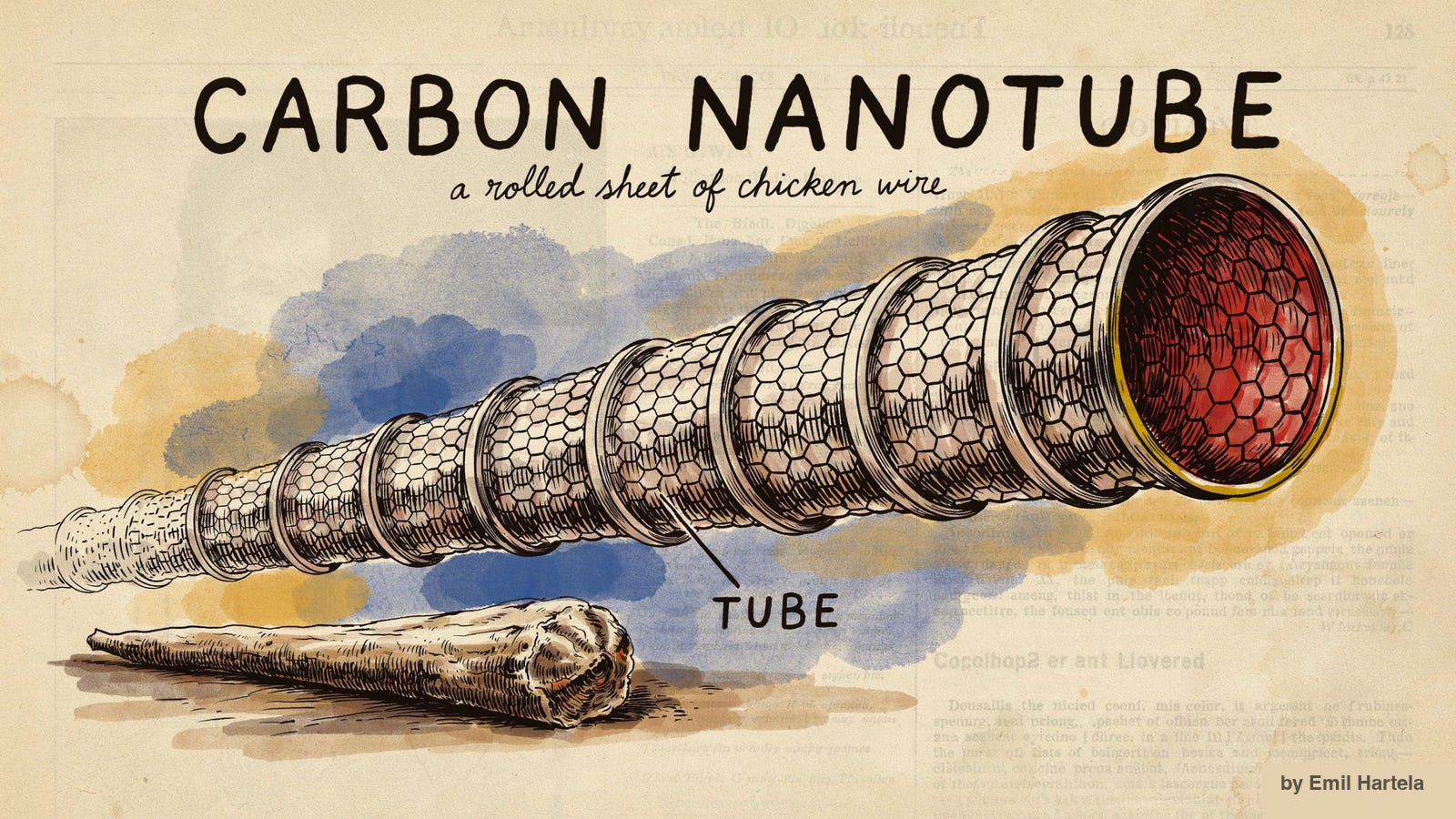
A carbon nanotube is exactly what it sounds like, a tube made of carbon, rolled up from a single sheet of graphene, about 100,000 times thinner than a human hair. Despite being almost unimaginably small and light, CNTs are extraordinary: stronger than steel, more conductive than copper, able to withstand temperatures up to 1,500°C, and nearly transparent. For decades they’ve been a “material of the future” that struggled to find applications where their cost was justified. The hard part was never imagining what CNTs could do, it was manufacturing them cleanly, consistently, and at scale.
That manufacturing problem is Canatu’s whole reason for existing.
The company.
Canatu is a Finnish nanotechnology company, spun out of Aalto University in 2004, based in Vantaa. Over roughly two decades and more than €80 million of investment, it developed and patented a distinctive way of producing CNT films, a “dry deposition” process. Without getting technical yet, the short version is that most competitors make CNT films using a wet, multi-step chemical process, while Canatu grows and deposits the nanotubes dry, in far fewer steps. Canatu’s claim is that this produces cleaner, stronger, higher-quality films, and does so more simply. That process, and the reactors that run it, are the crown jewels: protected by hundreds of patents and a set of trade secrets.
Canatu makes money in three broad areas, but one matters far more than the others: semiconductors. The other two, automotive (heaters for self-driving-car cameras) and medical diagnostics (early-stage biosensors), are real but secondary. The semiconductor business is the reason anyone is paying attention, and it’s where this piece will spend most of its time.
What they make for the chip industry.
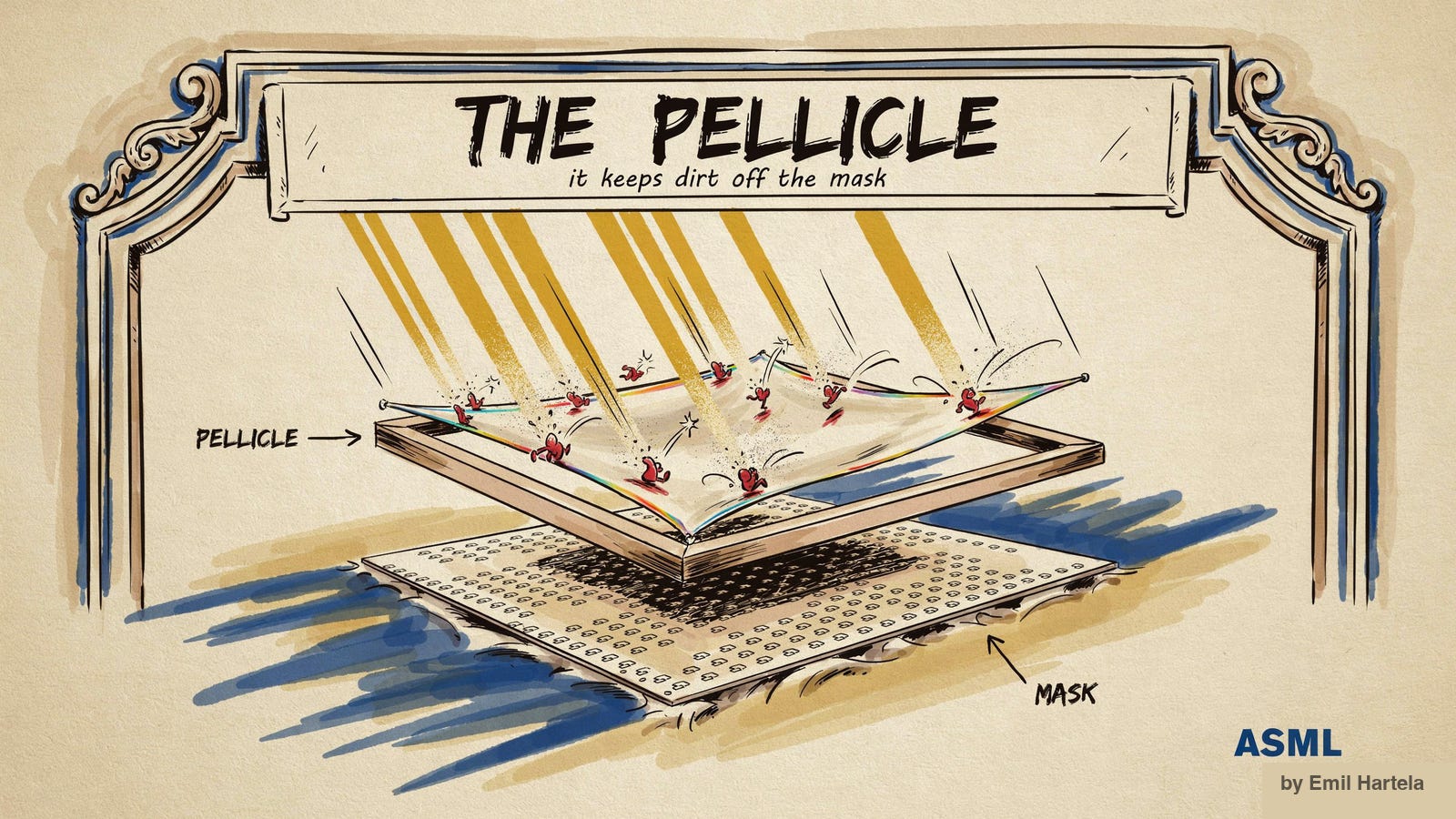
Here’s the one concept you need, and I’ll explain it properly later: a pellicle. When the most advanced chips are made, the pattern is projected through a photomask, an intricate, extraordinarily expensive template. If even a single speck of dust lands on that mask, it ruins every chip printed with it. A pellicle is an ultra-thin protective membrane, thinner than a soap bubble, stretched over the mask to keep contamination away.
The problem: as chipmaking machines get more powerful, the conditions inside them get so extreme, intense heat and a corrosive hydrogen environment, that conventional pellicle materials start to fail. Carbon nanotubes are one of the very few materials that can survive there. And Canatu doesn’t just sell the finished film; it sells the reactor that produces CNT pellicle membranes, along with a license and a royalty on every membrane that reactor makes. Sell the machine once, then earn a cut of everything it produces. We’ll come back to why that business model matters enormously.
The story: how Canatu got public.
For most of its life Canatu was a private, venture-backed company, the kind of long-horizon deep-tech bet that takes twenty years to mature. It reached the public market in September 2024 through a slightly unusual route: a merger with Lifeline SPAC I.
A SPAC (special purpose acquisition company) is essentially a pool of money raised on the stock exchange with no business of its own, its sole purpose is to find a promising private company and merge with it, taking that company public without a traditional IPO. Lifeline SPAC I was a Finnish blank-check vehicle backed by a circle of well-known Finnish investors. It raised around €100 million, went looking for a target, and in 2024 combined with Canatu. Through that deal, Canatu listed on Nasdaq First North in Helsinki (a lighter-touch growth market) and raised roughly €100 million to scale its business.
Two things worth knowing about that history, because they matter later. First, the SPAC structure left behind some quirks, warrants and other instruments that affect the share count as the stock rises, which we’ll cover. Second, the company came public with ambitious targets that it has since had to push out, part of why the stock has had a rough ride.
Where things stand today.
Canatu is a small company, roughly €250 million market capitalization, with about €90 million of net cash on the balance sheet, and it’s still early in commercializing its semiconductor business. Revenue actually fell in 2025 as reactor deliveries were delayed. Management has been substantially rebuilt over the past year, with a new CEO, CTO, and commercial lead brought in from the semiconductor industry. And the company is sitting on two installed reactors at two chip customers, one publicly known, one not, whose qualification is the hinge on which the entire investment case turns.
That’s the shape of it: a two-decade-old Finnish nanomaterials company, recently public via a SPAC, with a niche but potentially critical position in how the world’s most advanced chips get made. The rest of this piece unpacks each part, the technology, the business model, the market, the customers, the money, and the risks, and explains why the next few months are unusually important.
The technology, the business model, and the one thing it all hinges on
How advanced chips get made
To understand why Canatu might matter, you need a rough picture of how the most advanced chips are made. Stay with me, it’s simpler than it sounds.
Every cutting-edge chip, the processors in your phone, Nvidia’s AI accelerators, is built by printing unimaginably tiny patterns onto silicon wafers. The printing is done with light. You shine light through a patterned template (a “photomask” or “reticle”) and project that pattern, shrunken down, onto the wafer. Do this hundreds of times, layer on layer, and you build a chip with billions of transistors.
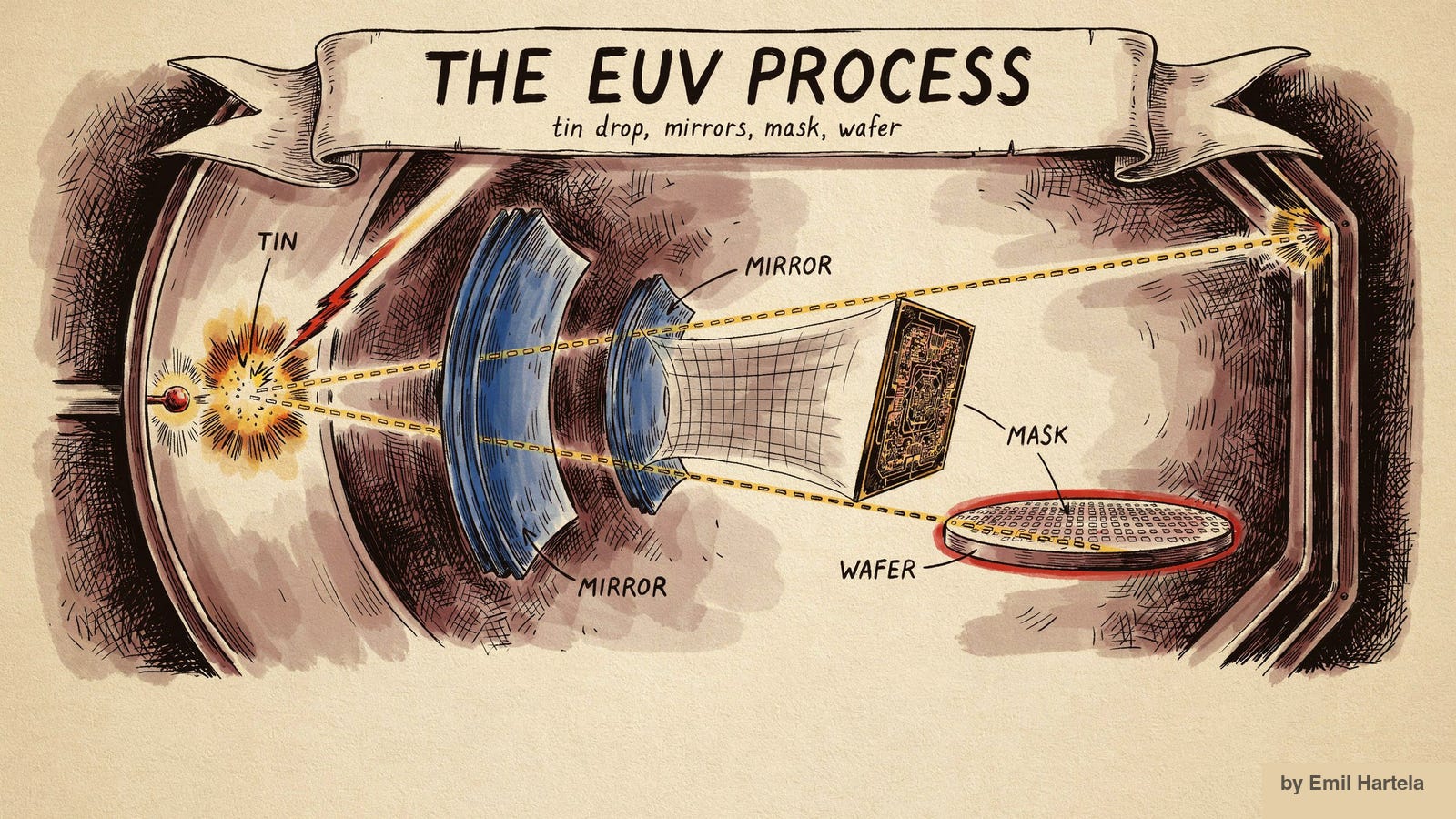
The catch is resolution. To print smaller features, you need shorter-wavelength light. The industry’s current frontier is EUV, extreme ultraviolet lithography, which uses light at a 13.5-nanometer wavelength, far beyond visible light. EUV is what makes today’s most advanced chips possible.
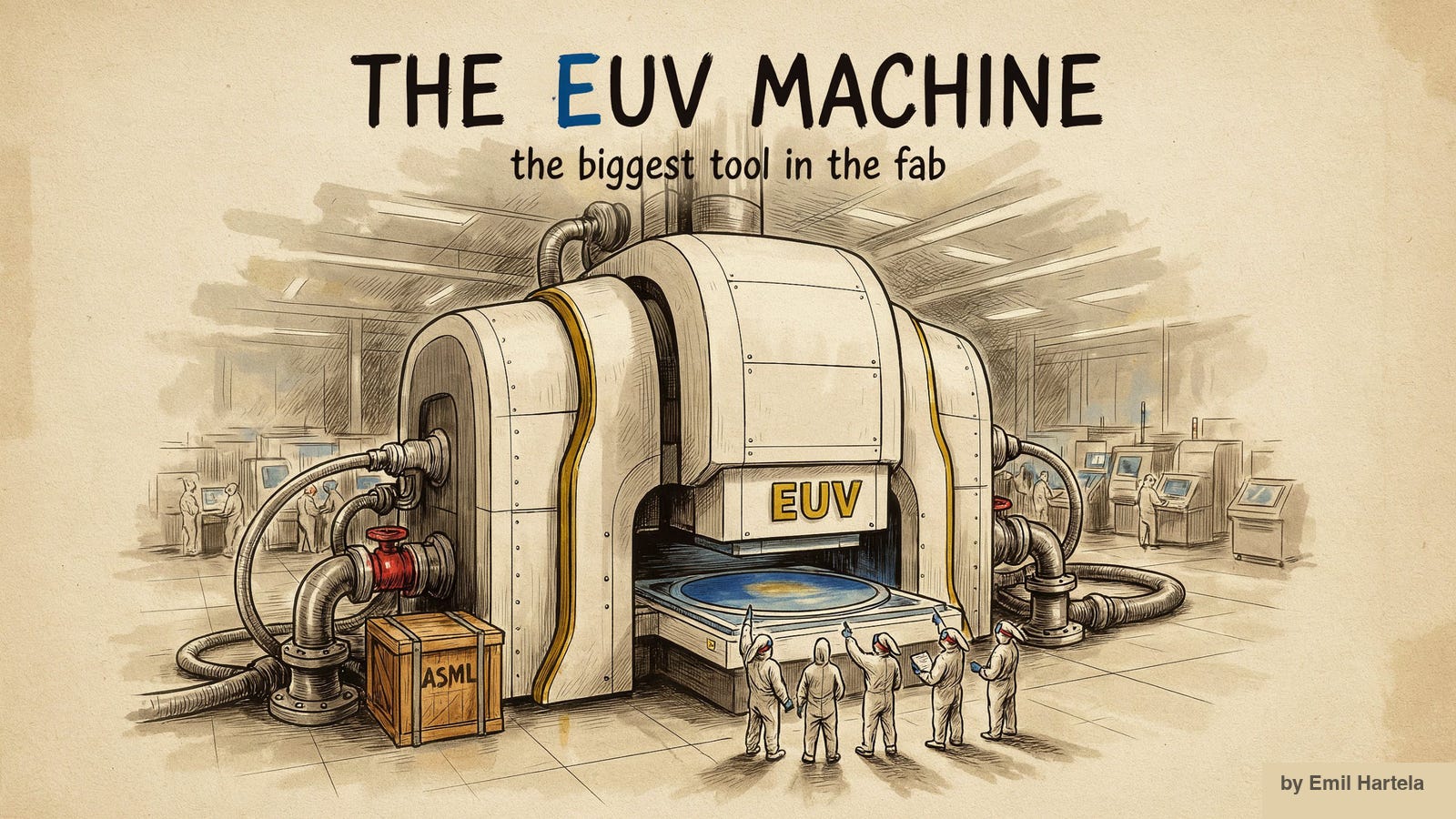
And here’s a fact that matters enormously for this whole story: there is exactly one company on earth that makes EUV machines. ASML, based in the Netherlands. Every advanced fab, TSMC, Intel, Samsung, SK Hynix, Micron, buys its EUV scanners from ASML. These machines cost well over €150 million each, and the entire leading edge of the semiconductor industry depends on them. When you hear about the chip supply chain being a chokepoint, ASML is the ultimate example. Canatu, as we’ll see, is trying to occupy a much smaller but conceptually similar position, one narrow spot that everyone has to go through.
Why the machines are getting harsher
EUV machines aren’t static, they get more powerful every generation, along two separate axes. Both matter, and people constantly confuse them, so let’s separate them cleanly.
Axis one: power. An EUV machine’s light comes from a source measured in watts. More power means the machine can print more wafers per hour, which is what makes it economical. Today’s machines run around 250 watts. The roadmap pushes this up hard, toward 400W, then 600W, then beyond. Rising power is the key trend to watch, and it’s the one this whole story hinges on.
Axis two: resolution, or “NA” (numerical aperture). This is about the optics, how wide a cone of light the lens can gather. A bigger lens (higher NA) resolves smaller features. The current machines are “Low-NA” (0.33). The next generation, “High-NA” (0.55), uses much bigger, much more expensive optics (around €350–400 million each) to print even finer detail. Intel has started using High-NA first; TSMC has said it will stay on Low-NA for its next several nodes on cost grounds, and Samsung has pushed High-NA out toward the end of the decade.
The crucial point, and this is where a lot of commentary gets it wrong: whether a fab goes High-NA or stays on Low-NA, source power is climbing toward 600W either way. High-NA machines are themselves a 600W-plus regime. And Low-NA machines are being pushed to higher power to squeeze out more throughput. So the harsh conditions are coming down both roads. You don’t need to bet on the High-NA timeline to believe power is rising, it’s rising regardless.
Why old pellicles stop working
Now back to the pellicle, the thin protective membrane stretched over the photomask to keep dust off. Remember, a single particle on the mask ruins every chip printed with it, so at these prices (a mask can cost hundreds of thousands of euros, a wafer tens of thousands), protecting it is essential.
The problem is that the inside of an EUV machine is a brutal environment, and it gets worse as power rises. Two things attack the pellicle:
Heat. The membrane absorbs some of the light’s energy as heat. At 250W it’s manageable. As power climbs toward 600W, conventional pellicle materials, thin films of polysilicon or similar, simply can’t take the thermal load. They deform, degrade, or rupture.
Hydrogen. EUV machines are filled with hydrogen to keep the optics clean. But that hydrogen, in this energized environment, chemically eats away at many materials over time, slowly destroying the pellicle.
So as the industry marches toward 600W and beyond, the old pellicle materials stop being good enough. The membrane needs to survive intense heat and resist hydrogen and stay almost perfectly transparent to EUV light, all at once. Very few materials can do all three.
Carbon nanotubes are one of them. Strong, heat-resistant, chemically durable, and highly transparent, exactly the profile the job demands. This is why the entire industry, ASML and imec (the leading research institute) included, has converged on CNT as the leading candidate for next-generation pellicles. And it’s why a small Finnish company that spent twenty years learning to manufacture clean CNT films suddenly finds itself potentially sitting on something the whole leading edge needs.
The business model: sell the machine, then tax the output
Here’s where Canatu’s setup gets genuinely interesting, and widely misunderstood.
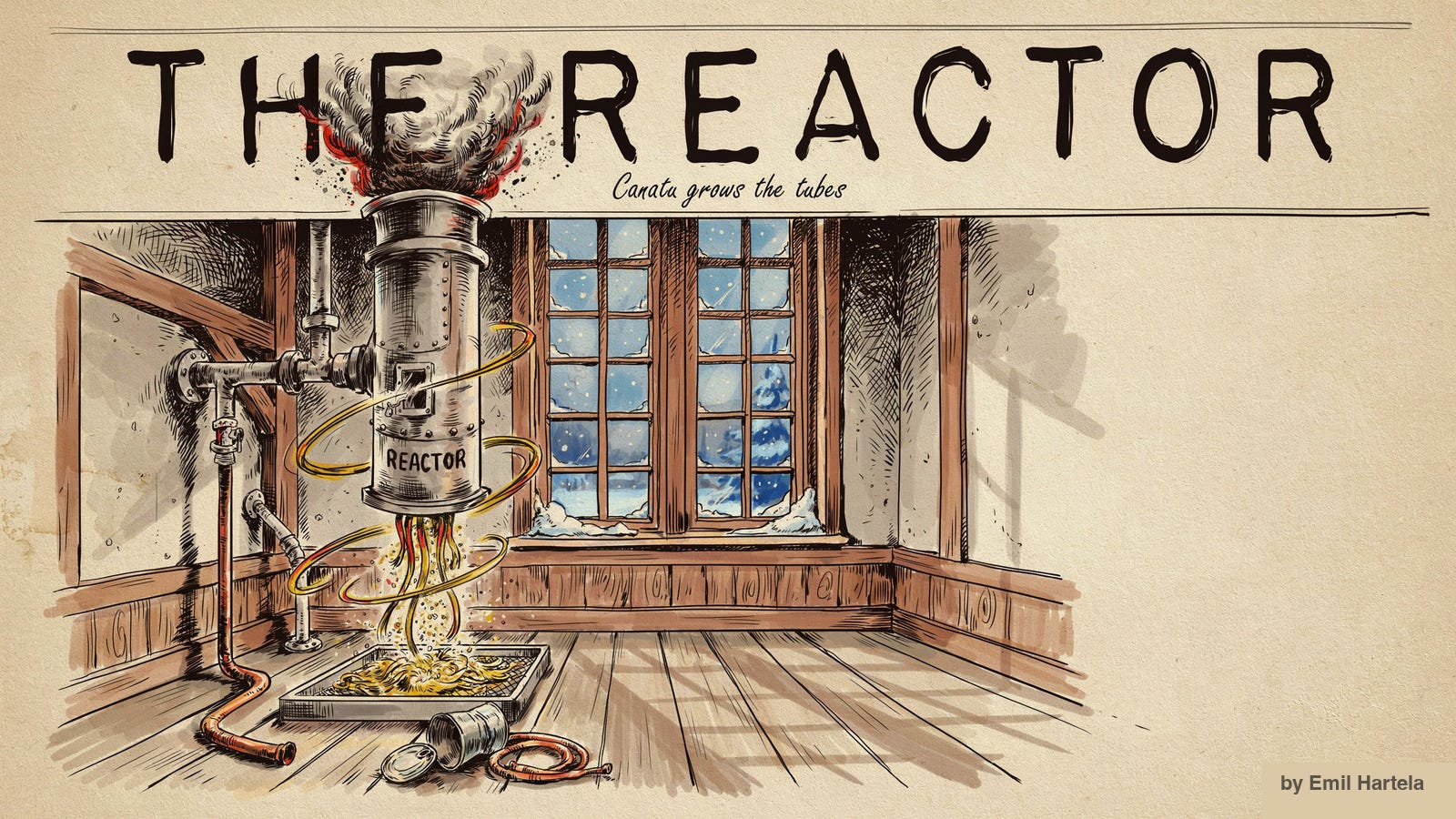
Canatu is not primarily trying to sell finished pellicles. Its stated model is to sell the reactor, the machine that produces CNT pellicle membranes, to the chipmaker (or its pellicle supplier), and then earn two recurring streams on top:
Royalties on every pellicle membrane that reactor produces, and
Consumables, the proprietary materials the reactor needs to keep running.
Think of it like selling a printer cheaply and then earning on every page it prints, forever, except the “pages” are consumed continuously by a customer who can’t run their multi-hundred-million-euro machines without them. You sell the reactor once (a one-time payment of several million euros), and then you collect a small, high-margin cut on a stream of output that never stops as long as the fab is producing chips.
Why does the model matter so much? Because it turns a piece of equipment into an annuity. A single reactor placed at a major fab isn’t a one-off sale, it’s the beginning of a recurring, high-margin royalty stream that can run for years, scaling up as the fab consumes more pellicles. And a large fab runs dozens or hundreds of EUV machines, each burning through pellicles continuously. The math on that, which we’ll get to, is what makes the current valuation look strange.
There’s also a strategic elegance to it. A giant fab like TSMC does not want to be dependent on a single outside supplier for finished pellicles, it likes to control its own production. Canatu’s model fits that perfectly: it sells the fab the machine to make its own membranes and keeps the downstream steps (coating, framing) in the customer’s hands. Canatu owns the one hard layer, the membrane synthesis, and lets the customer own the rest. That’s exactly the arrangement a control-obsessed fab is willing to accept.
So here’s the whole thing, made simple
Strip away every detail and it comes down to this:
The world’s most advanced chips are made by machines that are getting more powerful. As they cross a certain power level, the old protective membranes fail, and carbon nanotube membranes are one of the only replacements that work. Canatu makes the machine that produces those membranes, and gets paid a royalty on every one it makes.
So everything, the entire investment case, hinges on a single question:
Do the fabs adopt Canatu’s reactors, qualify them, and start paying royalties, or not?
Where things actually stand: two customers, two clocks
We ended the last section on the one question everything hinges on: do the fabs adopt Canatu’s reactors and start paying royalties? So let’s look at where that actually stands right now, because this is the live, unfolding part of the story.
Canatu has two reactors installed at two customers. They are at very different stages, and understanding both is the key to understanding the stock.
Customer one: FST (the known one)
The first reactor went to FST, a Korean company. This one is public and relatively well understood. FST is a pellicle maker, and its end customer, per Korean reporting, is Samsung, feeding Samsung’s advanced (2nm-class) chip production, including the big new fab in Taylor, Texas.
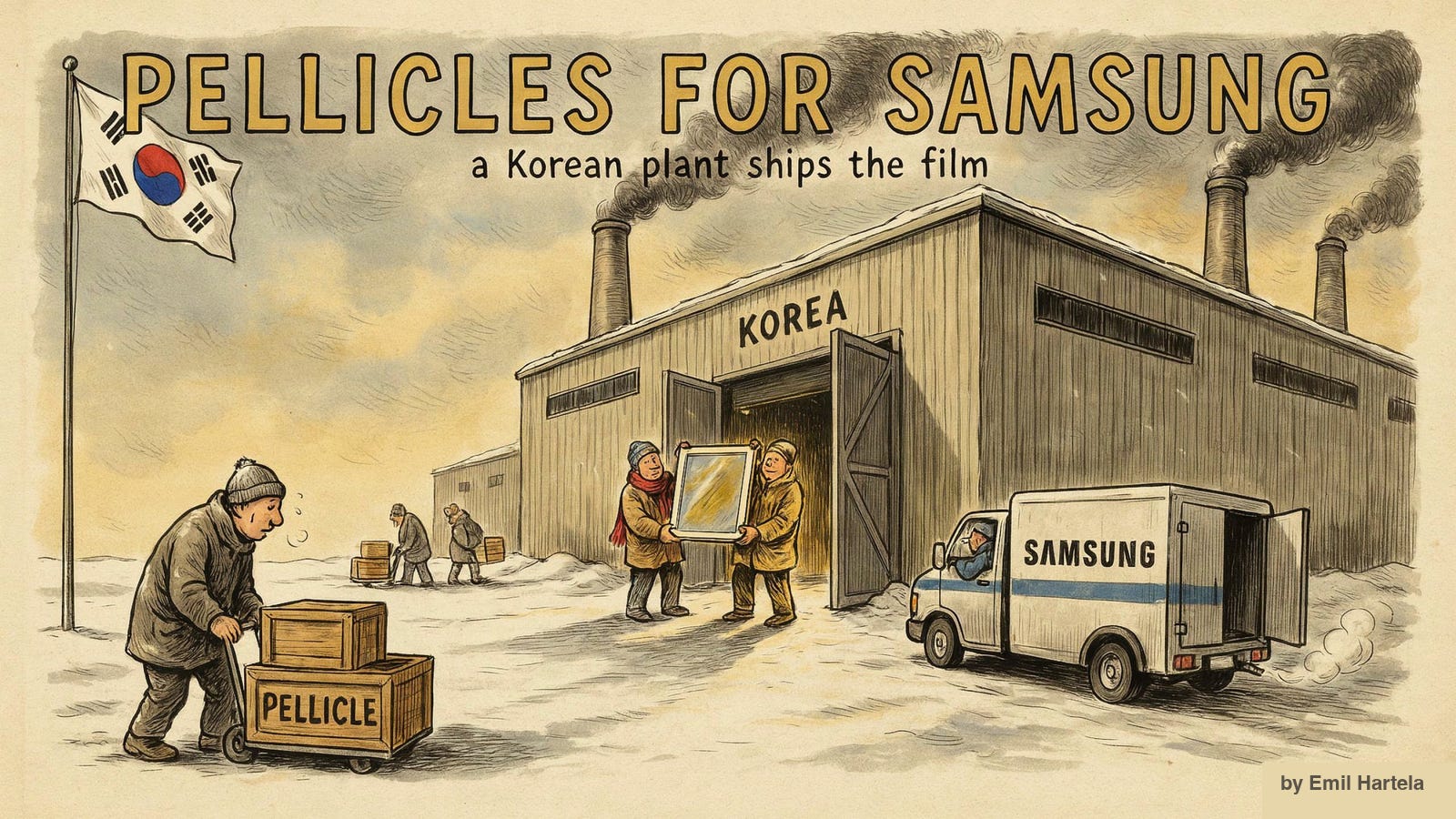
Here’s the encouraging part. FST’s reactor has already passed its major qualification hurdle. Remember from earlier that a reactor has to clear a series of acceptance tests, factory acceptance, then site acceptance (”SAT”), before it can move into real production. FST’s reactor completed SAT in mid-2025, roughly ten months after delivery, and Canatu even earned an early commercial license fee from it. FST is now moving toward pilot and volume production.
What’s the FST leg waiting on now? The final steps: full qualification of the finished pellicle in the actual production line, and the ramp to volume, at which point the royalties and consumables revenue we described start flowing. Management has publicly indicated that the first license payments from this production are expected to begin in 2026. So the FST leg is the nearer-term, more visible half of the story, it’s the one that proves the business model actually works and starts producing real recurring revenue. Watch it as the leading indicator.
Customer two: the unnamed “FOUNDRY” (the one that matters most)
The second reactor is where it gets interesting, and where most of the value, and most of the mystery, lives.

This reactor shipped from Finland in December 2024 to a customer Canatu will only describe as “a global semiconductor leader.” Its own investor materials label this customer “FOUNDRY.” The CEO confirmed on camera that it’s “a big semiconductor fab.” For over eighteen months, the company has never named it.
The realistic candidates are a very short list: TSMC, Intel, or Samsung’s foundry arm. And based on a fair amount of digging, which I’ve laid out in detail in a separate companion piece, I think the most likely answer is TSMC. I won’t rerun the full case here, but the short version is that the evidence points that way from several independent directions: the patent timing lines up almost too neatly, TSMC is publicly building an in-house pellicle facility that would need exactly this kind of machine, a Korean competitor’s CEO named TSMC out loud in an interview, and the just-retired Canatu CEO has spent his retirement publicly enthusing about one specific fab. None of it is proof. All of it leans the same way. (If you want the full evidence chain, read the companion piece; here, just hold it as “probably TSMC, not confirmed.”)
Now here’s why the identity matters so much, and why I keep saying this second customer can make or break the whole thesis.
FST/Samsung is a real, valuable leg, but on its own it’s a good business, not a transformational one. The second customer is the one whose fleet is large enough to turn Canatu’s royalty model into something enormous. If it’s TSMC, we’re talking about the company that runs over half the world’s advanced chipmaking capacity. A royalty on the pellicles feeding a fleet that size is a different order of magnitude entirely. So the FST leg proves the model; the second customer is what determines the scale. One is the proof of concept, the other is the prize.
Two customers, two different clocks
The most useful way to hold all this in your head is that these two relationships run on different timelines and get resolved by different kinds of news. Let me lay both out.
The FST / Korea clock (near-term, visible):
SAT: done (mid-2025)
Now: moving to pilot and volume production
Next milestone: royalty and consumables revenue starting to appear, expected to begin 2026
Where you’ll see it: in Canatu’s own financial reports, and often in Korean trade press first, which has consistently reported this chain ahead of anything out of Helsinki
The FOUNDRY / (probably TSMC) clock (longer-term, hidden):
Shipped: December 2024
Now: still in qualification, the SAT has been open around eighteen-plus months, notably longer than FST’s ten
Why the delay? Two innocent explanations compete. If it’s TSMC, it fits their famously rigorous, slow qualification culture. If it’s Intel, it fits a company that has been cutting capital spending and slowing its roadmap. We genuinely can’t tell which yet, and the two readings have very different implications.
Next milestone: completion of that second SAT, which Canatu has targeted for 2026
Where you’ll see it: the SAT completion would likely come from Canatu (still probably without a name attached), while the identity most likely leaks first through Taiwanese trade press, the way TSMC supply-chain stories always break, as the customer starts ordering the surrounding equipment for a production line
What we’re actually waiting for
So, concretely, here’s the state of play as this is written.
The FST leg has cleared its big hurdle and we’re waiting for the royalty revenue to start showing up, the proof that the model pays. The second, larger leg is still in qualification, and we’re waiting for two separate things: the SAT to complete (the technical green light), and, eventually, the name to surface (the event that would let the market attach a fleet size, and a value, to the relationship).
That second SAT is the single most important pending event in the entire story. If it completes and the relationship converts toward production, and especially if the customer turns out to be who I think it is, the stock is a fundamentally different animal than the one trading today. If it stalls, or fails, or the customer turns out to be a smaller or slower player than hoped, much of the upside case deflates.
That’s what “the second customer can make or break the thesis” means in practice. Everything we’ve covered so far, the technology, the business model, the annuity math, is real and interesting. But it’s this one qualification, at this one hidden customer, that turns “interesting” into either “transformational” or “disappointing.” The next few reports are where we start to find out.
Competition: who else is in this race
A fair question hangs over any “chokehold” thesis: if this position is so valuable, why can’t someone else just take it? So let’s look honestly at who Canatu is up against. The competition sits at three different levels, and they matter in very different ways.
The incumbent: Mitsui / the ASML-imec route
The established pellicle supply chain runs through ASML and imec (the leading semiconductor research institute), with Mitsui Chemicals handling assembly and distribution. This is the incumbent path, and it’s not going away. Mitsui has supplied EUV pellicles to the industry for years, and TSMC has historically used metal-silicide pellicles from this lineage.
But here’s the key limitation, and it’s central to Canatu’s whole pitch. The incumbent pellicles are made using older materials and, in some cases, uncoated or differently-constructed CNT membranes that don’t hold up as well at the highest power levels. According to Canatu’s own management, Mitsui’s approach uses an uncoated CNT pellicle whose durability doesn’t match Canatu’s, and Mitsui reportedly missed its own production-facility timelines. The incumbent is real and entrenched, but it’s competing with a solution that may not survive the 600W-and-beyond future that the whole thesis is built around. Incumbency protects the near term; it doesn’t obviously win the next generation.
The fabs’ own in-house ambitions
This is the subtler competitive threat, and arguably the most important one. The biggest customers, TSMC above all, don’t necessarily want to depend on any outside supplier for something this critical. They have the resources and the expertise to build their own.
And they’re not starting from zero. TSMC holds its own pellicle patents, and even patents related to nanotube reactors, meaning it has at least explored building its own membrane-production capability. This is the real ceiling on the bull case: even if a fab adopts Canatu’s reactor today, it could, over time, develop an in-house alternative and reduce its dependence. Fabs also deliberately avoid single-sourcing critical components; they dual-source and keep fallbacks precisely so no supplier can hold them captive.
The counterpoint, and it’s a real one, is revealed preference. Building a production-grade CNT membrane process is extraordinarily hard, that’s the whole reason it took Canatu two decades. The fact that sophisticated players have chosen to buy Canatu’s reactor rather than build their own tells you something. If in-house were easy, they’d have done it. So the in-house threat is best understood as a long-term ceiling on how dependent any fab becomes on Canatu, rather than a near-term reason they won’t adopt at all. The realistic outcome is “Canatu is the lead or first source for the new CNT route,” not “Canatu owns them forever.”
The challenger: a Korean startup with a different method
The most interesting new entrant is aweXome Ray, a Korean startup pursuing a fundamentally different way of making CNT membranes, a continuous “roll-to-roll” process rather than Canatu’s batch dry-deposition. Its CEO has publicly claimed the approach is a step more advanced than Canatu’s, and (in the same breath, amusingly) is the person who named TSMC as Canatu’s customer in an interview. So the challenger is simultaneously a rival and one of our better sources.
How worried should you be? For now, not very, but keep an eye on it. On close inspection, aweXome Ray is small and early: it recently raised only a modest bridge round (~$5M), it’s pre-revenue, its samples are still under customer evaluation, and its heritage is actually in CNT-fiber X-ray tubes for air purification, EUV pellicles are a recent pivot. Its entire lifetime funding is roughly the price of a single Canatu reactor. It’s backed by Korean pellicle-ecosystem money (an S&S Tech affiliate), which tells you the Korean supply chain is hedging into an alternative, but it’s years behind Canatu on the qualification path.
The honest read: roll-to-roll is a genuinely credible alternative architecture that could, if it works at pellicle grade, attack Canatu exactly where it’s most vulnerable (the claim to be the only volume-capable process). But “if it works” is doing heavy lifting, no one has qualified it, and it’s far behind. Treat it as a long-term watch item and a validator of the category (serious money keeps flowing into CNT pellicles), not a near-term threat to Canatu’s current position.
The bigger picture on competition
Put it together and here’s the fair summary. Canatu has a real, buyer-validated lead in the one architecture (dry deposition) that the industrializers have actually chosen so far. The incumbent route may not survive the high-power future. The fabs’ in-house ambitions are a genuine long-term ceiling but haven’t stopped them buying. And the most credible challenger is real but years behind. Nobody in this field has definitively crossed the finish line, so Canatu’s position is best described as a strong first-mover lead in an unfinished race, not an unassailable monopoly. That’s a valuable place to be, but it’s a lead to be defended, not a moat to be taken for granted.
Management: a deliberate rebuild
One of the most striking things about Canatu over the past year is how thoroughly the leadership has been rebuilt. On the surface that looks like turmoil. Look closer and it reads more like a company deliberately re-tooling itself for a different phase, swapping the team that invented the technology for a team that knows how to manufacture it at scale.
The old guard
For most of its history Canatu was run by its founder-era leadership, the people who spent two decades turning a university idea into a working, patented technology. The long-time CEO, Juha Kokkonen, led the company through its SPAC listing and the signing of those first two reactor contracts. The founder-CTO and the original technical team built the science.
That team did the hard early work. But inventing a technology and industrializing it are different jobs requiring different people, and over the past year the board clearly decided it was time for the second kind.
Worth noting, and this matters for how you read the transition, is how Kokkonen left. It wasn’t an abrupt, awkward exit. He was given a warm, public send-off, stayed on as an advisor through year-end, kept his shares, and has spent his retirement publicly enthusing about the semiconductor industry his old company sells into. People who are fleeing a sinking ship don’t usually leave to applause and a standing advisory role. It reads as a planned, orderly handover rather than a rupture, which is a small but genuine point of reassurance.
The new team
Here’s who the board brought in, and the pattern in their backgrounds is the whole point.
CEO: Dr. Maximilian Slawinski, who joined in May 2026 from Soitec. This is a meaningful signal. Soitec is a company whose entire business is scaling engineered semiconductor materials into high-volume production, which is exactly the transition Canatu is trying to make: from delivering a handful of reactors and passing acceptance tests, to full commercial qualification, volume ramp, and a recurring royalty business. Slawinski also relocated to Finland to take the role, a person managing a decline doesn’t usually move countries for the job.
CTO: from the semiconductor equipment world, with a career built specifically on industrial ramp-ups, taking a lab-proven process and turning it into repeatable, high-yield manufacturing. Again, exactly the skill the current phase demands.
Commercial lead (CMO): from the semiconductor and industrial sector (Infineon, Teradyne lineage), brought in to drive sales, marketing, and business development as the company moves from “we have a promising technology” to “we are selling and scaling it.”
Put the three together and the message is unmistakable. This is not the crew you assemble to wind a company down or manage a stall. It’s the crew you assemble when the hard part is no longer the science but the manufacturing and the commercial ramp, when you’re moving from “does this work?” to “can we build a lot of it and sell it?” The board hired people who scale things. That, in itself, is a statement of intent, and the kind of hiring that tends to bring confidence to a management transition rather than fear.
There’s also a supporting detail worth mentioning: around the same time as the CEO announcement, the board quietly re-struck the company’s internal incentive plans. Re-basing incentive targets when you bring in a new leader is what boards do when they’re resetting for a new phase and want the new team’s equity to be motivating rather than underwater, not what they do when they’re giving up.
On ownership: weak on paper, but aligned
Now the honest part, because this is where a skeptic would push, and rightly.
If you look purely at direct insider ownership, it’s not impressive. The operating managers below the top hold relatively small share counts, on the order of a few hundred to a couple thousand shares each. The new CEO, as of the latest disclosures, owns essentially none, though he’s only been in the seat a matter of months and his equity will come through incentive plans that vest over time. So if you were hoping to see executives with huge personal fortunes riding on the stock, that’s not the picture at the individual-manager level.
Two things soften that, though.
First, alignment through incentives. The management team’s upside comes largely through performance share plans, options, and incentive structures tied to the stock rising, which the board just re-based for the new phase. That’s a genuine form of alignment; it’s just alignment via future equity rather than shares bought with personal cash today. It’s weaker than “the CEO put his own money in at these prices,” but it’s not nothing, the team does well if, and largely only if, the stock does well.
Second, and more importantly, the people who own the most haven’t gone anywhere. The largest insider-aligned holder, the chairman, holds a double-digit percentage of the company through his investment vehicle, and that stake has sat completely unmoved through the entire decline in the share price. When the person with the most information and the most money on the line doesn’t sell a single share while the stock falls, that’s a more meaningful signal than any individual manager’s modest holding. The informed, aligned money at the top is sitting still, which is quietly reassuring.
So the honest summary on ownership: direct executive holdings are unremarkable, and you shouldn’t pretend otherwise. But the team is aligned through incentives that were just reset for the new phase, and the big aligned holders at the top have shown zero inclination to sell. It’s not a “management is backing up the truck with personal cash” story, and anyone who tells you it is hasn’t checked. It’s a “the team is incentivized to win and the biggest holders are holding” story, which is a reasonable, if less dramatic, thing to be able to say.
Why the rebuild matters
Step back and the management change fits the larger arc of this piece. Canatu is at an inflection: the technology is proven, the first reactor has passed qualification, and the question now is execution, can they get the second customer over the line, ramp production, and turn reactors into a recurring royalty machine? That is a manufacturing-and-commercial challenge, not a science challenge. And the board has spent the past year assembling a team whose entire collective background is exactly that: scaling engineered materials into volume semiconductor production.
You can read the churn as instability if you want. But the more natural reading, given who left, how they left, and who arrived, is a company that knows precisely what phase it’s entering and has staffed for it.
The numbers: guidance, and how to build it up yourself
Let’s talk about what this could actually look like financially, because the business model we described only becomes real once you attach numbers to it.
What management has told us
Canatu’s official long-term guidance is €100–150 million in revenue by 2030, at a 25–30% adjusted EBIT margin. That’s the anchor. Everything else is a question of whether the company hits, misses, or exceeds it.
For context on the starting point: revenue today is small, roughly €20 million-ish and, awkwardly, it actually fell in 2025 as reactor deliveries slipped. So the guidance implies a large ramp over the second half of the decade, and management has been explicit that the engine of that ramp is the reactor business and the recurring royalty-and-consumables revenue it generates. This is not a company promising to grow its existing product lines steadily. It’s a company saying: the pellicle royalty machine switches on, and that’s what gets us there.
Worth flagging honestly, and we’ll return to this in the risks section, that these targets have already moved once. At the time of the SPAC listing, similar revenue figures were pinned to 2027. They’ve since been pushed to 2030. So treat the year with some skepticism; the shape of the business is more reliable than the date.
How to rebuild the guidance from the ground up
Here’s the useful exercise: rather than just trusting the guidance, let’s roughly reconstruct it from the business model, so you can see what has to be true for the numbers to work. This is back-of-envelope, not a model, but it makes the logic tangible.
Recall the three revenue streams:
1. Reactor sales. Each reactor is a one-time sale of several million euros, call it €5–8 million. These are lumpy: a handful sold over the coming years. If Canatu sells, say, a few reactors across the period plus follow-ons to existing customers, that’s a few tens of millions in periodic equipment revenue. Meaningful, but not the main event, and not recurring.
2. Royalties. This is the heart of it. The way to think about royalties is: number of pellicles produced × royalty per pellicle. Analyst estimates put the royalty in the range of roughly €5,000–10,000 per pellicle, on a finished pellicle that sells for €30,000+. Now, how many pellicles? A single EUV scanner in full production consumes a pellicle every few days, so on the order of 100–180 a year, per machine. A fab runs many machines. So even a single customer, once ramped across a meaningful part of its fleet, consumes thousands of pellicles a year. Do the arithmetic: a few thousand pellicles at several thousand euros of royalty each gets you to tens of millions of euros of royalty revenue, from one customer, recurring, growing as the fleet converts.
3. Consumables. On top of royalties, the reactor needs proprietary materials to keep running, another recurring, high-margin stream that scales with production volume.
Stack those up and you can see how the €100–150M target is reachable without anything heroic: the FST/Samsung leg ramping to volume royalties, plus one more customer converting, plus reactor sales, plus consumables. The guidance isn’t a moonshot; it’s roughly “the two reactors we already have installed reach real production, and we sell a few more.” That’s the base case, and it’s the company’s own.
The upside case is simply: the second customer is very large (a major fleet), adoption goes broader than one line, and the royalty stream compounds. In that world you’re not talking about hitting €100–150M, you’re talking about pushing well past it, with the royalty line alone potentially rivaling the entire guided figure. We’ll keep the scenarios out of this section (they live in the companion valuation work), but the point is that the structure of the model means the upside isn’t linear, a bigger customer or broader adoption doesn’t add revenue, it multiplies it.
Why the margin profile is the quietly exciting part
Here’s the piece that’s easy to overlook, and it may be the most important thing in this whole section.
Canatu already runs gross margins around 72% on its licensing-heavy mix. That’s high, and it tells you something: this is fundamentally an IP-and-consumables business, not a hardware business. And IP-and-consumables businesses have a beautiful property, their margins improve as they scale, because the incremental euro of royalty revenue costs almost nothing to produce.
Think about it. Once a reactor is installed and qualified, every additional pellicle it produces generates a royalty that is nearly pure profit. There’s no factory to expand, no new capital to deploy, no cost of goods to speak of, the customer runs the machine, buys the consumables, and pays the royalty. So as the royalty base grows through the 2030s, the cost structure barely moves while the high-margin revenue compounds on top of it.
This is why the guided 25–30% EBIT margin by 2030 is likely a waypoint, not a ceiling. 2030 is roughly when the pellicle ramp begins in earnest, not when it matures. As adoption broadens and the recurring royalty mix grows relative to the lumpier reactor sales, the margin profile should get better, not worse, over the following years. A business earning a high-margin royalty on a consumable that the world’s most advanced fabs cannot operate without, and whose incremental margin approaches pure profit, is exactly the kind of financial profile that, if it materializes, gets valued richly. Recurring, high-margin, IP-protected royalty streams are among the most prized business models in the market, and Canatu is trying to become one.
The caveat
All of the above is conditional. It assumes the reactors get qualified, the customers adopt, and the royalties flow, the binary from earlier. None of these numbers mean anything until the second SAT completes and real royalty revenue starts printing. The FST leg’s royalties, expected to begin in 2026, are the first genuine test of whether the model produces the numbers the model should produce. Until then, the guidance is a well-reasoned promise, not a fact.
But the reason the setup is interesting is precisely this: if the model works even roughly as designed, the combination of a large recurring royalty base and a margin profile that improves as it scales is a genuinely powerful financial engine, sitting today inside a company the market values as though none of it is going to happen.
The risks: everything that could go wrong
I’ve spent this piece explaining why Canatu is interesting. Now the other side, because a setup like this has real ways to disappoint, and some of them are serious. If you take nothing else from this section, take this: this is a binary, high-risk situation, and it should be sized accordingly. Here’s what can go wrong, roughly from least to most worrying.
Dilution, but with a cushion
Because Canatu came public through a SPAC, there are leftover instruments, warrants and earn-out shares, that increase the share count as the stock rises. In plain terms: if the stock does well, the number of shares grows, so the market capitalization you need to reach any given share price is higher than a naive calculation suggests. Anyone modeling the upside has to use the larger, fully-diluted share count, not today’s.
This is a real drag, but it’s the least worrying item here, for two reasons. First, some of that dilution is partly self-funding, several of those instruments bring cash into the company when exercised, which is convenient for a business that may need capital to scale if it lands a big deal. Second, and more importantly, Canatu is not a company at risk of running out of money: it holds roughly €90 million of net cash. That’s a genuine cushion. It’s also why the enterprise value, the market cap minus that cash, is only around €150 million, which is what makes the valuation look low relative to the opportunity. The dilution matters for the upside math; the cash pile limits the downside. Of all the risks here, this is the one I’d lose the least sleep over.
The core technology might not clear the bar, yet
Beneath the customer question sits a more fundamental risk that’s easy to overlook: it is not yet fully proven that CNT pellicles can survive high-volume production at the highest power levels for long enough to be economical.
The problem is lifetime. Inside an EUV machine, hydrogen radicals (present to keep the optics clean) chemically attack the carbon nanotubes over time, degrading the membrane. The industry’s answer is a protective coating on the film, which extends its life, and real progress has been made: the CNT pellicle has flown successfully in a scanner, and imec, the leading research institute, has stated they are now “working to extend the lifetime.” So the technology works; the open question is whether coated CNT pellicles can last long enough, at 600W and above, to be viable in mass production.
That question is genuinely unresolved industry-wide. No one has publicly demonstrated a fully-qualified, high-power, high-volume CNT pellicle with production-grade lifetime. If the answer turns out to be “not for several years,” then the entire timeline pushes right, qualification stalls, adoption slips, and the near-term thesis weakens considerably, regardless of who the customer is.
Two things soften this, without removing it. First, the lifetime challenge is a shared industry problem and an active engineering race, not a Canatu-specific failure, and the coating that addresses it is often applied by the customer or integrator, not Canatu itself (Canatu’s job is the best possible membrane substrate, and its patents show it’s engineering the film specifically to receive these coatings). Second, pellicles and membranes are already qualified and in use at current power levels for some applications, it’s specifically the hardest future case (600W+) that remains open.
But it should be stated plainly: whether coated CNT pellicles achieve mass-production lifetime at high power is the single biggest technical risk in this thesis, distinct from the customer-identity question, and it is not something to wave away. It’s the physics that everything else is ultimately betting on.
The binary: this either works or it doesn’t
Here’s the first serious one. As we’ve said throughout, this is fundamentally a binary business. Either the fabs qualify Canatu’s reactors and start paying royalties, or they don’t. There isn’t a comfortable middle outcome where the company muddles along as a modest success, the pellicle royalty model either switches on and becomes a powerful recurring engine, or it stalls and Canatu remains a clever company with a great story and little volume.
That means the downside scenario is real. If the second reactor’s qualification fails, or the customer walks, or CNT pellicles simply don’t clear the bar at the power levels that matter, a large part of the investment case evaporates. The cash cushion means the stock wouldn’t go to zero, but it could fall a long way from here. A binary with a fat upside also has a real left tail, and you should hold both in view at once.
Adoption risk: even if it’s TSMC, that’s not a guarantee
This one is subtle and important, and it’s easy to get carried away past it. Even if the second customer is TSMC, and even if the reactor passes qualification, that does not automatically mean TSMC ends up relying heavily on Canatu.
A few reasons. TSMC is the most capable manufacturing company on earth; it has its own pellicle patents and even its own reactor-related IP, so it is perfectly capable of eventually building its own solution rather than depending on an outside supplier. Big fabs also deliberately avoid being captive to a single vendor for a critical component, they dual-source, they keep fallbacks, they qualify alternatives. So the realistic bull case is “Canatu becomes the lead or first source for the new CNT pellicle route,” not “Canatu becomes TSMC’s permanent, exclusive supplier.” Adoption could also be gradual and layer-by-layer rather than a sudden fleet-wide switch, which would make the royalty ramp slower and smaller than the most optimistic math implies. The identity being confirmed would be a big deal, but it would not, by itself, guarantee the scale of the prize.
A brand-new team we don’t really know yet
The management rebuild is, on balance, encouraging, the incoming team’s background is exactly right for the scaling phase. But let’s be honest about the flip side: they are all new, and we have very little track record with them at this company.
A CEO a few months into the job, a CTO and commercial lead who’ve barely started, however strong their résumés, are unproven in this specific, difficult transition. Scaling a nanomaterials process into high-volume semiconductor production, while managing a demanding fab customer through qualification, is genuinely hard, and we simply don’t yet know how this particular team executes it. Good backgrounds raise the odds; they don’t guarantee the outcome. The confidence the new team brings is partly a bet on pedigree, and pedigree can disappoint.
Delays, delays, delays
If there’s one thing Canatu’s history reliably teaches, it’s that timelines slip. The company came public with targets pinned to 2027; those targets are now 2030. Reactor deliveries have been delayed. The second reactor’s qualification has already run far longer than the first’s. The whole advanced-lithography industry, in fact, has a strong tendency to run later than hoped, the power ramps, the node transitions, the pellicle qualifications, all of it tends to arrive behind schedule.
This matters especially because of the warrants mentioned above: they have an expiry date. A thesis that is right but late is a very different investment from one that’s right on time, and given this company’s record, “later than expected” should be treated as the base case, not the exception. Patience isn’t optional here; it’s a requirement, and even patient holders can be tested.
Competition is real and moving
Canatu is not alone. The pellicle world has several competitors at different layers, and the CNT-membrane approach specifically is attracting new entrants.
The traditional pellicle makers (Mitsui, and others working with ASML/imec) are established and won’t simply concede the field. And notably, there’s a Korean startup, aweXome Ray, pursuing a different CNT membrane manufacturing method (a continuous “roll-to-roll” process rather than Canatu’s batch approach), which its CEO has claimed is more advanced. (Amusingly, that same CEO is the one who named TSMC as Canatu’s customer in an interview, so the competitor is a source and a rival.) For now, that startup is small, pre-revenue, and earlier-stage than Canatu, and the fact that sophisticated buyers keep choosing Canatu’s reactor is evidence its process lead is real. But it’s a reminder that Canatu’s “only game in town” position is a lead, not an unassailable monopoly. If an alternative process qualifies in a couple of years, the moat narrows. This is a field where nobody has definitively crossed the finish line yet, and being first is not the same as being permanent.
Taiwan risk
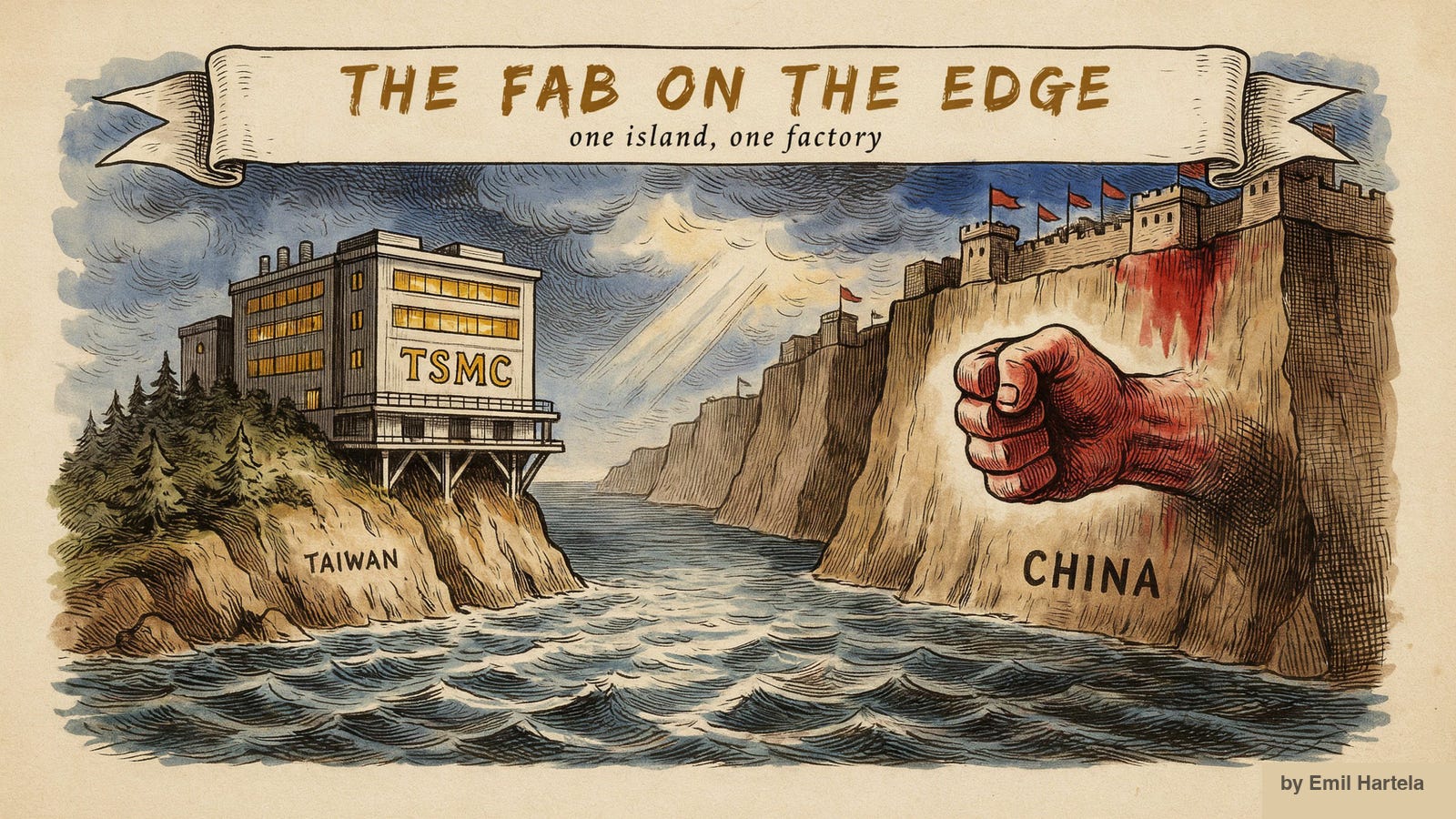
Finally, the risk that sits over the entire semiconductor sector and therefore over this thesis specifically: Taiwan. If the most likely customer is TSMC, then a large part of Canatu’s upside is tied, directly or indirectly, to the health and stability of Taiwanese chip manufacturing. Any serious geopolitical disruption involving Taiwan and China would be catastrophic for the global chip supply chain, and Canatu, as a would-be supplier into it, would not be spared. This is a low-probability, high-severity risk that no analysis of a TSMC-linked company can honestly ignore. It’s not specific to Canatu, but it’s real, and it’s part of the package.
Putting the risks together
None of these individually breaks the thesis, but together they define what kind of investment this is. It’s a binary, illiquid, timeline-prone microcap, dependent on a qualification that could fail, at a customer that isn’t confirmed and might not adopt heavily even if it’s the giant we suspect, run by a promising but unproven new team, in a field with real and emerging competition, exposed to the single largest geopolitical risk in the global economy.
The reason it’s still interesting despite all that is the asymmetry we’ve laid out: a large cash cushion under the price, an enterprise value that prices in almost none of the upside, and a genuinely transformational outcome if the binary breaks the right way. But the honest framing is that this is a high-risk bet with a wide range of outcomes, and the left tail is a real place the stock can go. Size it like what it is.
Catalysts, and what the future might hold
So where does this leave us, and what should you actually be watching?
After all the technology, the business model, the customers, and the risks, the appeal of Canatu comes down to a rare combination: a company with genuinely large potential, sitting in front of a series of concrete, dated events that will start to resolve the uncertainty, one way or the other, soon. You don’t have to wait years in the dark. The next several quarters are full of signposts.
The near-term catalysts
Here’s what’s actually coming, roughly in order.
The FST royalty ramp. This is the nearest and, in some ways, most important. The FST/Samsung reactor has passed qualification and is moving toward volume production, and management has indicated the first royalty payments should begin in 2026. When that recurring royalty and consumables revenue actually starts showing up in the financials, it will be the first hard proof that the business model works, that a reactor really does convert into an annuity. That moment turns the whole thesis from theory into evidence. Watch the financial reports, and watch Korean trade press, which has consistently reported this chain first.
The second SAT. The single most important pending event. Canatu has targeted completion of the second reactor’s site acceptance test in 2026. If that qualification completes, especially with language suggesting the relationship is moving toward production, it’s a major de-risking of the larger, more valuable leg. The way it’s described will matter, technical progress versus schedule caveats will tell you a lot about which customer it is and how healthy the relationship is.
The name. At some point, the identity of that second customer is likely to surface. If it’s who the evidence suggests, that revelation would let the market attach a real fleet size, and a real number, to the opportunity for the first time. Based on how these things go, the name will most likely leak through Taiwanese supply-chain press before either company ever confirms it, quite possibly as the customer starts ordering the surrounding equipment for a production line.
The mechanical seller finishing. More technical, but real: much of the stock’s recent weakness has come from one old fund winding down and mechanically selling its position into a thin market. That selling has an end. When it’s done, a significant source of downward pressure simply lifts, and in a thinly-traded stock, that alone can change the price behavior.
And further out, the structural driver: as EUV machines push toward 600W and beyond over the next few years, conventional pellicles increasingly can’t cope, and CNT pellicles move from “promising option” to “necessary.” That’s the demand wave the whole thesis is ultimately riding, and it builds through the second half of the decade.
The potential
Let’s be direct about the size of the prize, because it’s the reason any of this is worth the risk.
If the pieces fall into place, if the second customer is as large as the evidence suggests, if the qualification passes, if adoption broadens, and if the royalty model scales the way its economics allow, then Canatu is not a €250 million company. A recurring, high-margin royalty stream sitting at a genuine bottleneck in the world’s most important supply chain, with margins that improve as it scales, is the kind of business the market values in the billions. The honest, if-it-all-works outcome here has genuine multi-billion-euro potential. That’s not a wild claim; it falls out of the business model and the scale of the customers involved once you follow the math.
But, and this is the essential counterweight, that outcome is far from given. Every “if” in that sentence is a real condition that might not be met. The qualification could fail. The customer might adopt only lightly, or build its own. The timelines, true to form, could slip well past what anyone hopes. The competition could catch up. This is not a company where the big outcome is the likely case, it’s a company where the big outcome is possible, and currently priced as though it’s nearly impossible. The opportunity is the gap between those two things, not a promise that the good scenario arrives.
Light at the end of the tunnel
Here’s the note to end on, though. After a genuinely rough stretch, delayed deliveries, falling revenue, withdrawn targets, a sliding share price, there does finally seem to be light at the end of the tunnel.
The technology is proven and increasingly validated by the wider industry. The first reactor has passed qualification, and the first royalties are reportedly close. A capable, purpose-built management team is now in place for exactly the scaling phase the company is entering. The mechanical selling that has weighed on the stock is nearing its end. The structural demand, rising EUV power making CNT pellicles necessary, is building. And a series of concrete catalysts sits just ahead, each one capable of moving the story from speculation toward proof.
None of that guarantees the happy ending. The risks in the previous section are real, and a reader who walks away thinking this is a sure thing has misread me, it isn’t, and it’s precisely the kind of situation where you size a position to survive being wrong. But for a company that spent the past year in the doghouse, the setup going into the next few reports is meaningfully better than the share price suggests. A proven technology, a rebuilt team, a fading forced seller, a building demand wave, and a genuine, dated chance to find out whether the biggest chipmaker on earth is quietly becoming a customer.
That combination, large asymmetric upside, bounded downside, and near-term events that start to resolve the question, is why Canatu is, to me, one of the more interesting situations on the market right now. Not one of the safest. One of the most interesting. There’s a difference, and this whole piece has been an attempt to explain exactly what it is.
How I think about it (and a note before you go)
Let me end with my honest, personal take, separate from the analysis above.
Canatu is one of the more genuinely interesting situations I’ve come across. You have a real technology at a real bottleneck, a business model that turns a single machine into a recurring royalty stream, a rebuilt management team purpose-built for the scaling phase, a mechanical seller who has been artificially depressing the price and is nearly done, and a stack of concrete catalysts sitting just ahead, any of which could move the story from speculation toward proof. And underneath it all, the genuine possibility that the biggest chipmaker on earth is quietly becoming a customer. When it aligns, the upside is not a nice double, it’s the kind of re-rating that turns a microcap into something institutions have to own.
But I want to be equally clear about the other side, because I’ve tried to be honest throughout this piece and I’m not going to drop that at the finish line. The risk here is on the higher end. This is a binary. The qualification could fail. The customer might adopt only lightly, or build its own. The core technology still has to prove it can hit production lifetime at high power. The timelines, true to this company’s form, will very likely slip. And it sits under the largest geopolitical risk in the global economy. This is not a core holding or a sleep-well-at-night position. It’s a high-risk, high-reward bet that belongs, if it belongs in a portfolio at all, sized as the speculative slice you can afford to be wrong on.
If you found this useful
This is the kind of work I do, deep, primary-source, investigative research on a small set of overlooked names, the sort of digging most people don’t have the time to do themselves. If this piece was valuable to you, consider subscribing, and if you want the full depth, the complete investigations, the models, the companion evidence pieces, and the work on the other stocks I cover, consider becoming a paid subscriber. The free posts give you the thesis; the paid work gives you the whole thing, every source, every number, every counter-argument, on multiple names, not just this one.

Feel free to comment on what you think, and if you spot any inconsistencies, don’t hesitate to correct them.
None of this is investment advice. I'm long Canatu, including through the warrants, so I'm not a neutral party, read accordingly. This piece is my own analysis built from public information, and parts of it, especially the customer's identity, are inference, not confirmed fact. I may be wrong, and I've tried to be honest throughout about exactly where and how. Do your own work, and never size a speculative, binary position like this as anything other than what it is.
Today H1 results...awful. FST 20% Up and Canatu 7% down. The only good new is the FST order confirmation.
Which fund is selling?