

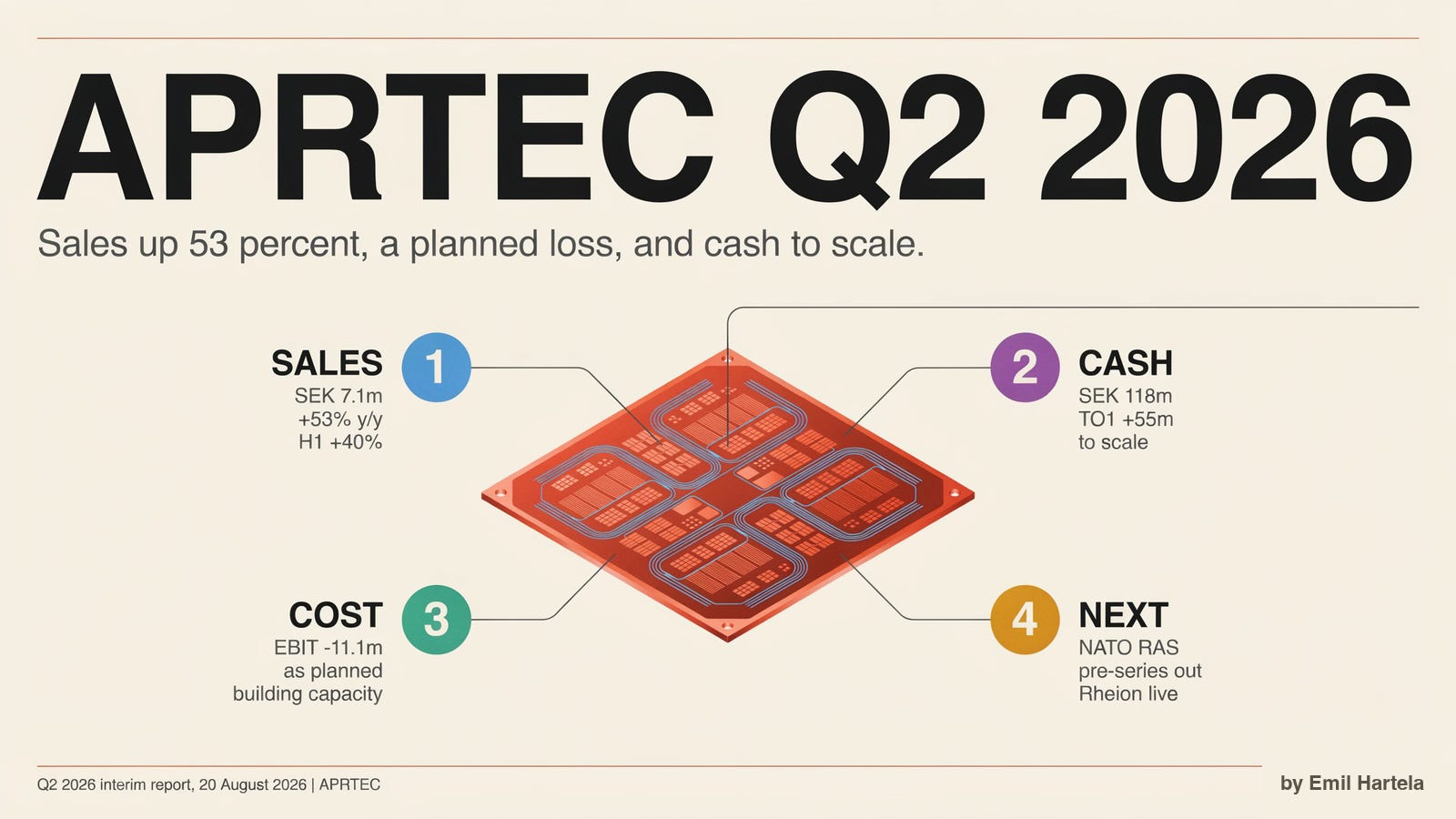
APR Technologies reported its half year on 20 August. I called it a dull report publicly and I stand by that. Nothing broke, nothing landed, the loss widened as expected.
Then I watched the presentation, and it is a substantially more bullish document than the report it accompanies. Not in tone, in content. There are concrete, checkable facts in the recording that appear nowhere in the eighteen pages the company filed the same morning.
That gap turns out to be the most useful thing I learned this quarter, both for what it says about the business and for how to follow this company from here.
Webcast quotes are from an automatic transcript, translated and lightly cleaned.
Part One: The Numbers, Briefly
Net sales came in at 7.1 MSEK for the quarter against 4.7 a year ago, EBIT at minus 11.1 MSEK, cash at 117.5 MSEK with no debt. The 53 percent growth deserves a shrug: Note 2 shows only about 1.9 MSEK was genuinely invoiced, with the rest grants and movement in unbilled accrued revenue. Q2 also redefined net sales to explicitly include grant funded projects, which Q1 did not. The loss widened because they chose to widen it.
One line matters. Tangible fixed assets went from 1.8 MSEK to 12.5 MSEK. They spent 10.4 MSEK on production equipment in three months, roughly seven times their entire previous equipment base, in a quarter where they invoiced under 2 MSEK.
My August piece ended by saying the binding variable in this investment had stopped being demand and become execution speed of the factory. That is the line where execution speed shows up in the accounts.
What the accounts do not tell you is whether it works. The webcast does.
Part Two: What the Recording Says That the Report Does Not
The factory is running, not being built
The report says only that capacity build continues. Lars, on the Enköping line:
“We have also built a robot line that assembles our product and does all the visual vision inspections. It handles the welding of the product itself, everything fully automatic. The capacity is very high, and it can be run around the clock if we wanted to. So it works now.”
The Uppsala cleanroom equipment is installed and in startup. So the 10.4 MSEK has already converted into working, automated capacity rather than purchase orders.
Yield, answered directly
Someone asked the right question: is the bottleneck material, manufacturing precision, or getting repeatable quality between units?
“It has gone surprisingly well during the spring and we have good yield, so now we can raise the tempo and build up larger capacity. So we see no direct bottlenecks that are difficult to handle.”
He volunteered that he had been worried in the spring about the process steps that were new to them, and that it resolved better than he expected. For a company whose entire thesis rests on making hundreds of thousands of units, an unprompted “we have good yield” from the CEO is not a small thing, and it is not in the report.
A pipeline the report does not admit exists
“Then we have new dialogues with a number of additional larger and smaller global tech customers, with whom we are having similar discussions.”
Similar discussions. Not vague interest, not booth conversations. Similar to the relationship that is the entire investment case.
And on inbound:
“Quite a few significant customers have contacted us wanting to talk specifically about Rheion. The Rheion brand has already established itself.”
The written report mentions exactly one customer, three times, and never suggests there is a second.
Geography, which the report scrubbed entirely
“We are soon heading off to a number of trade shows and customer meetings in China, the USA, Italy, France, Germany and others, and that is just what is planned for August and September.”
The Q2 report contains no country names at all. Not one.
The anchor relationship is direct
“We want to work directly with the customers. Zoppas is a partner now, but in many cases, including the customer we have, we deliver directly, and then we also have to match the requirements that are placed on us. They place quite high demands on all suppliers.”
No distributor, no partner in between. APR is a direct supplier to the anchor customer and has to clear that customer’s supplier qualification. That is the context that makes the China production constraint make sense: it is a supplier requirement, not a preference.
Zoppas is already working, before it is signed
Peter describes Zoppas as a family company outside Venice, global, active from China to the USA, supplying heating elements to essentially all satellites, plus defence, data centers, battery systems, EVs and consumer appliances. Three thousand Zoppas heating units flew in the Artemis capsule.
Then:
“They have already introduced us to the big players in Italy. Leonardo, for example.”
APR exhibited inside the Zoppas booth at Farnborough and will do so again at BEX in Rimini. The framework agreement guided for Q3 is paperwork on a partnership that is already running trade shows and making customer introductions. That changes it from a binary event into a formality, and makes a delay more informative than a signature.
And one that cuts the other way
Asked how far the 55 MSEK from the warrant exercise goes:
“It lasts a good twelve months ahead.”
117.5 MSEK across twelve months is roughly 29 MSEK per quarter against an actual Q2 burn of about 21 MSEK, so he is guiding to a real step up in spend. Twelve months from now is August 2027. The stated volume target is 2028. There are no warrants left after TO 1, so any future raise is a fresh issue, and the AGM handed the board an issuance mandate in May.
On the CEO’s own framing, the balance sheet does not reach the volume year. Either 2027 revenue arrives on schedule or there is another raise in between. That belongs in everyone’s model and it is the single most important thing said all day.
Part Three: Why the Report Is So Thin
Here is the part that makes the gap interesting rather than just annoying. The report is not thin because the business got worse. It is thin because someone went through it with a redline.
Q1’s outlook, published 20 May, opened with this:
“APR Technologies har kommit väsentligt närmare ett kommersiellt genombrott med Bolagets mikropumpar för kylning av elektronik, vilka har väckt ett stort intresse hos flera av de allra största techbolagen i världen.”
“APR Technologies has come materially closer to a commercial breakthrough with the Company’s micropumps for cooling electronics, which have attracted great interest from several of the very largest tech companies in the world.”
And later on the same page:
“Bolagets besök på mässor och företag i Europa, Asien och USA har skapat intresse hos flera namnkunniga techgiganter, med vilka Bolaget nu för djupare tekniska diskussioner med.”
“The Company’s visits to trade fairs and companies in Europe, Asia and the USA have created interest among several renowned tech giants, with whom the Company is now conducting deeper technical discussions.”
None of that survives into Q2. No commercial breakthrough, no largest tech companies, no renowned tech giants, no geography.
But look at what did survive, word for word. Q1:
“Bolaget fortsätter arbetet med det globala techbolag som testar och anpassar APR:s mikropumpar i sina produkter.”
Q2:
“Inom Chip Cooling fortsätter arbetet med det globala techbolag som testar och anpassar APR:s Rheion®-teknologi i sina produkter.”
“Work continues with the global tech company that is testing and adapting APR’s technology in its products.” Identical apart from the product name.
Everything deleted between the two reports sat around that sentence. The sentence itself was untouched. And every deleted phrase has one thing in common: it is a claim about a third party’s state of mind that APR cannot evidence. The one relationship they can evidence, because there is a signed order and physical deliveries against it, was preserved verbatim. That is what a redline looks like. A deteriorating customer relationship produces the opposite pattern.
The rest of the document agrees. Q2 added a risk section that did not exist in Q1. The related party note went from “no other material transactions identified” to naming four consulting entities plus supplier transactions with Shanghai Chillwind and the TO 1 underwriting arrangement. Net sales got a formal definition and grant income was broken out for the first time. And the MAR footer changed from the vague legacy formulation to the wording Spotlight’s own guidance prescribes, asserting outright that the report contains inside information. Every one of those increases scrutiny of the company rather than reducing it.
The honest complication is that Q2 does not only delete, it inserts. The CEO letter now says large customers have high requirements, long decision processes and extensive test programs, and that APR’s job is to reduce the customer’s risk step by step. That was not in Q1 in any form, and a compliance review explains removals, not new sentences. My best reading is that Q1 described the stage more flatteringly than warranted and the same review corrected it. It is the only explanation that fits both the deletions and the insertion without requiring the program to have gone backwards, which matters because the hard facts moved forward in the same report.
And the practical conclusion, which is the useful one. The discipline is document level, not company level. Both written reports and the written business update were tightened. The live presentation was not, which is why the funnel, the countries and the working factory all appear there and nowhere else.
So from here: the reports will be sparse and the webcasts will carry the actual news. If you skipped the Q2 presentation because the report was dull, you missed a running production line, a yield answer, a pipeline of additional customers and the runway statement.
Part Four: The Unnamed Big Tech Customer
As you might remember, I have already speculated that the customer could be Amazon, and that the application is somehow linked to BBUs, sidecars, PSUs and immersion cooling.
The presentation gives a mixed message on that front.
On one side, immersion. The entire product demo is immersion cooling: chip, micro fin, dielectric fluid, Rheion on top, roughly 95 degrees down to about 60 when the unit switches on, drawing under half a watt. Lars calls it next generation immersion cooling and says the big players all have immersion in the pipeline even though it is not yet common. That sits well with a good part of what I wrote in August.
On the other side, the global tech customer barely appears. Two mentions in 32 minutes. The deliveries are working very, very well, and the customer is testing and building the units into their own equipment and lines. That is the whole of it. No volumes, no timing, no colour.
Compare that to Q1, when they were essentially shouting that they had a tech customer, plural even, several of the very largest tech companies in the world. In Q2 there is moderation. Some of that is natural, the listing excitement has worn off and the third report is always calmer than the first. But there is a lingering feeling that either the big unnamed customer is further out on the timeline than I assumed earlier, which is very likely because these things always get delayed, or they simply made the presentation more balanced. And there is of course the tail risk that they already know the relationship is slipping in some respect.
The key item, and the one I keep coming back to, is that both the report and the webcast describe this customer as demanding. The report says large customers have high requirements, long decision processes and extensive test programs, and that APR’s job is to reduce the customer’s risk step by step. On the webcast Lars says they need a production apparatus mature enough to meet the demands of large tech buyers, that those buyers place high demands on all suppliers, and that APR delivers to this customer directly rather than through a partner.
The way I read it, they very likely have the technology the customer needs. What they are struggling with is convincing a company of that size that a company of this size can deliver.
And that is where the twelve month runway stings. Put yourself in the customer’s procurement seat. Your prospective supplier has twenty employees, one production line that just started up, and on their own CEO’s account about a year of cash. You are being asked to design their part into something you will ship in volume for years. Seen that way, everything APR is doing right now, the machines, the yield work, the hiring, the Chinese ownership separation, is not selling. It is supplier qualification.
So the team is very likely racing at full speed to reassure this customer. What at some point looked like a sure thing now looks more like a bloody battle.
Still, I think the story is alive and well. The interest is clearly there, the funnel is growing, and they are clearly scaling well.
What to Watch
Late 2026. The patent families APR filed during 2025, inside the collaboration, begin publishing as the 18 month secrecy window expires. Their claims language remains the best discriminator the public record will ever offer, and it is two to four months away.
Q3 2026. The Zoppas framework agreement. Since the partnership is already running trade shows and customer introductions, treat a delay as more informative than a signature.
Autumn. BEX in Rimini and a drone show in London in September, plus customer meetings in China, the USA, Italy, France and Germany. On this quarter’s evidence, whatever comes out of those will appear in a webcast before it appears in a report.
19 November. Q3 report, and more importantly the Q3 presentation. Watch whether the capex line continues or was a one off, and listen for any change in the twelve month cash language.
Q4 2026 to Q1 2027. The validation window closes and the customer decision either arrives or visibly does not. On the CEO’s own runway statement, this is also roughly when the funding question becomes live.
Spring 2027. Customer side patent filings from the collaboration period begin surfacing. The first large company filing that cites APR Technologies as prior art is a fingerprint.
Closing Thoughts
For me this report reads slightly bullish leaning.
The webcast is full of excitement, especially around the market finally understanding and needing the product. Peter’s version of it is the part that stuck with me: they saw this coming when they started the company, but back then it was not urgent. Now the customers are sitting with the problem in front of them, cold plates have maybe five percent left in them, and a new generation arrives every quarter instead of every year. The technology did not change. The world caught up to it.
More importantly, the webcast gives us a glimpse into a very successful start of the production ramp. For a company at this stage, going from lab to volume is the single biggest thing that can go wrong, and it is where most hardware microcaps quietly die. A robot line that assembles and inspects fully automatically, a cleanroom in startup, and a CEO who volunteers that yield is good and that there are no bottlenecks which are hard to handle, is about as good as this phase gets. There are no massive issues anywhere in this quarter.
The open question is the big tech customer, and the report was light on it. The webcast was not much better. Two mentions and no real colour.
But at the same time, we now know others are interested too. Additional larger and smaller global tech customers in similar discussions, inbound contacts asking about Rheion by name, dialogues turning into projects. A year ago this was a single counterparty story. It is less binary now.
So the worst case is that the main big tech customer turns out to be more challenging than anticipated, for one reason or another, while the product itself still has enormous demand behind it.
I did a tiny add today.
Disclaimer: I hold a position in APRTEC and my view is accordingly biased. Everything above is built from public documents, the company’s own presentation, and IR correspondence. The parts about customer identity are speculation, clearly labelled as such. Nothing here is financial advice, and nothing here should be read as a claim of fact about any company named. Do your own research.