

APRTEC is a more recent holding of mine, one I found by going through countless names in the liquid cooling race. Understanding the company is trickier than it first appears: the website paints a picture of direct chip cooling, while the patents point toward BBUs and power related products. That gap is not a red flag, it is the normal distance between a platform company’s vision and its first products, but it means the real story has to be assembled from primary sources rather than read off the homepage.
In this piece I dive into the deepest part of the story: the rabbit hole of their unnamed global tech customer, the counterparty behind the development deal, the pre-series orders, and the 150 000 to 500 000 unit volume scenario that the entire investment case hangs on. I have gone through patents, grant databases, hiring pages, earnings calls and one very helpful local newspaper, and while certainty is not on offer, the clues stack in interesting directions.
I expect APRTEC to become a regular series here, where I update and comment on events as they land, and there will be plenty of them: the Q2 report, the patent publications coming late this year, and the customer’s volume decision. The name is severely under covered, essentially no one writes about it, and that is exactly where digging really deep can still produce alpha. So that is what I have done.
Who Is the Unnamed Global Tech Customer?
A rabbit hole in public sources
If you read my APR Technologies deep dive, you know the spine of the whole thesis is one relationship: an undisclosed customer that paid roughly 14 MSEK in spring 2025 to design APR’s EHD pumps into its own products, took first delivery of custom units in December 2025, ordered a pre-series on volume tooling in January 2026, and has a disclosed follow-on scenario of 150 000 to 500 000 pumps per year, which would mean hundreds of MSEK in annual revenue from a single counterparty. Everything else in the APR story orbits this deal.
So naturally I wanted to know who it is. I have spent an unreasonable amount of time going through patents, grant databases, job postings, earnings calls, local newspapers and corporate filings, and I want to say this clearly at the start: I do not know who the customer is, and neither does anyone else outside the companies involved. High certainty is not available here. The customer is running this program in complete public silence, which itself tells you something about what kind of company it is. But the public record contains multiple genuinely compelling clues, and when you stack them, some candidates fit far better than others.
This piece walks through the case for each candidate, from strongest to weakest. Everything below is built from public sources, nothing more. Treat it as an educated rabbit hole, not as information.
The dossier: what we actually know
Before the candidates, the facts. APR has described the customer three different ways across its documents: “ett globalt teknikbolag” (a global tech company), “ett ledande globalt elektronikföretag” (a leading global electronics company), and, in the listing memorandum, the most specific version, “ett multinationellt tech-infrastrukturbolag” (a multinational tech infrastructure company). The application is described as dielectric liquid cooling of circuit boards in IT equipment, and the annual report says APR’s “kylmodul”, cooling module, was integrated into the customer’s systems. In an interview, CEO Lars Almhem described the customer as testing APR’s immersion cooling solution “in a redesigned system,” on 6 to 9 month validation cycles, with revenue potential of 15 to 50 miljoner euro per year. The pre-series is validated in the customer’s “production processes and authentic end-use environments.” The customer demanded that APR divest its Chinese ownership links, which drove the spinoff of the battery subsidiary Chillwind. And the annual report notes the relationship existed “a longer time” before the 2025 agreement. In Q1 2026, APR management traveled to Texas and California.
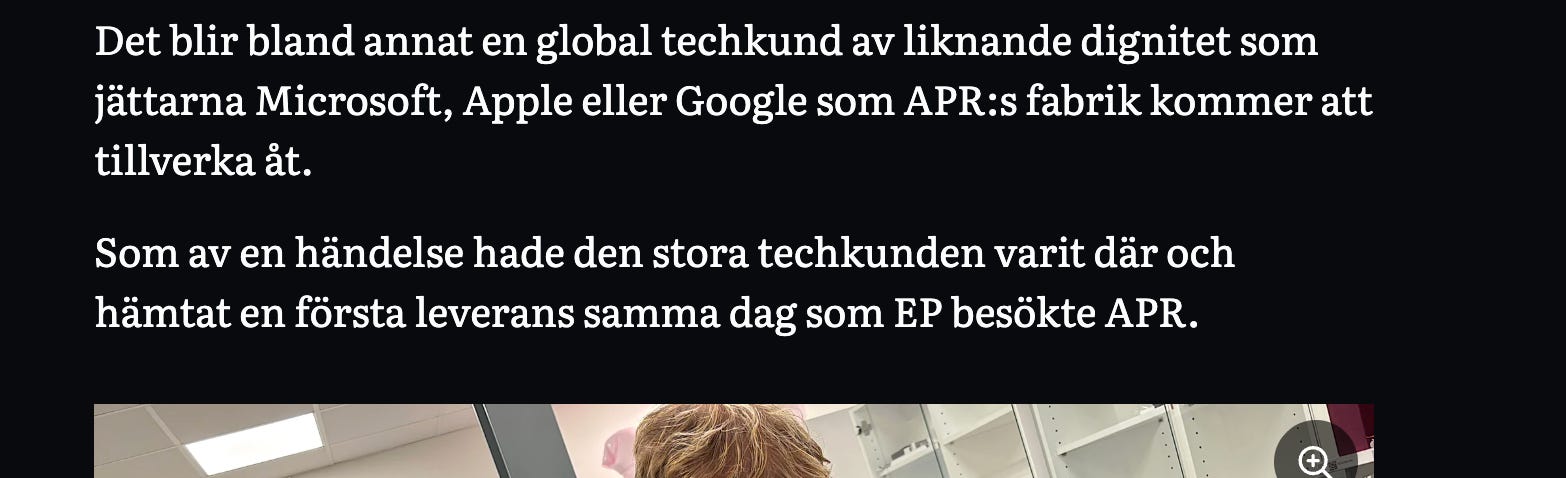
Two more details come from outside the company, and they are the best clues in the whole record. First, the local newspaper Enköpings-Posten visited APR’s new factory in late December 2025 and described the customer as “a global tech customer of similar stature as the giants Microsoft, Apple or Google,” adding, almost in passing, that the customer had been at the factory and collected a first delivery in person the very same day the paper visited. A local journalist standing inside the building reached for the biggest names in tech as the comparison class. Second, APR’s own press boilerplate has, since at least 2021, mentioned an unnamed “American partner located in Seattle, Washington.”
What the patents say APR is building
This part matters more than people realize, because APR’s patent estate quietly describes the product even while the customer stays hidden.
Read APR’s filings in chronological order and you watch a company pivot in real time. The 2013 to 2016 families are pure space: satellites, RF amplifiers, lab manufacturing methods like screen-printed platinum sintered at 800 degrees. In the 2019 filings, “computing systems” moves to the front of the application lists and direct-contact chip immersion appears. A 2021 filing introduces, for the first time, the phrase “power back up in stationary applications,” which is UPS and battery-backup language. Then 2023 is the pivot year: “telecommunication equipment” and “ICT” enter the vocabulary, electrode gaps widen tenfold (a higher-flow pump), the manufacturing methods switch from lab techniques to stamping and plating, which are volume production methods, and a new family appears whose entire purpose is a lifetime-hermetic, non-pressurized sealed loop using a multilayer foil gas bag to absorb the fluid’s thermal expansion.
And then the 2024 and 2025 filings put hard numbers on it for the first time anywhere in the portfolio: channels under 3 millimeters, rows of flat components held within 2 to 3 degrees of each other by a flow-distribution plate with graded hole sizes, a casing described as “liquid tight but not pressure tight,” an external radiator loop under temperature setpoint control. Put together, the recent filings describe one specific object: a factory-sealed, maintenance-free immersion cassette holding a row of flat heat-generating units, pumped by a stamped, volume-manufacturable solid-state pump, thermally balanced to within two degrees, sealed for the life of the product. The wording leans battery, but the claims are deliberately drafted to also cover “micro-processors and printed circuit boards,” and, tellingly, the patent examiners prosecuted the newest family against Fujitsu and Tyco server immersion tank prior art. The examiners, reading the engineering, saw servers.