

Over the past year, liquid cooling for AI data centers has become one of my highest conviction themes. More specifically, I have focused on next generation cooling: the solutions that become necessary once chips run hotter than conventional cold plates can handle.
I have spent most of that year going through essentially every listed way to play it. That includes the fluids (Chemours, Solstice), the two phase challengers (Innventure via Accelsius, and privately ZutaCore), the picks and shovels (Aeroflex, Vertiv, Modine, Munters), the component layer, and the rest of the stack. The main lesson is that clean public exposure to this trend is very hard to get. The purest plays are private. The listed names are mostly diversified industrials where cooling is one segment among many, or chemical companies whose outcome depends as much on regulators as on data centers.
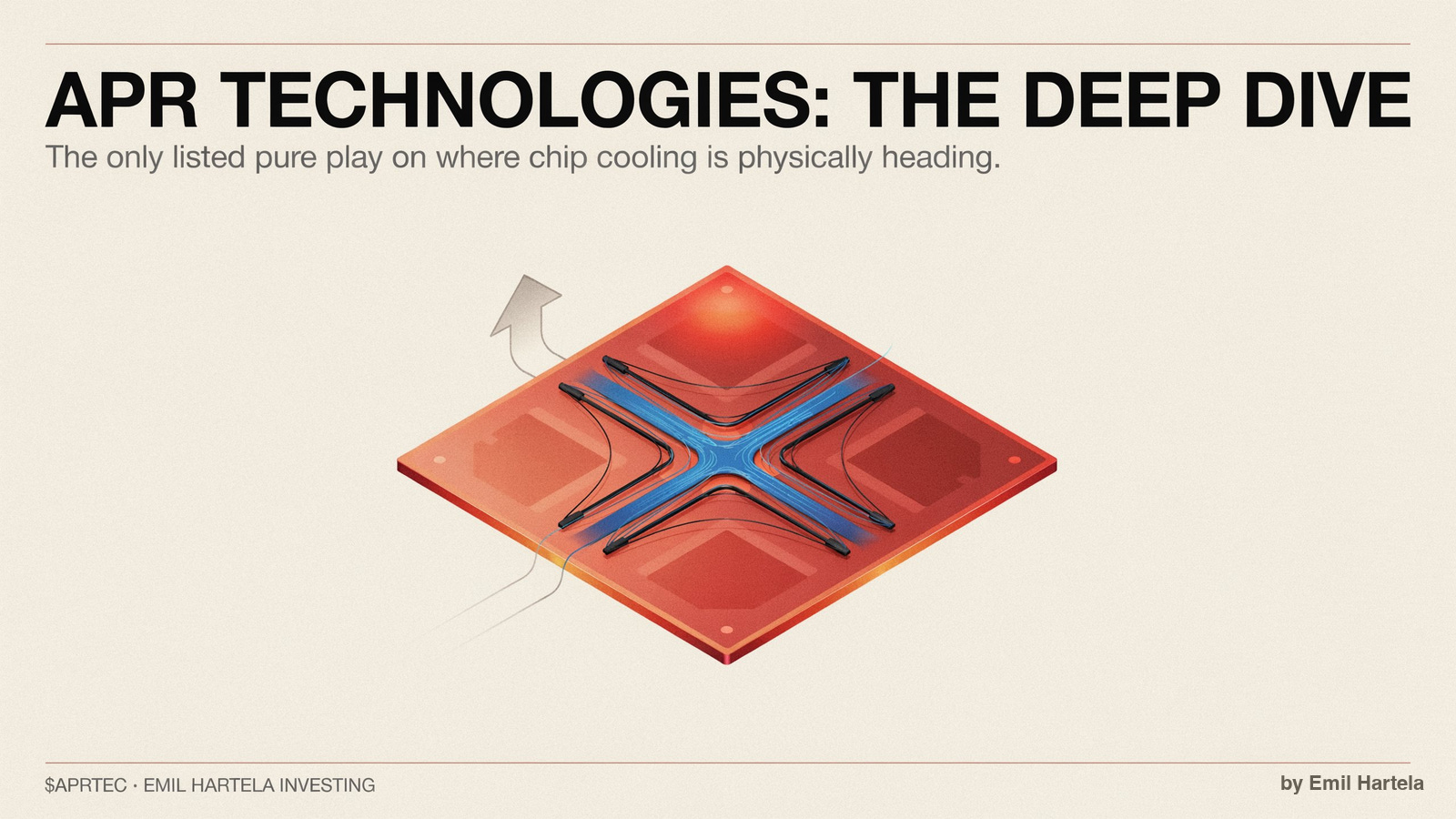
One name kept surviving every filter I put it through: a Swedish microcap that almost nobody covers, that listed in January, and that sits, as far as I can tell, directly on the endpoint the entire industry is migrating toward. It is the most appealing way I have found to play the trend.
That name is APR Technologies, ticker APRTEC. The first edition of this deep dive was the one I promised in Execution Memo No. 014. This is the second edition, and two things have changed since then.
First, I have spent time in direct conversation with CEO Lars Almhem and chairman Peter Nilsson. Those conversations have filled in many of the gaps the public material left open.
Second, the company has simply disclosed much more. Since the first edition we have seen:
the first quantified performance claims for Rheion
positive results from pre-series testing with an unnamed global tech company
NATO DIANA prequalification
a signed licensing and supply agreement with Zoppas aimed at space thermal management and the EU’s IRIS² constellation
a first factory up and running, alongside a quiet buildout of operations, quality and sales hires
Taken together, these let me tell a much more concise and complete story: what APR is, where it stands today, and what has to happen next for the thesis to play out.
A few words on what this piece is and isn’t. Coverage of this company is still close to nonexistent, so I have tried to write the piece I wish had existed when I started digging. It aims to be thorough enough to actually understand the technology, the people and the economics, without becoming a 200 page initiation report.
Everything performance related that comes from the company is labeled as such. As you will see, there is an important distinction between what has been claimed and what has been proven. The same applies to information from my conversations with management: where a point rests on what Lars or Peter told me rather than on a public filing, I say so.
The standard warning applies with unusual force here. This is a venture stage company on Spotlight, and the position is risky and extremely illiquid. I own shares, and nothing here is financial advice.
With that, let’s follow the heat.
Disclaimer: This is not financial advice. I own shares in APRTEC, so my view is biased. This piece combines public filings, company presentations and my own conversations with management. Not every point has been confirmed with the company, and despite my best efforts it may contain errors or outdated information. APRTEC is a venture stage microcap on Spotlight with very limited liquidity, and the risk of substantial or total loss is real. Do your own research before making any investment decision.
Part 1: The problem
AI compute is thermally gated
Every generation of AI silicon runs hotter than the last. A GB200 superchip, which pairs one Grace CPU with two Blackwell GPUs, draws up to 2 700W, or roughly 1 200W per GPU, with heat flux above 50 W/cm² on the cold plates. Rubin pushes the per GPU figure further, toward 1 800W in its standard configuration and reportedly up to 2 300W in its highest power versions. Rubin Ultra, which puts four GPU dies in one package, is reported to reach around 3 600W per package. At rack level, a GB200 NVL72 rack draws around 120kW, and Nvidia has already announced 600kW rack architectures for Rubin Ultra in 2027.
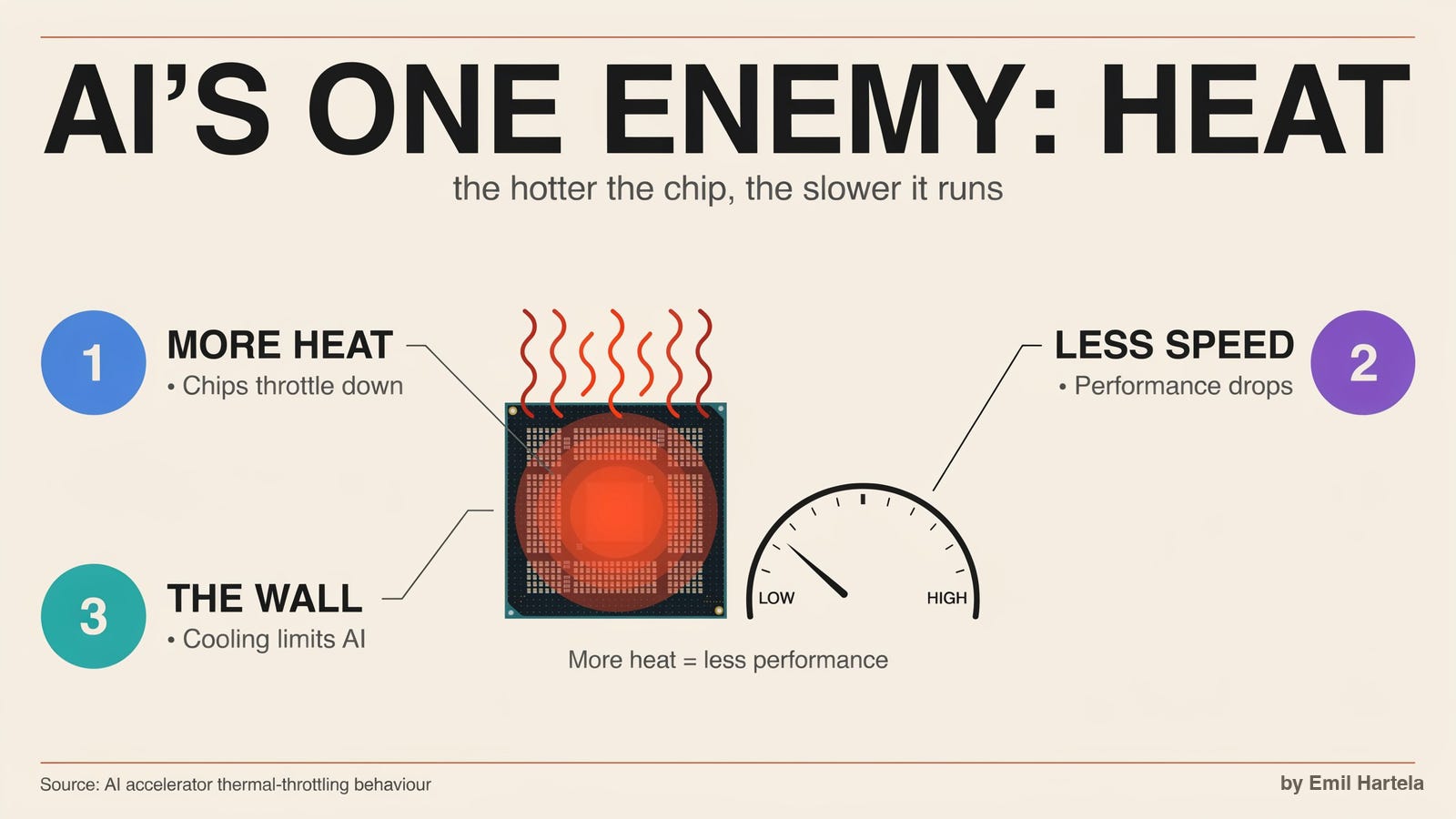
Air cooling hit its limits around the Hopper generation. The industry’s answer is direct to chip liquid cooling: water glycol pumped through copper cold plates pressed onto the chips. It works, it is deployed at massive scale, and it is visibly being pushed toward its limits.
The stack, and why every layer is a tax
To understand where the opportunity sits, you have to follow the heat from the transistor to the coolant, because heat doesn’t jump into the liquid. It crawls through layers, and every layer resists.
In a classic packaged chip, a desktop CPU say, the journey is: silicon die, then a thermal interface material filling microscopic gaps, then a metal lid, then a second interface layer, then the cold plate’s base, and only then liquid. Nvidia has already stripped this as far as the current architecture allows; H100, B200 and GB200 modules are bare die packages where the cold plate presses onto the silicon through a single interface layer. Even that last layer is a nuisance: it’s a consumable, replaced every time a cold plate comes off, and one of the two dominant resistances in the chain.
The other dominant resistance is the one most people never hear about. Even when heat reaches the liquid, the liquid touching the metal barely moves. Friction pins a thin film of near stationary fluid against the wall, the boundary layer, and heat must conduct through this sluggish film before flowing coolant can carry it away. Conduction through liquid is slow. In a modern direct to chip system, the interface material and the boundary layer together make up the bulk of total thermal resistance.
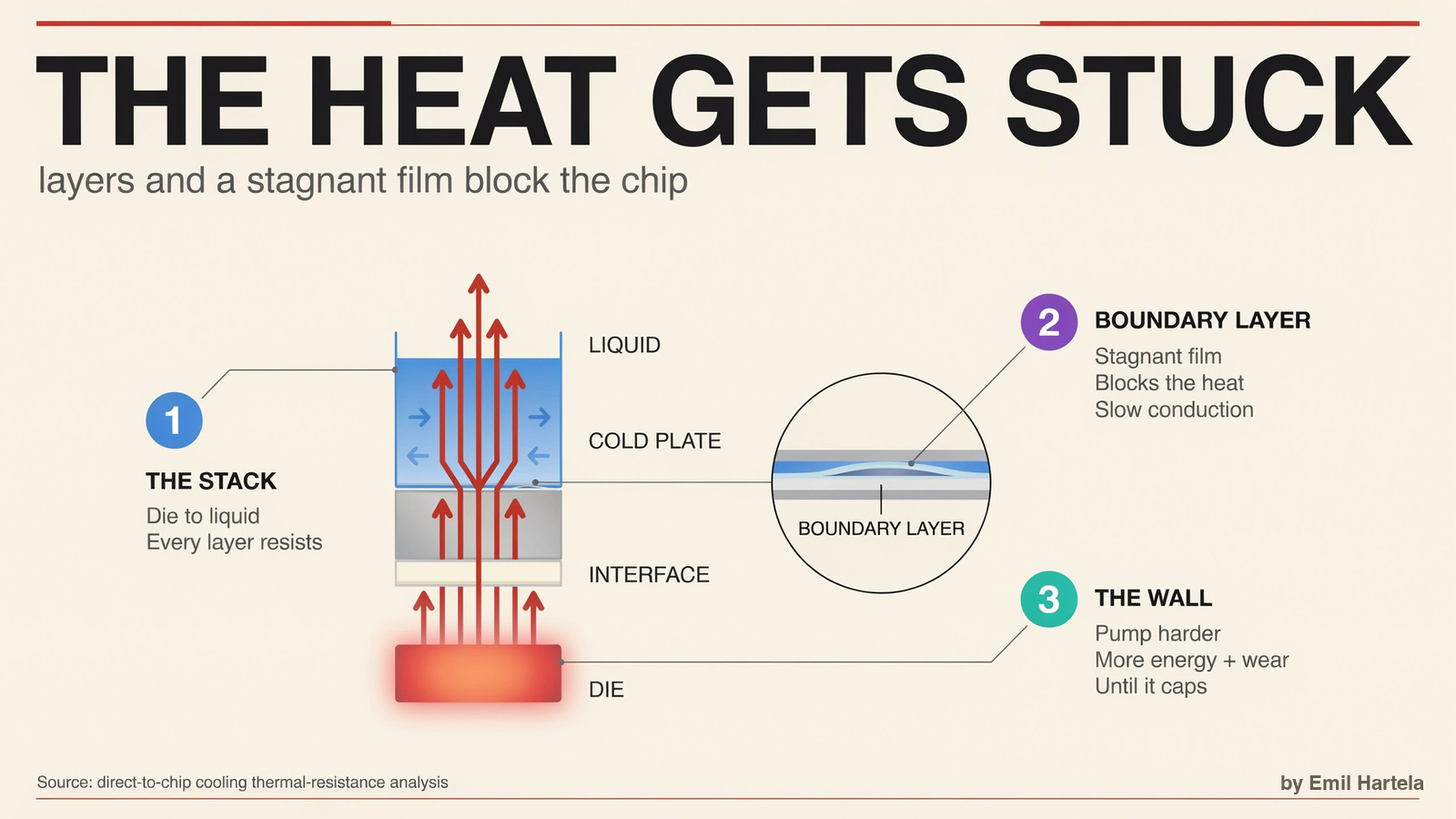
So all of chip cooling reduces to two questions: how do you get rid of the layers, and how do you kill the boundary layer.
Watch what the industry does, not what it says
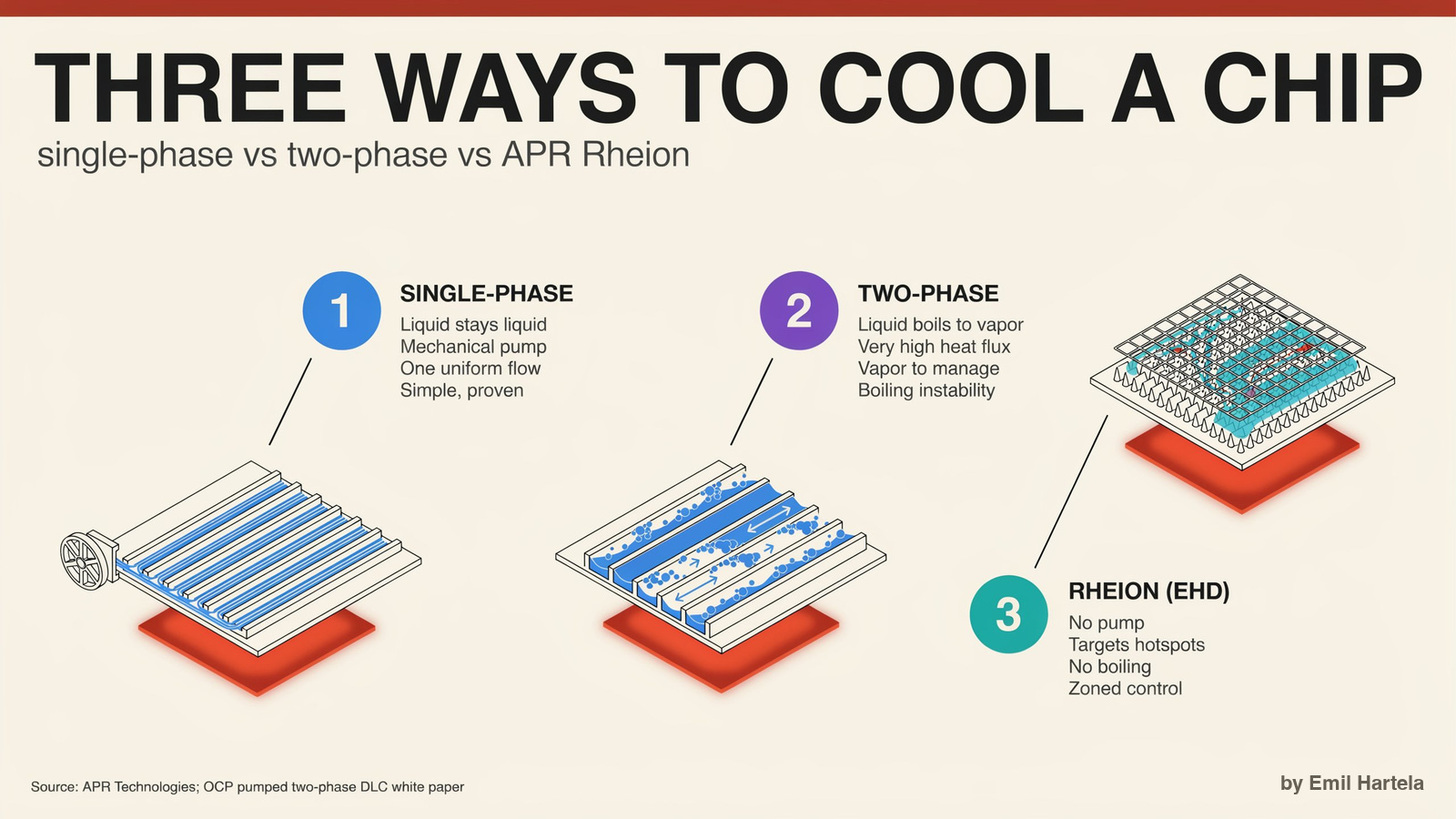
Single phase answers both with force. The recipe never changes: push more liquid through finer channels, accept the rising pressure, let the pumps pay in energy and wear. Vera Rubin is this recipe at its logical extreme; trays go fully fanless and the racks run nearly double the coolant flow at the same CDU pressure. For Rubin Ultra, supply chain reporting points to microchannel cold plates where coolant runs directly across the die surface. Microsoft has demonstrated channels etched into the silicon itself, cutting peak temperature rise by 65 percent versus the best cold plates.
Two phase answers the boundary layer question with boiling, which moves heat far more effectively than conduction through a stagnant film. I have written about two phase before and I still believe in it long term. But it leaves the interface layers intact, chip makers haven’t blessed it, questions about maintenance and reliability at hyperscale remain open, and managing boiling vapor inside a chip package is a problem nobody has solved. It is, in my view, further away than the demos suggest.
Put the datapoints in a row and the direction is unambiguous: coolant is migrating toward the silicon. Room, to rack, to plate on the lid, to bare die, and next to channels at and inside the chip. Every step strips one more layer of the tax.
The endpoint has a specification
Follow the migration to its endpoint and write down what it demands:
A fluid that can touch live silicon without destroying it. Water is disqualified on chemistry.
A loop at near zero pressure, because a bonded chip stack cannot take mechanical stress.
A pump that works at chip scale. Mechanical pumps do not miniaturize; bearings, seals and impellers don’t shrink.
Control fine enough to chase hotspots that move around the die in milliseconds, which passive channels, sized once at manufacture for the worst case, fundamentally cannot do.
Neither of today’s camps is built for this. The endpoint belongs to a third kind of solution, and almost nobody is building it.
The latest sector chatter
The direction of travel keeps getting confirmed from the top of the supply chain. At SEMICON Taiwan on 1 September, TSMC said total power per AI system will rise roughly sixfold over the next five years as compute grows and 3D stacking deepens, making power delivery and cooling the two key constraints on next generation systems. Between 2024 and 2029, CoWoS packages are expected to grow from 3,3 times the reticle limit to more than 14 times. On cooling, TSMC was unusually explicit: beyond traditional cold plates, it is working with partners on microchannels, jet impingement and two phase cooling, with the end goal of integrating package and cooling and eventually removing the thermal interface material altogether. That is the coolant to silicon migration this piece is built on, now stated as roadmap by the company that packages nearly every AI accelerator.
The sell side is moving the same way. Goldman models liquid cooling penetration in AI training servers at 15%, 45%, 74% and 80% for 2024 through 2027. TrendForce sees penetration among AI chips rising from about 33% in 2025 to 53% in 2026 and close to 60% in 2027, and Nvidia’s Vera Rubin is designed as a fully liquid cooled, fanless rack, extending cooling to networking, power boards and optical transceivers. Liquid cooling is no longer the question; what kind, and how close to the die, is.
The less discussed problem is warpage. As dies and interposers grow, TSMC has flagged warpage control as an urgent challenge for joint quality, assembly yields and testing. The root cause is physics: silicon and organic substrates expand at different rates, so very large packages bend with every thermal cycle. Moving coolant into the lid or onto the silicon makes this harder, not easier, because every channel and seal must now survive a package that flexes. TSMC’s own microchannel work has had to adopt sealants that follow the warp, and questions remain around package yield after adding cooling structures and who is responsible for coolant quality and connections. Solving warpage is difficult, and it is one of the main reasons the last centimetre to the silicon is taking the industry so long.
Part 2: The company
Fifteen years of preparation
APR Technologies was founded in 2011 in Enköping by microelectronics researchers, Are Björneklett, Peter Nilsson and Robert Thorslund, with backgrounds in industrial research including 3D chip packaging; the founders were inventors or co-inventors of, among other things, XiVia and Bluetooth. Their founding insight, stated in 2011, was that cooling would become an ever larger problem and that new thermal solutions would be needed.
For its first decade the company built thermal control hardware for the space industry. It won development projects from the Swedish space agency, sold temperature regulation systems to ground stations, won (and then walked away from, over price pressure) a component procurement for the NASA/ESA Orion crew vehicle, delivered parts to an instrument on the ISS, and built long-running relationships with ESA and Airbus, who formally approved APR’s pilot production line, manufacturing processes and quality system in 2022. In 2024 the company was selected into NATO’s DIANA accelerator and won a 19 MSEK grant from the Swedish Energy Agency to demonstrate high volume production. It ISO9001 certified its operations based on the quality system from the space division.
Fun fact: During one of our calls, Lars told me that APR has managed to crack problems in EHD pumping that even NASA struggled with. NASA Goddard spent years researching EHD conduction pumping for spacecraft thermal control, so it is a bold claim.
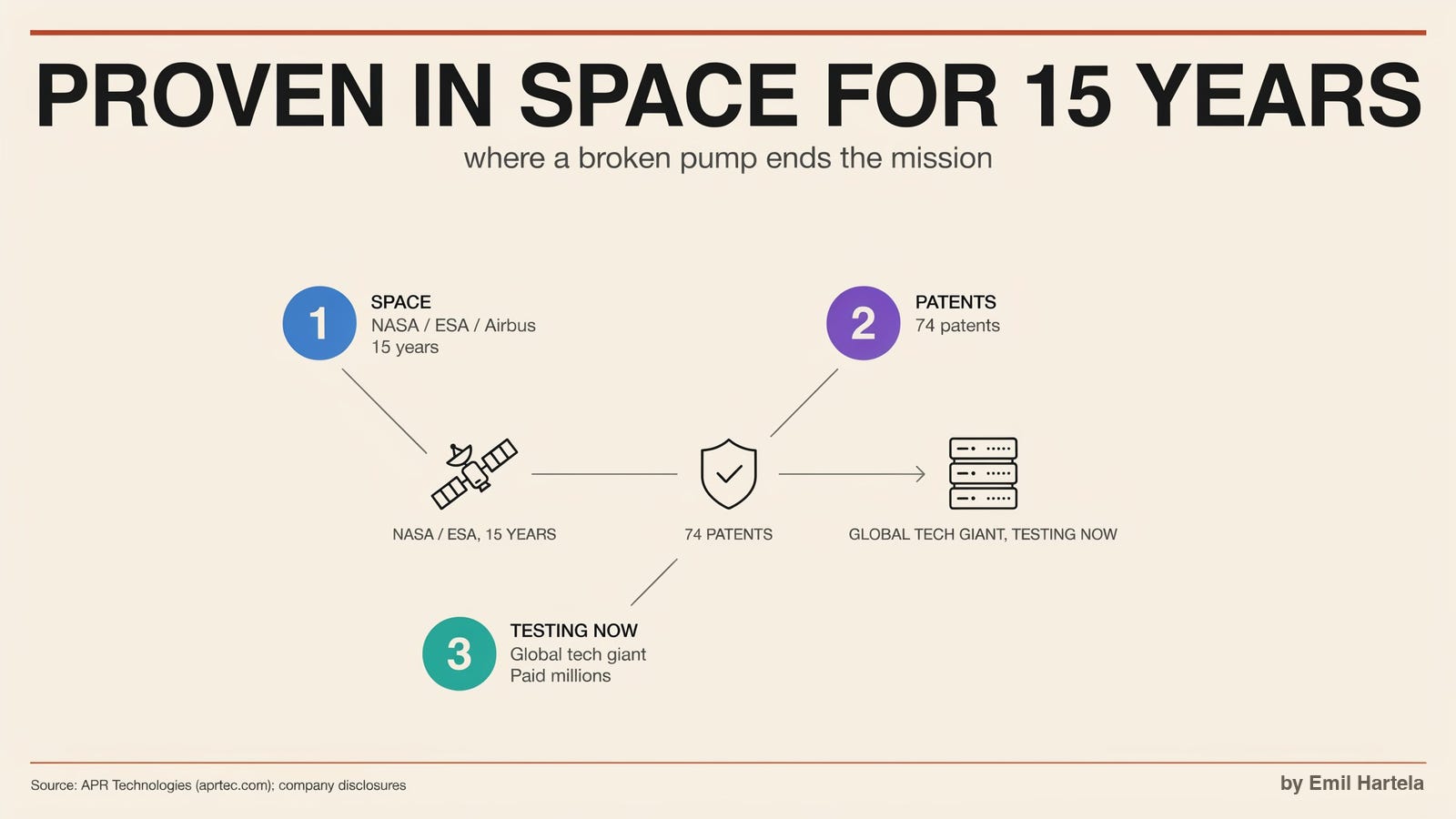
Why does this heritage matter for an AI cooling thesis? Because space is the one customer base where a failed cooling component ends the mission. Fifteen years of surviving NASA, ESA and Airbus qualification is the strongest reliability evidence a company this size can hold, and reliability, as we’ll see, is the heart of the product.
One more detail from the company’s own history that I find telling: in 2020 APR built a lab prototype for super efficient cooling of Nvidia chips, judged the market not quite ready, and predicted the need would grow. That was five years before the market agreed.
The company listed on Spotlight Stock Market on January 13, 2026 at a valuation of roughly 330 MSEK, alongside a warrant series (TO 1) that was exercised to 99,85 percent in June, adding roughly 55 MSEK before costs.
Rheion: the technology
APR’s core technology, branded Rheion this spring, answers both of the questions Part 1 reduced cooling to.
The pump is electrohydrodynamic (EHD). Electric fields push a dielectric fluid through microchannels, with no mechanical pump anywhere and essentially no moving parts in the loop. The physics is old and solid; charges injected into a weakly conducting dielectric liquid get dragged by the Coulomb force between electrodes, transferring momentum to the fluid. NASA Goddard has patented pumps in the same family for space thermal control, and EHD hardware has flown on the ISS. What’s remarkable is not that it works; it’s that essentially nobody else has commercialized it. Reviews of the field classify EHD pumping as early stage as a category. APR has spent fifteen years in a discipline that barely has other occupants.
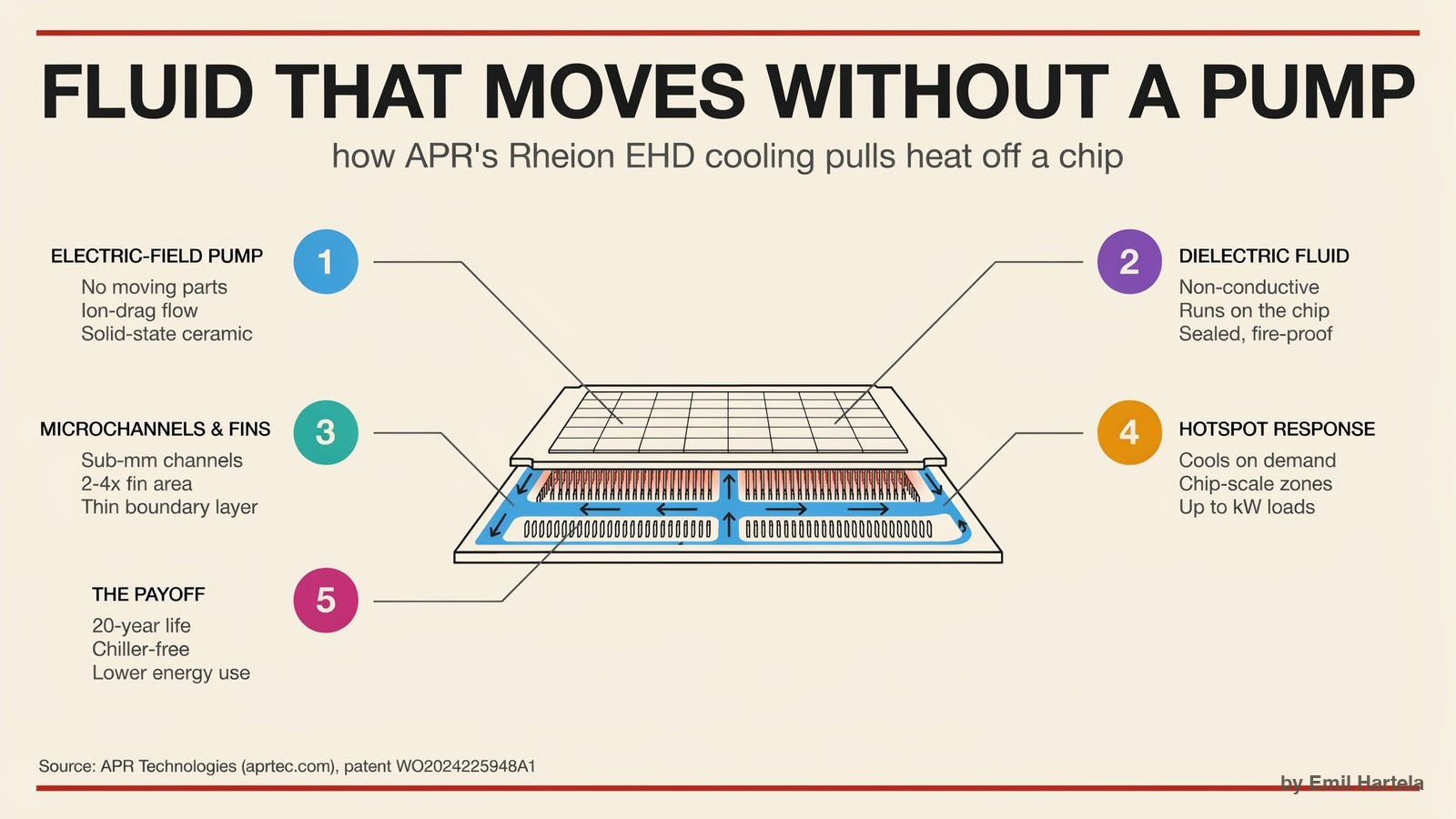
Because the fluid is dielectric, it can sit in direct contact with live silicon. The interface layers can simply go; the layer problem is solved by removing the layers. And because the flow is generated by electrode structures inside the channels themselves, the boundary layer is disrupted actively by electric body forces rather than by brute pumping power. The company claims a 5 to 10x improvement in heat transfer coefficient, practical cooling capacity of 100 to 300 W/cm² versus 20 to 50 for conventional approaches, chip heat loads handled up to the kW range including hotspots, all at 0,1 to 1W of pump power. Multiple independently controlled units can be tiled across a chip, steering fresh coolant to hotspots in real time as they appear. The system runs sealed at near zero pressure, avoiding both the pressure stress of pumped water loops and the vapor management complexity of two phase.
The whole architecture, the pump, the microchannels and the fluid, is patented as one integrated system: 74 granted patents plus 31 applications across 18 families, most of the portfolio’s costs already taken.
Two deeper points worth internalizing.
First, the pump and the fluid are not separable choices. An EHD pump physically cannot pump water; water is far too conductive. And water cannot touch a die. So the thermally handicapped fluid class, dielectrics conduct heat far worse than water, is the only class that works at the endpoint of the coolant migration, and APR’s entire architecture, micro fins multiplying surface area, micrometer proximity to the die, active boundary layer disruption, is a fifteen year old engineered answer to exactly that handicap. They aren’t fighting the fluid’s weakness; the design exists to cancel it.
Second, EHD gets better as it shrinks, which is the opposite of mechanical pumping. Electric field strength is voltage divided by electrode gap, so smaller channels mean stronger pumping at constant voltage, and the electrodes are patterned lithographically, meaning the technology rides the semiconductor industry’s own manufacturing curve. The published record suggests today’s claims sit at perhaps 10 to 20 percent of what the physics permits; academic microchannel work has demonstrated 790 W/cm² with water in 50 µm silicon channels as far back as 1981, and DARPA programs have pushed embedded cooling toward 1 kW/cm². The scaling laws cooperate, which is historically the difference between a product and a paradigm.
The honesty section: claims versus proof
Everything performance related above is a company claim. There is still no published thermal test vehicle result, no third party benchmark, and nothing comparable to Accelsius’s public 4 500W per socket demonstration or the in chip data Microsoft published together with Corintis.
The published academic EHD record demonstrates flow control recovery at 77,5 W/cm² and roughly 2 to 5x heat transfer enhancement. APR’s claims therefore sit above the public state of the art. There are two readings. Either fifteen years of proprietary work in a near empty field has put them ahead of a literature that barely exists (ESA’s own workshop material describes the EHD technology as mastered by APR, with deterministic, fast flow regulation), or the claims are marketing forward extrapolations awaiting proof.
This gap looks set to narrow. In my conversations with Lars, he said that third party validated results, in the form of white papers or similar publications, are likely to come in the not so distant future. They are expected to draw on a mix of customer funded research and APR’s own internal testing. Until they are published, I treat every number on the website as a claim, not a fact. When they arrive, they will be the single most important disclosure for how the market prices the technology.
What exists instead of published benchmarks is a customer, and this is the spine of the whole thesis.
The anchor customer
In spring 2025 a leading global tech company signed a key agreement with APR. It covered an initial product order of roughly 1 MSEK, plus roughly 14 MSEK paid to fund a year of development. That development work involved designing APR’s pumps into the customer’s own end products and building APR’s solutions into the complete system the customer sells on to its own customers.
In December 2025 the first custom designed products were delivered. In January 2026 a follow on pre series order of roughly 1,5 MSEK arrived, covering on the order of a hundred pumps built on volume tooling. The company states the order confirms the technology meets its calculated functionality. Per the Q3 business update, all pre series deliveries have now been completed and testing at the customer has, per the company, shown positive results. Live testing has been running for most of 2026.
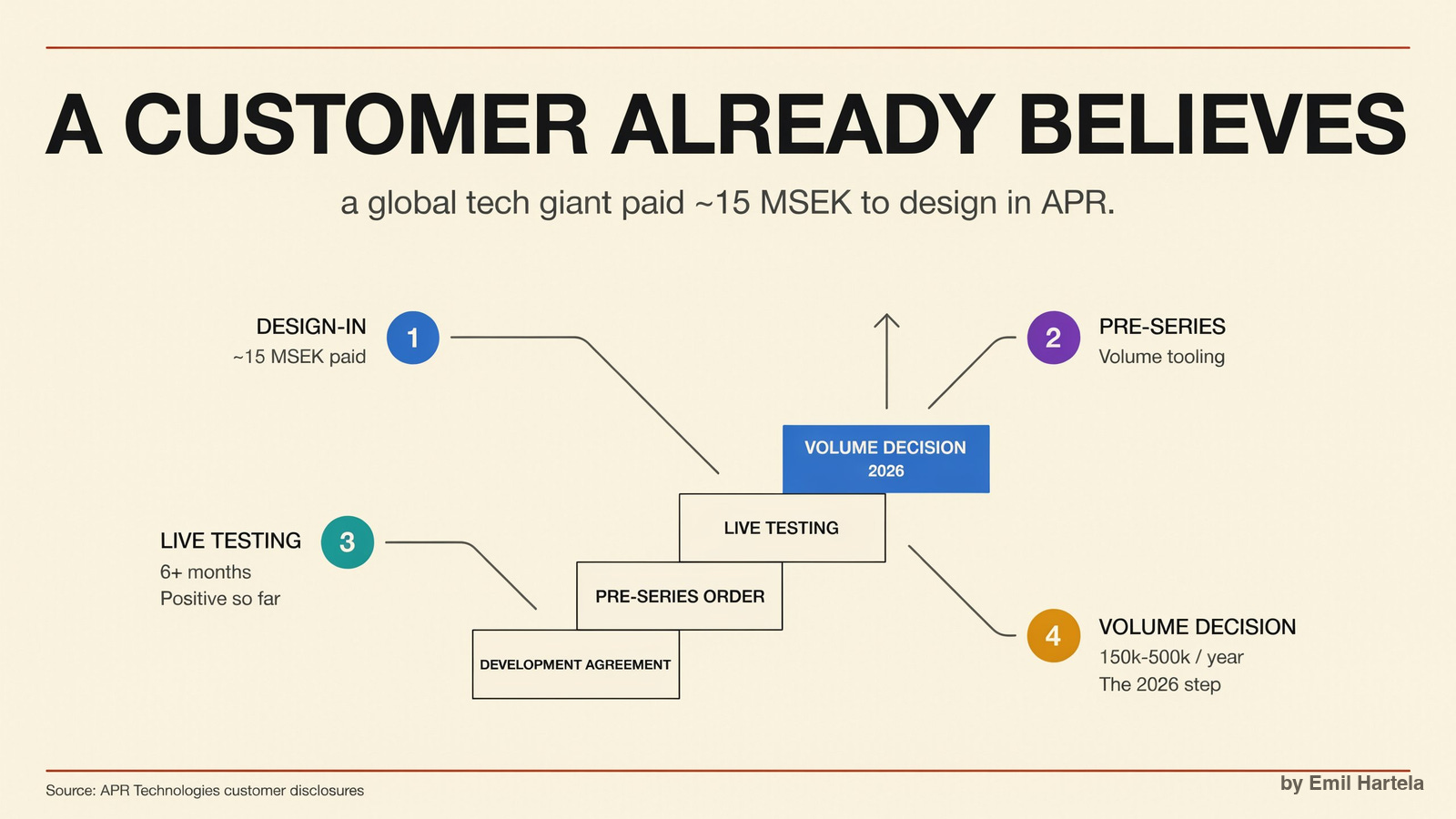
Testing is not finished. In an investor presentation, management described the customer evaluation as long term testing that runs through both summer and winter conditions, which is standard practice for data center hardware. The summer leg is behind them. If a winter leg is required, results would most likely land around February to March 2027. That fits management’s stated ambition of volume deliveries starting in 2027.
The disclosed follow on if tests convert is an inquiry for large scale production of 150 000 to 500 000 units per year, from one customer. The company states this would mean revenues of hundreds of MSEK per year. Behind it sits a separately disclosed inquiry from larger data center manufacturers for roughly 100 000 pump units per year, with revenue potential of 75 to 100 MSEK annually. Long term, the company estimates volumes of 500 000 to 1 000 000 units per year within electronics. It also notes licensing negotiations with international companies, and states that over 50 large American tech companies fit its product market.
Production is being built to match. Factory 1 is funded and operational. Management has talked openly about factories 2, 3 and 4, each essentially a copy of the first. Per management, the replication approach should bring capex per factory down by roughly half. That approach only makes sense if a volume order lands, which brings everything back to this one customer.
Who is the customer? Still undisclosed. The memorandum calls it a leading global electronics company. The spin off of the China linked battery subsidiary Chillwind was done partly to meet customer requirements on the ownership picture, which tells you the customer is Western and security conscious. On X there has been light speculation about various candidates; none of it is confirmed and I won’t add to it.
What matters analytically is the structure. Customer funded development is the strongest validation signal available at this stage; a global company does not spend 14 MSEK of its own money designing a Swedish microcap’s component into its products for fun. It is also, for now, the only validation. Everything between “meets calculated functionality” and “runs in volume for years” is precisely what the ongoing tests exist to establish.
The customer remains anonymous, and a volume order from them is the single most important catalyst to watch. It is what turns factory 1 from capacity into revenue, and factories 2 to 4 from a plan into a necessity.
The use cases beyond the data center
The company organized itself this spring into three business areas, and the breadth here matters for the downside case.
Chip Cooling is the spearhead: data centers, AI infrastructure and advanced electronics, where heat directly limits performance, energy use and system design. This is where the anchor customer sits and where the volume scenarios live.
Space & Defence is the heritage business, and the area where the most has happened since the first edition. ESA and Airbus remain repeat customers on the space side. On the nuclear side, APR received two orders from an established nuclear industry customer during Q2, and per the Q3 update those deliveries have been completed. On 31 July APR was prequalified under NATO DIANA after completing the test and verification phase. That makes Rheion procurable through the Rapid Adoption Service across all 32 NATO member countries.
The biggest change is Zoppas. In the first edition this was an evaluation agreement with Zoppas Industries Heating Element Technologies, a global Italian thermal group. It is now a signed technology collaboration and licensing agreement for Rheion based products in aerospace thermal management. The structure is close to what was intended. APR keeps the IP, supplies the Rheion pump units and earns a royalty plus revenue from components and fluid. Zoppas handles integration, qualification and the system integrator role toward customers, using its industrial capacity and sales channels. Exclusivity for Zoppas is conditional on performance. The named target programme is IRIS², the EU’s planned secure satellite constellation, with first launches expected in 2029. Defence applications are on the roadmap but not yet contracted. The two companies already exhibited Rheion together at Farnborough in July. This is the licensing model in miniature, and I’ll come back to why it matters for the economics.
Energy covers battery related applications: energy storage, mobility, drones, and now data center backup power. The company exhibited at The Battery Show Europe in Stuttgart with a battery cell partner and reports early dialogues with drone companies in Eastern Europe. It has also developed a battery backup unit reference design aimed at the 800VDC sidecar architecture Nvidia is pushing, which management says can be adapted to the ±400VDC designs used by other hyperscalers.
The battery angle exploits two things in the architecture. The first is weight. Because Rheion moves the fluid precisely where the heat is, APR’s battery packs need considerably less coolant than conventional liquid cooled packs, which per the company makes them noticeably lighter. In drones and mobility, where every gram counts against range and payload, that is the edge.
The second is that Rheion is bidirectional. It is not just a cooler; it is a thermal controller that can heat as well as cool, hold a setpoint, and respond in milliseconds. For batteries that means both high load cooling and cold climate conditioning (lithium plating avoidance, winter readiness), which no cold plate and no boiling system can offer.
The same control capability opens a defence application: infrared signature management. A system that can actively hold surface temperatures at a chosen setpoint can be used to mask the heat signal of a drone or vehicle from thermal sensors. APR is exploring this, and Lars has commented publicly that he expects the IR capabilities to sell well. Given the role of drones and thermal detection on today’s battlefields, and APR’s existing NATO DIANA prequalification, it is one of the more interesting threads to watch, though nothing has been contracted yet.
And then there are the use cases the market hasn’t touched at all: photonics and memory.
Co-packaged optics is coming to AI hardware, and thermal is its central engineering obstacle. Laser wavelength drifts roughly 0,1 nm per degree, and photonic components need control within about ±1°C while sitting next to 500W+ ASICs. The industry’s current solution is essentially to give up: exile the lasers to external modules (the ELSFP standard) and stabilize them with thermoelectric coolers, which burn one to three watts for every watt of heat they move. Nvidia’s chosen modulator technology for CPO, micro rings, is the thermally fragile one, requiring continuous active thermal tuning inside the package. A sub 1W, bidirectional, millisecond setpoint controller at component scale is aimed at precisely the problem the industry is currently routing around rather than solving.
Memory is the other one. High bandwidth memory stacks sit right next to the GPU, are increasingly heat limited as stacks get taller, and are harder to cool than the logic die itself.
I asked management about both. Peter was clearly excited about photonics, though we ran out of time before going into it properly. My read is the same for both areas: they suit APR’s architecture unusually well, but the company has to focus, and right now that focus is the anchor customer and production. APR has zero disclosed photonics or memory customers; this is architectural fit, not pipeline. But both are real, documented unmet needs, and I count them as free options on the position.
Part 3: The people
For a company this size with this little coverage, the diligence has to be on the people as much as the product. The good news is that the people are unusually legible, because the board was visibly rebuilt in December 2025, right before listing, around one specific problem: industrialization.
The CEO: Lars Almhem
Almhem, born 1961, took over as CEO in December 2025. His background: SAAB Automobil and Volvo Cars, 25 years running his own business in quality, efficiency and supply chain globally for Ericsson, NOTE, IKEA and Volvo, production chief at Plasman, and most recently CEO of listed SHT Smart High Tech from mid 2022 to February 2025.

The SHT chapter deserves scrutiny because it was a dress rehearsal for this job, and I have looked at it closely. SHT sells graphene enhanced thermal interface materials, one layer of the thermal stack away from APR. Under Almhem, SHT landed development orders from AMD (including for future AI processors), a delivery approval from another large American electronics company, global consumer distribution through Thermal Grizzly, and the partner strategy that matured into the Henkel relationship. That strategy was built on the insight that giant customers demand size and stability from suppliers, so a microcap must scale through partners. It is item for item the playbook now running at APR: customer funded development from a global giant, and partner led scaling via Zoppas.
The counterweight: revenue never converted during his SHT tenure. Full year 2023 net sales were under 3 MSEK against a 38 MSEK operating loss, and the actual breakthroughs, first deliveries toward a world leading AI hardware company and advance payments through the Henkel channel, came after his departure; seeded during his time but harvested by his successor. His departure itself was an amicable, planned succession with warm words from the founder. The fair summary: proven at building blue chip validation and partner rails at a thermal microcap; unproven at converting them to volume.
Ten months into the APR job, there is more to go on. From my conversations with him and his presentations, Lars comes across as very efficient: direct, focused on execution and on the few things that matter for industrialization. The record so far supports that. In under a year the company has listed, closed its warrant programme at 99,85 percent, completed all pre series deliveries, brought factory 1 online with yields ahead of expectations, signed Zoppas and Airbus, and been prequalified under NATO DIANA.
The one caveat is timelines. Lars tends to be somewhat optimistic about when things will land; the Zoppas agreement, for example, slipped past its expected date before it was signed. The things have arrived, but often a little later than first indicated, and I build that into how I read his guidance, including the ambition of volume deliveries from 2027.
For the phase APR is in right now, he looks like close to the right profile, and so far he appears to be doing great work. The phase after is where the rest of the board comes in.
The board
Peter Jansson (joined December 2025) is the quiet key recruit. Co-owner of Lintron Elektronik, which became the foundation of NOTE AB, one of Sweden’s larger contract electronics manufacturers; COO and senior adviser at NOTE until 2009; integration lead for nine acquired units and operationally responsible for three factories in Eastern Europe. He has actually done the thing APR must now do: run volume electronics production at industrial quality and cost. Notably, he and Almhem sit together on another board (HEAD Engineering), meaning the CEO recruited a factory veteran he already knew and trusted.
Johan Claesson (joined August 2025) is the balance sheet, and worth a proper look because he’s more than a financier. Born 1951, Handelshögskolan educated, he owns Claesson & Anderzén with his brother: fourth generation family capital founded 1912 in Kalmar, today a group with property assets valued in the 12 billion SEK class, operations across southern Sweden, Germany and Estonia, roughly 46 000 hectares of Ukrainian farmland via Grain Alliance, and a history chairing listed Catella. Swedish wealth rankings have placed him around 2,5 billion SEK personally, with the family sphere well above that. His investment style, per an old profile literally titled “He waits for the fall”: hold liquidity, wait for dislocation, buy big.
Through his vehicles Movenio Fastigheter and Bremia he put over 90 MSEK into APR during 2025 and controls roughly 30 percent. And here’s the detail I find most interesting, sitting in plain sight in the memorandum’s directorship tables: during 2025 Claesson took the chairman seat of newly formed entities including CA Datacenter Holding AB and a family of CA Batteribalans (battery energy storage) companies. The anchor investor’s own group is concurrently building data center and BESS ventures, two of APR’s three business areas. This is strategic capital with potential first customer channels attached, not a passive allocation. One more connection worth knowing: Movenio participated in SHT’s December 2024 raise, which is very likely where Claesson met Almhem before recruiting him.
Mats Ekberg rounds out the board with small cap financial process experience; for completeness, his firm was paid to produce the listing memorandum and he chaired a dairy company through a 2024 bankruptcy. Process support rather than industrial competence.
The founders
Three founders built APR, and all three are still involved. The company name comes from their initials: Are Björneklett, Peter Nilsson and Robert Thorslund. Together they hold roughly 35 percent of the company. The technical memory of fifteen years lives here.
Peter Nilsson deserves more than a line. He co-founded APR, ran it as CEO from 2012 until the listing, and now chairs the board. On paper that reads like a founder stepping back. In practice it is the opposite: Peter remains extremely active in the business. The clearest way to describe the current setup is that Lars runs the company as CEO, while Peter in practice functions as its head of business development. He is out meeting customers and partners, and he knows the technology, the customer history and the commercial relationships better than anyone.

From a call with him and several hours of presentations where he and Lars present the company, my impression is of a humble and extremely competent operator. There is none of the promotional energy you often find around Spotlight microcaps; he talks about the technology and the customers with the precision of someone who has spent fifteen years on them, and he is careful not to claim more than he can back up. For an outside shareholder, having the founder with the deepest knowledge of the business still this close to the customers is one of the more reassuring parts of the story.
Robert Thorslund, the second co-founder, also remains on the board.
Are Björneklett, the third co-founder, returned to the R&D team earlier this year, putting one of the original technical minds back where the next generation of the product is being built.
Ownership and alignment
Insiders control over 60 percent: Claesson’s vehicles around 30 percent including Bremia, founders around 35 percent, all under lock up agreements limiting sales to 20 percent of holdings in year one. The CEO holds about 120 000 shares. Alignment reads well: the people who know the technology stayed, the people who know factories took the wheel, and the balance sheet has a named backstop with real skin in the game.
What is missing is a formal incentive structure. As of now there is essentially no short term or long term incentive programme (STI or LTI) in place for management. When I asked Lars, he said it is something that will be thought about, but there does not appear to be any immediate urgency in getting one in place. For now, alignment rests on direct shareholdings rather than structured incentives. That is not a red flag at this stage, but a well designed LTI tied to commercial milestones would be a welcome addition as the company moves into volume production.
The gap, stated plainly
Nobody in the building has worked at a hyperscaler, a chipmaker, or a data center operator. The technical chip knowledge exists in the founders (3D packaging researchers) and the commercial adjacency in Almhem (selling TIM into the AMD ecosystem), but the domain where the value is supposed to be realized has no native representative. The company’s implicit answer is structural: the customer brings the domain knowledge, funds the development, and carries the product to market inside its own systems; Zoppas plays that role for space and defense. Component companies have always scaled this way, Bluetooth itself did, but it means APR’s understanding of its most important end market is mediated through counterparties. A data center or semiconductor name joining the board would be the single most bullish governance signal this company could send, and its absence is the first thing I would fix.
The SHT connection, and why the two aren’t competitors
Since Almhem connects the two companies, a word on SHT Smart High Tech, because the relationship is instructive. SHT sells a better version of the interface layer (graphene enhanced TIM); APR’s endgame abolishes the interface layer at the chip. On the surface that sounds like competition. In practice they occupy opposite ends of the same timeline. Every improvement in cold plates and boiling makes the TIM relatively more of the remaining bottleneck, so SHT’s product gains value throughout the transition, and especially if two phase converts; APR’s architecture wins at the terminal state where fluid meets silicon directly, which arrives socket by socket, years out, at the highest value packages first. Almhem has said publicly he sees the companies as complementary rather than competing, and structurally he’s right: they are opposite sides of the TIM elimination trade, separated by time. For a portfolio builder, the pair is closer to a hedge on architecture timing than a redundancy.
Part 4: The economics
What the financials actually look like
Let’s be blunt about the starting point. In Q2 2026 net revenue was 7,1 MSEK, up 53 percent from 4,7 MSEK a year earlier. For the first half, revenue was 11,2 MSEK, up 40 percent from 8,0 MSEK. Against that, operating profit was minus 11,1 MSEK in Q2 (compared with roughly break even a year earlier) and minus 22,0 MSEK for the half year. Full year 2024, for reference, was 13,1 MSEK of revenue against a 10,4 MSEK loss.
The step up in losses is deliberate. It reflects the buildout of production capacity, the organization and market development, not a deteriorating business. Revenue is still project and development driven: the tech infrastructure key customer, ESA and space projects, the nuclear industry, and public grants, rather than product sales at volume. This is a venture stage company with a ticker.
The balance sheet, however, was rebuilt for the task. Roughly 115 MSEK was raised across 2025, and another 55 MSEK came in via the TO 1 warrant exercise in June. Cash stood at 117,5 MSEK at the end of Q2, against operating cash flow of minus 8,3 MSEK in the quarter and minus 17,5 MSEK for the half year. The 2026 industrialization programme is roughly 40 MSEK of capex, largely equipment for production and controlled environment assembly, partly offset by the 19 MSEK state grant. As covered in Part 5, Lars has described the runway as roughly one year, enough to build out factory 1.
Unit economics: component pricing, not metal bending
Here’s where it gets interesting, because APR’s product has electronic component economics rather than cooling hardware economics.
Back out the average selling price from the company’s own disclosed scenarios: 100 000 units generating 75 to 100 MSEK implies roughly 750 to 1 000 SEK per unit, and the anchor customer scenario implies the same range. A Rheion unit is a sealed ceramic device with printed electrodes, microchannels and proprietary fluid; at volume on automated tooling, the bill of materials plausibly lands around 200 to 400 SEK. That’s gross margin potential in the 50 to 65 percent range in theory, and I’d underwrite 50 to 60 percent in practice, because a customer taking hundreds of thousands of units per year will extract volume pricing (the company’s own history contains a lesson here: APR walked away from the Orion space procurement in 2016 over excessive price pressure, which tells you management has margin discipline and tells you what negotiating with giants does to prices).
Why component pricing holds at all: the product is a sole source, spec’d in part that customers design their products around. The business model, in the company’s own words, ties each customer relatively hard to APR as the supplier of cooling for that customer’s product. Add 74 patents and the absence of any functional substitute, and you price on value, not on BOM. Compare commodity cold plates, bent copper in a brutal supply chain running 25 to 35 percent gross, and you see why the distinction is worth 20 margin points.
At a few hundred MSEK of revenue, with a 60 to 90 person organization, patent costs already largely taken, and depreciation on the modest capex base, that translates to EBITDA margins plausibly in the 20 to 30 percent range. Not software. But rare for hardware.
The factories and the royalty layer
The production plan. The original plan ran from artisanal short series to roughly 10 000 units per year starting spring 2026 (about 1 000 units a month), scaling toward 100 000 units per month, one million per year, during 2028. Cleanroom process steps run at the Ångström laboratory in Uppsala; assembly, quality control and flows are built with high automation in Enköping.
That plan is now in motion. Factory 1 is operational, yields have per management come in better than expected, and the hiring profile has shifted toward automated serial production. The scaling path has also become clearer. Rather than one ever larger plant, management plans a sequence of factories, 2, 3 and 4, each essentially a copy of the first, with capex per factory expected to fall by roughly half through replication.
The capital efficiency is striking. At the implied unit pricing, a fully utilized million unit line generates 750 MSEK to 1 billion SEK of revenue against a build cost measured in low hundreds of MSEK. That means the asset pays itself back in roughly a year of gross profit at full utilization, and each copy should pay back faster than the last.
The structure is now largely known. In the first edition I described licensing as the elegant escape hatch once the company’s own walls topped out. We now know much more precisely how APR intends to split the business, and it differs by segment.
Chip Cooling stays in house. All chip cooling manufacturing will be kept within APR rather than licensed out. This is where the volume scenarios live, and the company has chosen to capture the full manufacturing margin itself, scaling through factory replication rather than licensing.
Space & Defence is a blend. Zoppas is the template: Zoppas handles integration, qualification and sales toward customers under a license, while APR keeps the IP, supplies the Rheion pump units from its own production, and collects a royalty plus revenue from components and fluid. The critical production stays in house; the market access and system integration sit with the partner.
Energy has its own precedent. Chillwind, the divested battery business, pays running royalties on sales using APR’s technology. Management also contemplates selling manufacturing licenses against a per unit royalty in other areas, alongside an aftermarket in service on installed systems.
Every krona arriving through the royalty channel comes in at something like software margins. High margin hardware where it matters most, with royalties layered on in the segments where partners bring the market access, is a rare structure. It exists here because the defensible asset is IP and fifteen years of process know how, not the factory.
The open question is who pays for factories 2 to 4. If the anchor customer places a volume order, it may well come with buyer financing, prepayments or customer funded capacity. That would reduce dilution, but it could also change the economics of the factories themselves: dedicated lines, exclusivity, priority on capacity, or pricing concessions in exchange for the capital. How future factory builds are financed is still unresolved, and it will shape how much of the manufacturing margin actually reaches shareholders.
The market
The headline numbers are enormous and mostly irrelevant. Data center liquid cooling passing 15 billion dollars by 2028; direct to chip alone growing toward 5,6 billion dollars by 2030 at roughly 20 percent annually. APR sells none of the racks, CDUs and plumbing that make up most of that.
The honest addressable slice is component level thermal control: chip level devices, precision temperature stages, pack level battery systems, the layer where solid state flow steering is the actual differentiator. I put that at 3 to 4 billion dollars by 2030 across data center, photonics, defense, space and batteries. Against that, the realistic base case is simply the company’s own disclosed pipeline: the anchor customer scenario (hundreds of MSEK), the data center manufacturer inquiry (75 to 100 MSEK), and growing space, defense and energy revenue. That lands somewhere around 300 to 800 MSEK by 2030.
Part 5: Liquidity, Spotlight, and the cash question
This section exists because it will determine more of your practical experience owning this stock than anything in Part 2.
The venue. APRTEC trades on Spotlight Stock Market, an MTF, not a regulated exchange. Disclosure standards are lighter, institutional participation is minimal, there is no liquidity guarantor agreement, and research coverage is essentially zero. This is both the opportunity (nobody is looking) and the tax (nobody is looking).
The float and the trading. With insiders above 60 percent under lock ups, the effective free float is small, and the stock is very thinly traded. It takes extremely little volume to push the price 20 percent in either direction, and swings of 10 percent or more on no news are routine. The stock closed September at 28,40 SEK, roughly double the 13,50 SEK listing level, after a much sharper run earlier in the year. Position sizing and limit orders are not optional here. If you cannot tolerate a 50 percent drawdown on sentiment alone, this is not the name.
The thin float also shapes who can own it. For a fund, building a meaningful position through the order book is close to impossible without moving the price against itself. In practice, institutional money can only come in through block trades from existing holders or through new share issues. That is worth keeping in mind for the next point, because a capital raise is also the natural entry door for new institutional owners.
The cash math. Cash stood at 117,5 MSEK at the end of Q2, after the TO 1 warrant money, against an operating cash burn of roughly 8 MSEK per quarter that will rise with the industrialization programme and hiring. A few months ago Lars described the runway as roughly one year: enough to build out the first factory, and likely not much beyond that. Read that plainly: new financing becomes a live question around the end of H1 2027, and some form of dilution looks quite likely.
There are ways around it. A volume order could come with customer financing, prepayments or other structures that reduce the need for equity, and the company has said that loans and other financing would be examined before new issues. But here is the paradox worth internalizing in advance: good news accelerates the need for capital. A volume order from the anchor customer would require production capacity well beyond factory 1, and factories 2, 3 and 4 do not build themselves. So model dilution into your expected return now, and decide in advance whether you would participate.
The mitigating factor is the anchor owner. Raising capital is a different exercise when a multi billion SEK family sphere with a stated preference for dry powder sits at around 30 percent and has already followed on repeatedly. The dilution risk is real; the financing risk, the risk that money simply isn’t available, is much smaller than for the average Spotlight microcap.
Part 6: Valuation, and the M&A floor
I’m not going to pretend a DCF on a pre volume company means much. The more honest frame is the one the industry itself has been writing in transaction prices for two years, because the liquid cooling sector has been consolidating at a furious pace, and it gives us marks at every maturity stage.
At the bottom of the ladder: Flex acquired JetCool in November 2024 for roughly 53 million dollars total. JetCool was a venture stage company with clever chip level cooling technology (microconvective jets), modest revenue, and a team. In the middle: Schneider Electric paid 850 million dollars for 75 percent of Motivair, implying roughly 1,1 billion for a 150 person company with real CDU and cold plate revenue. At the top: Ecolab agreed this spring to buy CoolIT for 4,75 billion dollars at 29 times forward EBITDA, explicitly to align with Nvidia’s cooling roadmap. Vertiv took CoolTera along the way, and Boyd has been reported as a sale candidate. In under two years the strategics have swept the shelf; what remains independent is a handful of venture darlings, the two phase players, and APR.
Now place APR on that ladder. Today, at roughly 27,6 million shares and recent prices, the market cap sits around 700 to 800 MSEK, roughly 65 to 80 million dollars depending on the day. That is only modestly above the JetCool price, for a company with a deeper patent estate (74 granted versus JetCool’s much smaller portfolio), its own proprietary fluid, fifteen years of flight heritage, NATO selection, and a paying global customer in live validation, none of which JetCool had. I think of the JetCool mark as establishing something close to a floor logic: this is roughly what a strategic pays for a differentiated cooling technology team and IP estate before commercial proof. At worst, the bear case where the anchor customer walks, you own a competent team, 74 patents, a proprietary fluid and fifteen years of progress in a sector where that exact bundle has a demonstrated clearing price not far below the current market cap, plus a real, revenue generating space and defense business underneath it. The floor isn’t zero, and in a consolidating sector it isn’t even particularly far down.
The upside frame is the other end of the ladder. If the volume order lands and APR becomes a company shipping hundreds of thousands of units into a global customer’s products, the comp set jumps from JetCool to the Motivair and CoolIT axis, where strategics have paid roughly 4 to 8 times revenue and up to 29 times EBITDA for proven, roadmap aligned cooling businesses. On the base case revenue range that supports a valuation of 1,5 to 4 billion SEK; in the bull case where factories 2 to 4 fill and royalties from space and defence come on top, meaningfully more. That is the honest shape of the asymmetry: roughly 1 to 2x of downside protection from the tuck in floor against 4 to 10x in the scenarios where execution matches the disclosed pipeline. And critically, the rerating mechanism doesn’t require years of compounding; the CoolIT arc, bought by KKR pre volume, sold three years later for multiples of entry, shows that in this sector a validation event moves a company from one rung of the ladder to another in a single step. If things start rolling, I believe this stock could rerate by an order of magnitude in a fairly short time frame, because that is quite literally what the industry currently pays at the next rung.
Two caveats on the M&A frame. Control sits with insiders who have every incentive to wait for the higher rung; the floor supports the stock, but no near term bid should be expected. And the company itself flags that its products could come to be classified as strategically significant or dual use, which, combined with Swedish FDI screening and the NATO DIANA involvement, trims the list of possible acquirers even as it validates the asset.
Part 7: Risks
Let me be explicit, because the risk profile here is closer to a venture investment that happens to have a ticker.
Single customer concentration. The thesis spine is one undisclosed customer. If their tests disappoint, or their own product fails commercially, or they redesign around APR, the volume scenario evaporates. The company’s own risk section names customer concentration explicitly.
Claims without public proof. All performance figures are company claims. No thermal test vehicle results, no third party benchmarks.
The scaling problem. Factory 1 is running and yields are ahead of expectations, but going from today’s volumes to hundreds of thousands of units a year, across several factories, is a different exercise. Yield on sealed fluidic ceramic devices at true volume is unproven by anyone, anywhere. The company itself rates the production scale up risk as medium probability, high impact.
Dilution. Likely, as covered in Part 5. Success makes it arrive sooner.
The fluid question. The fluid chemistry is undisclosed. Fluorinated fluids are the canonical working liquids in EHD research, and if APR’s fluid is fluorinated, EU PFAS regulation sits directly on the thesis. Conversely, the company recently advertised for a fluid and coolant specialist to evaluate coolants on thermal, electrical, chemical and environmental requirements, suggesting fluid selection is active engineering. I have not been able to resolve this question from public material and consider it the single most important unanswered item.
Competition converging on the neighborhood. Corintis has raised tens of millions of dollars, ships microfluidic cold plates at real volume, and partners with Microsoft on in chip cooling. AVC reportedly builds Nvidia’s coming microchannel plates. None of them do solid state pumping or active flow control, that discipline remains essentially empty, but if passive geometry plus bigger central pumps stays good enough for long enough, APR’s differentiator gets commoditized around. This, more than two phase, is the real competitive risk: the bet is intelligent thermal control versus brute force, and brute force has a lot of budget behind it.
Timeline slippage, the Sivers lesson. Swedish deep tech microcaps with world class niche technology, blue chip engagements, and imminent commercial breakthroughs have a well documented base rate: qualification cycles run longer than retail patience, financing needs compound, and the stock round trips before anything converts. Almhem’s own SHT tenure demonstrated exactly this pattern. Assume every timeline in this piece slips 12 to 24 months and check whether you’d still hold; I did, and I would, but only at the position size I actually have.
Liquidity. Covered in Part 5. It bears repeating: this stock can fall 30 percent because one holder needed a boat.
Lock up expiry
The lock ups are worth understanding precisely, because they expire inside the catalyst window. Per the listing memorandum, the three founders (Peter Nilsson, Robert Thorslund and Are Björneklett) and Claesson’s two vehicles (Movenio Fastigheter and Bremia) have agreed to sell at most 20 percent of their holdings during the first year after listing. Listing day was 13 January 2026, so the restriction falls away around mid January 2027. The project manager for the listing, Företagsfinansiering Fyrstad, has a stricter three year lock up on its small 40 008 share holding. The board can grant exceptions, for example in the event of a public takeover bid.
At listing these locked holders owned roughly 16,2 million shares, about two thirds of the company at the time and close to 60 percent of today’s share count after the TO 1 exercise. Shares subscribed through the warrants in June do not appear to be covered by the agreements. Not every large holder is locked either: Ming Zhang, directly and through HSC Invest Nordic, held around 9 percent at listing with no lock up disclosed.
In a stock this thinly traded, even a small fraction of that overhang reaching the market would move the price sharply. The timing matters: expiry lands just as the market waits for the anchor customer’s winter test results, and a few months before financing becomes a live question. My read is that the risk of heavy selling is modest. Claesson’s style is to buy dislocations rather than sell into them, and the founders have stayed in the company for fifteen years and remain closely involved in running it. But after fifteen years without liquidity, it would also be entirely natural for founders to sell a portion of their holdings, and the market would likely read any such sale more harshly than it deserves. Expect some volatility around January 2027, and keep an eye on insider transaction filings from mid January onwards.
Part 8: Recent developments and what to watch
The recent tape
The past quarter has been the most eventful since listing, and the news has shifted from strategy to execution.
Zoppas signed. On 7 October APR signed a long term technology and license agreement with Zoppas Industries covering the industrialization and commercialization of Rheion based products in aerospace in Europe and North America. APR receives a milestone based initial payment of EUR 500 000 for license, technology transfer and qualification support, plus royalties on sales and future revenue from components and fluid. Zoppas gets a conditional exclusive license, and APR keeps full ownership of the IP. The agreement guarantees no future orders or volumes, but it is the first live demonstration of the license and royalty model.
Airbus. A week later, on 14 October, APR signed an agreement with Airbus UpNext to test a Rheion based thermal switch in orbit aboard the SpaceRAN demonstrator. Delivery is planned for late 2026 or early 2027, with testing from 2028 and the goal of documenting one year of flight heritage. The test will also evaluate the technology for future applications, including processor cooling. It covers testing and validation only and has no bearing on near term revenue, but it is validation once again, from one of the most demanding customers in the industry.
Factory 1 is running, and yields are good. Per management, production yields have come in better than expected and positively surprised the team itself. For a company whose main risk is turning a lab technology into a manufactured product, that is one of the most important data points of the year.
Factories 2, 3 and 4. Management now talks openly about a sequence of factories, each a copy of the first, with capex per factory expected to fall by roughly half through replication. Nothing is built yet, but a company planning its fourth factory is telling you what it expects demand to look like.
Hiring for production. The latest opening is a Production and Process Engineer, and the profile is telling. It requires experience in robot manufacturing and PLC programming, and covers designing automated production equipment, defining tools and methods for serial production, ultrasonic welding, optics and vision hardware, machine learning trained on manufacturing data, and capacity analysis. You don’t need robots, vision inspection and ML driven yield optimization to hand build prototypes. This is the profile you hire when you are building an automated line for volume. Companies usually hire for this kind of role a few months before production starts ramping, which fits management’s guidance of building capacity during 2026 and delivering volumes from 2027. It follows earlier hires in operations, quality and qualification, including a fluid and coolant specialist focused on reliability testing.
Deliveries completed. All pre series deliveries to the global tech company are done, with positive test results reported, and the deliveries to the nuclear industry customer are also completed.
NATO DIANA. On 31 July APR was prequalified after completing the test and verification phase, making Rheion procurable across all 32 NATO member countries.
Insider buying. Two board members bought shares in July, for roughly 0,2 and 0,4 MSEK. Modest in size, but pointing the right way.
Coverage: still nearly nothing. A handful of X threads, no analysts, and almost all primary material in Swedish. The discovery hasn’t happened, which for current holders is the point.
The catalyst calendar
Q3 report, November 19. The financials themselves will say little, since the Zoppas agreement was signed after quarter end. The earnings call is the thing to listen to: management has tended to drop hints about customer progress verbally that never make it into the written releases.
Q4 business update, early January 2027, and full year report, February 18. This is where it starts getting interesting. If the anchor customer runs a winter testing leg, results should be landing around this window, and the full year call will be the first real chance to hear how close a volume order is.
The anchor customer’s volume decision. Still the big one, and the timeline belongs to the customer, not to APR. All pre series deliveries are done and the tests have reportedly gone well. The realistic expectation is that we know considerably more during Q1 2027, with slippage more likely than acceleration. This is the binary that moves the company between rungs of the valuation ladder.
Defence. APR plans to showcase its defence products this winter. With NATO DIANA prequalification in hand and the IR signature work in the background, news from this direction could be a surprise item.
Batteries. As I understand it, APR has a partner for battery production. That makes Energy another area where interesting news could come with little warning.
Zoppas follow through. The agreement is signed. What remains is the detail: royalty levels, qualification timelines and any first volume commitments toward IRIS² or other programmes.
Production milestones. Any announcement on factory 2 would itself signal what management is hearing from customers.
Board or advisory additions. A data center or semiconductor name joining would be the strongest possible tell that the volume phase is real.
Closing
Let me compress the whole piece into its essential shape.
The industry has agreed, in actions if not in words, on where chip cooling is going: coolant migrating step by step toward the silicon. The endpoint of that migration has a physical specification that disqualifies water, mechanical pumps and boiling. One listed company has spent fifteen years building the only commercialized technology that matches the specification, hardened it in space where failure isn’t an option, fenced it with over 70 granted patents including the fluid itself, and convinced a global tech company to pay for the privilege of designing it into their products.
Since the first edition, the proof has thickened. Zoppas has signed a license and supply agreement, Airbus is taking Rheion into orbit, NATO has prequalified it, the pre series deliveries are complete with positive results reported, and factory 1 is running with yields ahead of expectations. The technology question is increasingly being answered. What remains is a volume question: does the unnamed customer place the order or not?
All the early signs point toward success. The customer paid for development, ordered a pre series on volume tooling, has kept testing for most of a year, and APR is hiring robot and vision engineers for an automated line. But you never know with these things, and until the order lands, owning APRTEC is essentially a bet on a binary.
It is not only a binary, though. Around the core sits a real base of other business: space and defence through Zoppas and Airbus, nuclear, batteries and backup power, and the free options in photonics and memory. Each has the potential to generate sales on its own and gives the downside case something to stand on. But be clear about what moves the stock. It is data center cooling news, and above all the volume order.
Around it, the sector is consolidating at prices that make the current market cap look like a floor: the last comparable technology tuck in cleared a majority of APR’s entire valuation, and the proven names go for billions. Against that stands venture grade risk in every direction: one customer, unproven performance claims, a steep manufacturing ramp, likely dilution, an unanswered fluid question, and liquidity that punishes impatience.
I own it small, sized like the venture bet it is, watching three things: the volume order, the financing of factories 2 to 4, and the boardroom. The asymmetry is the position; the patience is the price of admission.
Thank you for reading. Questions welcome, as always.
Disclaimer: This is not financial advice. I hold a position in APRTEC and my view is accordingly biased. The company is a venture stage microcap trading on Spotlight Stock Market with very limited liquidity; the stock can move violently on small volume and the risk of substantial or total loss is real. All performance figures originate from the company unless otherwise stated. Do your own research.